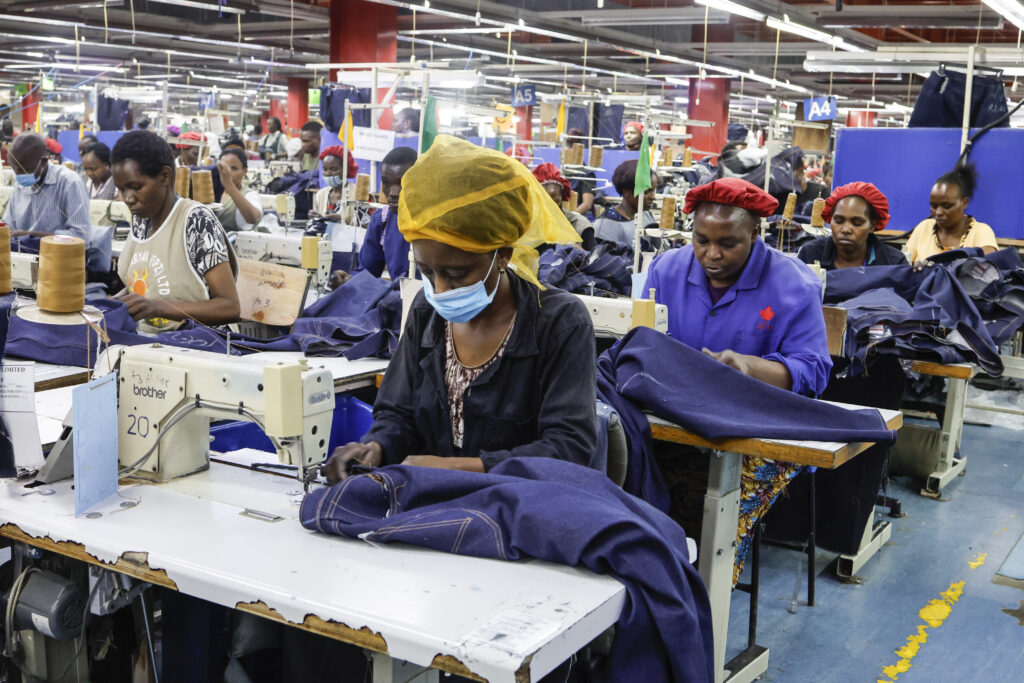
African manufacturers on Wednesday welcomed US lawmakers’ approval for renewing their duty-free access but called for urgency in finalising the deal.The African Growth and Opportunity Act (AGOA) has been a cornerstone of trade relations for 25 years, allowing the United States to buy billions of dollars of duty-free cars, clothes and other items from select African countries each year.But the deal, which operates in 32 African nations, expired last September, putting thousands of jobs at risk and forcing exporters to absorb high tariff duties.On Tuesday, the US Congress passed a bill to revive AGOA for at least three years, but it must still be approved by the Senate.The Congress vote was “a very positive sign”, said Pankaj Bedi, CEO of United Aryan factory in Nairobi, which exports Wrangler and Levi’s jeans under the deal and employs around 10,000 Kenyans.”But we need to keep the pressure up,” he told AFP. “It is our desperate need as the sector continues to slow down and suffer due to cash flows and many other external challenges.”Bedi said his company has been absorbing the increased import duties — which went up by 33 percent for Kenya after AGOA expired — so as not to lose customers, but said this is not “sustainable”.Kenya’s trade minister Lee Kinyanjui welcomed the approval by the US House of Representatives, calling it a “critical milestone” in US-Africa trade relations.”The uncertainty that had previously engulfed the sector will now give way to renewed confidence and expansion,” Kinyanjui said in a statement.The African Union chair also welcomed the approval and appealed to the Senate “to give favourable and timely consideration to the extension, in a spirit that upholds partnership, and shared strategic interests”.- US eyes China, Russia -South Africa, which has been at loggerheads with the US in recent months, also hailed the approval.Its trade minister Parks Tau said the country “values its longstanding trade and investment relationship with the US”.South Africa was the primary beneficiary of the preferential agreement before it expired. The automotive sector accounted for 64 percent of trade under AGOA, totalling $1.6 billion in 2024, and is the sector most affected by US President Donald Trump’s measures.US Trade Representative Jamieson Greer in December told a Senate Appropriations subcommittee hearing that if Congress pushes for it, he is open to consider separating South Africa from AGOA.The Republican chairman of the House’s powerful Ways and Means Committee, Jason Smith, also called to urgently finalise the final deal.”An extended lapse in AGOA would create a void that malign actors like China and Russia will seek to fill,” he said.”Africa is home to approximately 30 percent of the world’s critical mineral resources and China has invested $8 to $10 billion in Africa to try to monopolize these essential supply chains.”Trump has criticised free-trade deals, and slapped swingeing tariffs on many countries.Kenya, which has been a close political and military ally, received the lowest rate of 10 percent, but others saw far higher, such as the tiny kingdom of Lesotho, which saw an initial rate of 50 percent before it was lowered to 15 percent in July.As a result, Lesotho’s textile industry witnessed massive job cuts, prompting protests by workers.Fako Hakane, head of the Lesotho Chamber of Commerce and Industry, expressed relief at signs of AGOA being renewed, saying the tariffs were “cruel” for the small, landlocked country of around 2.3 million people.”If it comes back, it is a critical economic lifeline for Lesotho,” Hakane told AFP.
African manufacturers on Wednesday welcomed US lawmakers’ approval for renewing their duty-free access but called for urgency in finalising the deal.The African Growth and Opportunity Act (AGOA) has been a cornerstone of trade relations for 25 years, allowing the United States to buy billions of dollars of duty-free cars, clothes and other items from select African countries each year.But the deal, which operates in 32 African nations, expired last September, putting thousands of jobs at risk and forcing exporters to absorb high tariff duties.On Tuesday, the US Congress passed a bill to revive AGOA for at least three years, but it must still be approved by the Senate.The Congress vote was “a very positive sign”, said Pankaj Bedi, CEO of United Aryan factory in Nairobi, which exports Wrangler and Levi’s jeans under the deal and employs around 10,000 Kenyans.”But we need to keep the pressure up,” he told AFP. “It is our desperate need as the sector continues to slow down and suffer due to cash flows and many other external challenges.”Bedi said his company has been absorbing the increased import duties — which went up by 33 percent for Kenya after AGOA expired — so as not to lose customers, but said this is not “sustainable”.Kenya’s trade minister Lee Kinyanjui welcomed the approval by the US House of Representatives, calling it a “critical milestone” in US-Africa trade relations.”The uncertainty that had previously engulfed the sector will now give way to renewed confidence and expansion,” Kinyanjui said in a statement.The African Union chair also welcomed the approval and appealed to the Senate “to give favourable and timely consideration to the extension, in a spirit that upholds partnership, and shared strategic interests”.- US eyes China, Russia -South Africa, which has been at loggerheads with the US in recent months, also hailed the approval.Its trade minister Parks Tau said the country “values its longstanding trade and investment relationship with the US”.South Africa was the primary beneficiary of the preferential agreement before it expired. The automotive sector accounted for 64 percent of trade under AGOA, totalling $1.6 billion in 2024, and is the sector most affected by US President Donald Trump’s measures.US Trade Representative Jamieson Greer in December told a Senate Appropriations subcommittee hearing that if Congress pushes for it, he is open to consider separating South Africa from AGOA.The Republican chairman of the House’s powerful Ways and Means Committee, Jason Smith, also called to urgently finalise the final deal.”An extended lapse in AGOA would create a void that malign actors like China and Russia will seek to fill,” he said.”Africa is home to approximately 30 percent of the world’s critical mineral resources and China has invested $8 to $10 billion in Africa to try to monopolize these essential supply chains.”Trump has criticised free-trade deals, and slapped swingeing tariffs on many countries.Kenya, which has been a close political and military ally, received the lowest rate of 10 percent, but others saw far higher, such as the tiny kingdom of Lesotho, which saw an initial rate of 50 percent before it was lowered to 15 percent in July.As a result, Lesotho’s textile industry witnessed massive job cuts, prompting protests by workers.Fako Hakane, head of the Lesotho Chamber of Commerce and Industry, expressed relief at signs of AGOA being renewed, saying the tariffs were “cruel” for the small, landlocked country of around 2.3 million people.”If it comes back, it is a critical economic lifeline for Lesotho,” Hakane told AFP.