Bangladesh’s political crossroads: an election guide

Bangladesh has been in political turmoil since a student-led revolt overthrew former prime minister Sheikh Hasina in August 2024, ending her 15-year autocratic rule.The Muslim-majority nation of 170 million people will hold its first elections since the uprising on February 12.Here are the key players in a vote that European Union election observers say will be the “biggest democratic process of 2026, anywhere”.- Interim government -Nobel Peace Prize winner Muhammad Yunus, 85, returned from exile in August 2024 at the behest of protesters to lead a caretaker government as “chief advisor”. He will step down after the polls.Yunus said he inherited a “completely broken” political system, and championed a reform charter he argues is vital to prevent a return to authoritarian rule.A referendum on the proposed changes will be held on the same day. He says the reforms will strengthen checks and balances between the executive, judicial and legislative branches. – Bangladesh Nationalist Party (BNP) -The BNP, led by Tarique Rahman, 60, is widely tipped to win the election, after he returned from 17 years of self-imposed exile in December 2025.His mother, the BNP’s veteran leader and former prime minister Khaleda Zia, died aged 80, days after his return.A BNP-led alliance includes both leftist and centrist parties, as well as small Islamist groups.- Islamist-led alliance -Jamaat-e-Islami, the country’s largest and best-organised Islamist party, ideologically aligned with the Muslim Brotherhood, is seeking a return to formal politics after years of bans and crackdowns under Hasina’s 15-year rule.Jamaat is leading an alliance of more than 10 smaller parties, including the National Citizen Party (NCP), formed by student leaders who spearheaded the uprising.It also includes the small Liberal Democratic Party, as well as fringe Islamist parties, most of which held only a handful of seats in previous parliaments.Bangladesh — one of the world’s mostpopulous Muslim-majority countries after Indonesia and Pakistan– is home to diverse strands of Islamic practice, including a significant Sufi community often condemned by hardline Islamists.Bangladesh also has a small Shia community. Around 10 percent of Bangladeshis are not Muslim — the majority of those are Hindu and the country is also home to a small number of Christians. – Awami League – Hasina, 78, a fugitive in India, was sentenced to death in absentia for crimes against humanity in November.Her former ruling Awami League, once the country’s most popular party, has been outlawed.Loyalists may run as independent candidates, but it is unclear who the party’s once sizable membership will back.Human Rights Watch condemned the ban as “draconian”, while Hasina has warned that holding elections without her party would be “sowing the seeds” of further division.- Army – In a country with a long history of military coups, the army remains a pivotal force.It played a decisive factor in Hasina’s downfall, choosing not to intervene against the protests.The military continues to patrol the streets, maintaining a visible presence alongside the police.- International players -Regional powers have taken a keen interest.Bangladesh’s relations with India — once Hasina’s strongest ally — have cooled.Yunus’ first state visit was to China, signalling a strategic shift, while Dhaka has also deepened engagement with Pakistan, India’s arch-rival.

US sends more agents to Minneapolis despite furor over woman’s killing

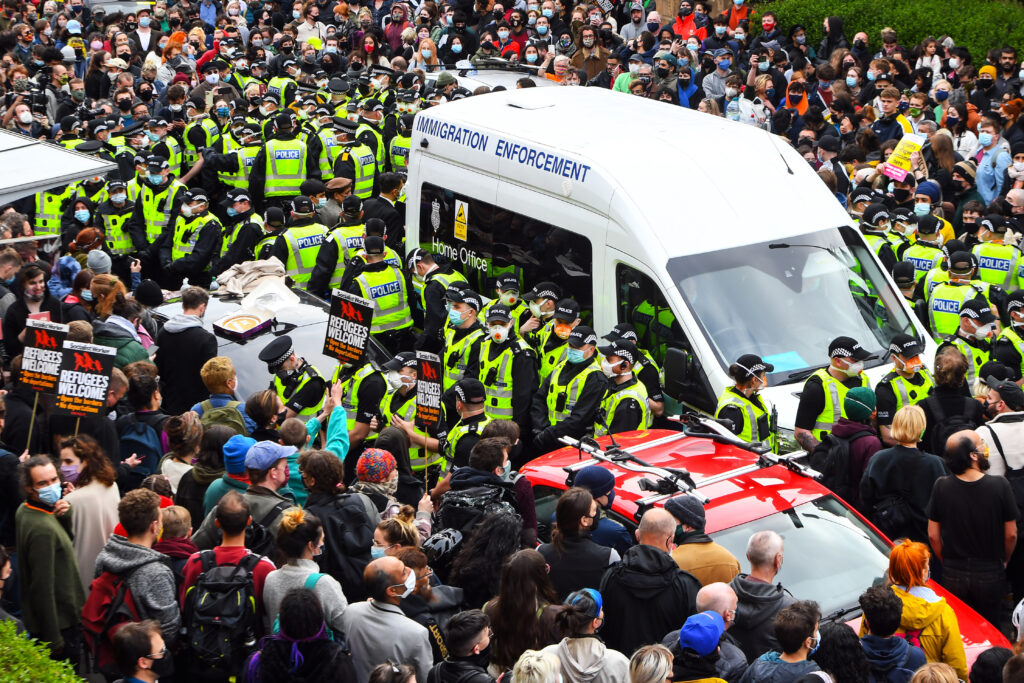
Hundreds more federal agents were heading to Minneapolis, the US homeland security chief said Sunday, brushing aside demands by the Midwestern city’s Democratic leaders to leave after an immigration officer fatally shot a woman protester.In multiple TV interviews, Kristi Noem defended the actions of the officer who shot and killed 37-year-old Renee Nicole Good, whose death has sparked renewed protests nationwide against President Donald Trump’s immigration crackdown.Homeland Security Secretary Noem reiterated her claim that Good’s actions in the Midwestern city on Wednesday amounted to “domestic terrorism,” and that the agent acted in self-defense when he shot Good in her car.Prominent Democratic officials, including Minnesota Governor Tim Walz and Minneapolis Mayor Jacob Frey, have strongly disputed this narrative, saying viral footage from the scene shows Good’s vehicle turning away from the agent and posing no threat to his life.Noem was pressed repeatedly by CNN about how she could make such definitive statements while an investigation into the incident had just begun, but she insisted the administration was in the right.”Why are we arguing with a president who’s working to keep people safe?” she said.Asked late Sunday if deadly force was justified in the Minnesota incident, Trump replied that Good was “violent” and “very, very disrespectful to law enforcement. “These are professional agitators, and law enforcement should not be put in a position where they have to put up with this stuff,” Trump told reporters aboard Air Force One.  – ‘Extremely politicized’ -Speaking separately to the Fox News network, Noem said hundreds more officers would arrive Sunday and Monday, to allow immigration agents “that are working in Minneapolis to do so safely.”If protesters “conduct violent activities against law enforcement, if they impede our operations, that’s a crime, and we will hold them accountable to those consequences,” Noem told “Sunday Morning Futures.” Confrontations between federal agents and protesters occurred again Sunday in Minneapolis, with officers seen using pepper spray against people holding signs outside an Immigration and Customs Enforcement (ICE) facility in the city.Noem accused Democrats of encouraging violence against immigration officers.”These locals, if you look at what Governor Walz has said, if you look at what Mayor Frey has said, they’ve extremely politicized and inappropriately talked about the situation on the ground in their city,” she told CNN’s “State of the Union.””They’ve inflamed the public. They’ve encouraged the kind of destruction and violence that we’ve seen in Minneapolis the last several days.”Since Wednesday’s shooting, thousands of people have largely peacefully demonstrated in several cities across the country, including in Minneapolis, where 29 people were detained and then released Friday, according to police.Protesters have demanded a full investigation into the circumstances of the deadly encounter.Democratic officials are particularly critical of the fact that local authorities have been excluded from the investigation, which is being conducted by the FBI.”It should be a neutral, unbiased investigation where you get the facts,” Frey told CNN.He also described as legitimate some activists’ actions to disrupt immigration enforcement operations, such as the one in which Good was involved.”You need to enforce laws, of course, but there’s also a requirement that you carry out laws and carry out enforcement in a constitutional way,” Frey added.”We’ve got pregnant women getting dragged through the street. We’ve got high schoolers just getting — American citizens, by the way — getting taken away.”On Sunday agents were carrying out Trump’s immigration crackdown and were seen detaining people in residential areas. People were also seen laying flowers at makeshift memorials honoring Good.The federal security operation in Minneapolis occurred amid a highly politicized fraud investigation in Minnesota.

Bangladesh’s powerful Islamists prepare for elections

After years of repression, Bangladesh’s Islamist groups are mobilising ahead of February 12 elections, determined to gain a foothold in government as they sense their biggest opportunity in decades. The South Asian nation — home to 170 million people, the vast majority Sunni Muslims — is preparing for its first polls since the mass uprising that toppled the autocratic government of Sheikh Hasina in 2024.At the centre of this formidable push is the Jamaat-e-Islami, the country’s largest and best-organised Islamist party.Ideologically aligned with the Muslim Brotherhood, they are seeking a return to formal politics after years of bans and crackdowns.They have papered over divisions with several other Islamist groups for the election and put forward only male candidates.The Jamaat has also allied with the National Citizen Party (NCP), formed by student leaders who spearheaded the 2024 uprising — prompting some aspiring female candidates to quit.- Troubled past  -Hasina, who was blamed for extensive human rights abuses, took a tough stand against Islamist movements during her 15-year rule.Under her tenure, several top Islamist leaders were sentenced to death — and several hanged — for war crimes.They were accused of having supported Pakistan during Bangladesh’s 1971 independence war, a role that still sparks anger against Islamists from many in Bangladesh today.Hasina, a onetime ally of the United States and close to the Hindu-nationalist government of neighbouring India, also launched crackdowns against Islamist militants, killing scores and arresting hundreds.Since 2013, extremist groups inspired by Al-Qaeda or the so-called Islamic State carried out a string of attacks, including targeting writers and publishers. A 2016 attack on a Dhaka cafe killed 22 people, including 17 foreigners.Mufti Abdul Hannan, the Afghanistan-trained leader of the Bangladesh chapter of the Harkat-ul-Jihad group, was executed with two associates in 2017 for an attempt to kill Britain’s High Commissioner to Bangladesh.- Resurgence -Since Hasina fled to India, key Islamist leaders have been released from prison, and Islamist groups have grown increasingly assertive.They have demanded restrictions on cultural activities they consider “anti-Islamic”, including music and theatre festivals, women’s football matches and kite-flying celebrations.More violent elements have smashed Sufi shrines, and even exhumed a Sufi leader’s body and set it on fire.Many are inspired by the Deobandi teachings, a conservative Sunni movement rooted in 19th-century India, and the ideological source of Afghanistan’s Taliban.Hefazat-e-Islam, an influential coalition of thousands of Islamic schools and Muslim organisations, acts as a powerful grassroots pressure group in Bangladesh.Hefazat leaders travelled to Afghanistan last year, and Afghan Taliban officials visited Bangladesh in December.Other strands of Bangaldesh’s Islamist movements follow the rigid Wahabi and Salafi schools of Islam, powerful in the Arabian Peninsula, and which reject centuries-old Bengali cultural rituals.- Sufi opposition -Home to the world’s fourth-largest Muslim population, Bangladesh includes a wide range of beliefs.Bangladesh has a significant number of Sufi followers — more than a quarter of Muslims, according to one estimate by the US Pew Research Center.The country’s two traditional power brokers — the Bangladesh National Party (BNP) and the now-banned Awami League of Hasina — previously launched their election campaigns from a centuries-old Sufi shrine in the northern city of Sylhet.Sufi popularity poses a challenge to the Islamists, who condemn their mystical interpretation of the Koran as heretical. Bangladesh also has communities of the long-persecuted Ahmadiyya, as well as Shia Muslims.Around 10 percent of Bangladeshis are not Muslim — the majority of those are Hindu and the country is also home to a small number of Christians. Jamaat-e-Islami has named a Hindu candidate — but analysts are sceptical.”These efforts are to deceive the public. The reform is not coming from within,” political analyst Altaf Parvez told AFP. 

Rohingyas: la Birmanie devant la CIJ pour génocide

La Birmanie a-t-elle commis un génocide contre sa minorité musulmane rohingya ? C’est la question que les magistrats de la Cour internationale de justice (CIJ) devront trancher à l’issue de trois semaines d’audiences qui débutent lundi.Dans cette affaire, portée par la Gambie devant la plus haute instance judiciaire de l’ONU, le pouvoir birman est accusé de violations de la Convention des Nations unies sur le génocide de 1948.Le dossier est suivie de près car il est susceptible de créer des précédents pour une affaire portée devant la CIJ par l’Afrique du Sud, qui accuse Israël d’avoir commis un génocide à l’encontre de la population palestinienne de Gaza.Des centaines de milliers de musulmans rohingyas ont fui en 2017 une répression sanglante de l’armée birmane et de milices bouddhistes, trouvant refuge au Bangladesh voisin.Des témoignages ont fait état de meurtres, de viols collectifs et d’incendies criminels.Aujourd’hui, 1,17 million de Rohingyas vivent entassés dans des camps délabrés qui s’étendent sur plus de 3.200 hectares à Cox’s Bazar, au Bangladesh.”Je veux voir si les souffrances que nous avons endurées seront prises en compte lors de l’audience”, a expliqué à l’AFP Janifa Begum, mère de deux enfants vivant dans ces camps.”Nous voulons justice et paix”, a ajouté cette femme de 37 ans.- “Meurtres insensés” -La Gambie, pays à majorité musulmane d’Afrique de l’Ouest, a porté l’affaire en 2019 devant la Cour internationale de justice de La Haye, qui statue sur les différends entre Etats.En vertu de la Convention pour la prévention et la répression du crime de génocide, un pays peut saisir la CIJ contre un autre qu’il estime avoir violé le traité.En décembre 2019, les avocats de la Gambie ont présenté des preuves de ce qu’ils ont qualifié de “meurtres insensés”, et “d’actes de barbarie qui continuent de choquer notre conscience collective”.La lauréate du Nobel de la Paix Aung San Suu Kyi s’était elle-même rendue à La Haye pour défendre la Birmanie devant la cour.Elle a rejeté les arguments de Banjul, les qualifiant de “tableau trompeur et incomplet” de ce qu’elle a décrit comme un “conflit armé interne”.L’ancienne figure emblématique de la démocratie a averti que l’affaire devant la CIJ risquait de raviver la crise, qu’elle a attribuée aux attaques de militants rohingyas.Aung San Suu Kyi a depuis été évincée de la tête du gouvernement birman par le coup d’État militaire du 1er février 2021, et se trouve actuellement en détention.La Birmanie a toujours soutenu que la répression menée par les forces armées était justifiée pour réprimer l’insurrection des Rohingyas après une série d’attaques qui avaient coûté la vie à une douzaine de membres des forces de sécurité.- Pression politique -La cour de La Haye s’est initialement rangée du côté de la Gambie, qui avait demandé aux juges des “mesures provisoires”, c’est-à-dire des décisions d’urgence pour mettre fin aux violences pendant l’examen de l’affaire.En 2020, le tribunal a déclaré que la Birmanie devait prendre “toutes les mesures en son pouvoir pour empêcher (… ) tous les actes” visés par la convention de 1948.Suite à cet arrêt de la CIJ, les États-Unis ont officiellement déclaré en 2022 que les violences constituaient un génocide.Une équipe de l’ONU avait déjà affirmé en 2019 que la Birmanie nourrissait des “intentions génocidaires” à l’encontre des Rohingyas.Un verdict final de la cour de La Haye pourrait encore prendre des mois, voire des années.Bien que le tribunal n’ait aucun moyen de faire appliquer ses décisions, un arrêt favorable à Banjul exercerait une pression politique sur la Birmanie.Les juges de la CIJ ne sont pas les seuls à se pencher sur les violences contre les Rohingyas.La Cour pénale internationale (CPI), qui siège également à La Haye, mène une enquête sur les crimes contre l’humanité qui auraient été commis par le chef militaire birman Min Aung Hlaing.