Stocks mostly rise on trade deal optimism

Asian markets mostly rose Thursday on optimism that governments will hammer out deals to avoid the worst of US President Donald Trump’s tariffs even after he broadened his range of measures.Negotiators from around the world have tried to reach agreements with Washington since Trump in April unveiled his “Liberation Day” tariff bombshell, with a July 9 deadline recently pushed back to August 1.Letters have been sent in recent days to more than 20 trading partners — including Japan and South Korea — setting out new tolls, with some higher and some lower than the initial levels.The US president also said this week he would put a 50 percent tariff on copper imports, while considering a 200 percent charge for pharmaceuticals.However, analysts said the threats are largely being seen as negotiating tools, and investors have increasingly taken them in their stride, with the S&P 500 and Nasdaq hitting all-time highs in New York.And David Chao, global market strategist for Asia Pacific at Invesco, painted a positive picture even in light of the threatened levies.”Should the US ultimately impose higher tariffs on Asian countries, the region appears better positioned to withstand the resulting headwinds,” he wrote.”A softer dollar should give Asian central banks greater flexibility to ease policy to support their domestic economies without heightened concerns over currency depreciation.”Asian stocks mostly advanced after a healthy lead from Wall Street, where the Nasdaq hit another peak thanks to a surge in Nvidia that pushed the firm to a $4 trillion valuation at one point.Hong Kong, Shanghai, Sydney, Singapore, Seoul, Taipei, Manila and Jakarta all rose, though Tokyo edged down with Wellington.The broadly upbeat mood helped push bitcoin above $112,000 for the first time.There was also little reaction to news that Trump had hit Brazil with a 50 percent tariff as he blasted the trial of the country’s ex-president Jair Bolsonaro.In a letter addressed to Brazilian President Luiz Inacio Lula da Silva, he called the treatment of his right-wing ally an “international disgrace”. Bolsonaro is on trial over accusations he plotted a coup after his 2022 election loss to Lula.Lula said he will impose reciprocal levies on the United States.Brazil had not been among those threatened with these higher duties previously, with the United States running a goods trade surplus instead with the South American giant.Traders were given few guides on the Federal Reserve’s interest rate plans after minutes from its June policy meeting showed officials divided on the best way forward.Boss Jerome Powell’s patient approach to lowering borrowing costs has drawn the ire of Trump, who on Wednesday said they were “at least” three points too high.While the board sees the president’s tariffs as inflationary, the minutes said there remained “considerable uncertainty” on the timing, size and duration of the effects.Companies might choose not to raise consumer prices until they depleted their product stockpiles, for example, but supply chain disruptions caused by the levies could trigger larger price hikes.”While a few participants noted that tariffs would lead to a one-time increase in prices and would not affect longer-term inflation expectations, most participants noted the risk that tariffs could have more persistent effects on inflation,” the report said.- Key figures at around 0230 GMT -Tokyo – Nikkei 225: DOWN 0.5 percent at 39,610.61 (break)Hong Kong – Hang Seng Index: UP 0.2 percent at 23,938.07Shanghai – Composite: UP 0.3 percent at 3,503.13Euro/dollar: UP at $1.1741 from $1.1719 on WednesdayPound/dollar: UP at $1.3608 from $1.3590Dollar/yen: DOWN at 145.95 yen from 146.30 yenEuro/pound: UP at 86.28 pence from 86.21 penceWest Texas Intermediate: DOWN 0.2 percent at $68.28 per barrelBrent North Sea Crude: DOWN 0.1 percent at $70.15 per barrelNew York – Dow: UP 0.5 percent at 44,458.30 (close)London – FTSE 100: UP 0.2 percent at 8,867.02 (close)

Israel’s Bedouin communities use solar energy to stake claim to land

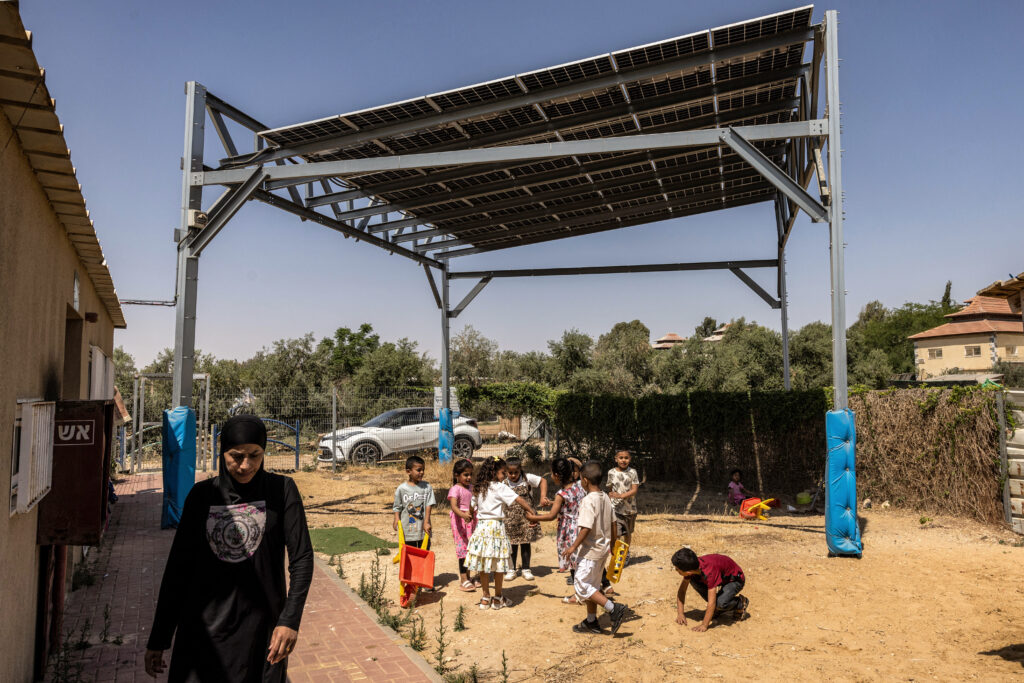
At the end of a dusty road in southern Israel, beyond a Bedouin village of unfinished houses and the shiny dome of a mosque, a field of solar panels gleams in the hot desert sun.Tirabin al-Sana in Israel’s Negev desert is the home of the Tirabin (also spelled Tarabin) Bedouin tribe, who signed a contract with an Israeli solar energy company to build the installation.The deal has helped provide jobs for the community as well as promote cleaner, cheaper energy for the country, as the power produced is pumped into the national grid.Earlier this month, the Al-Ghanami family in the town of Abu Krinat a little further south inaugurated a similar field of solar panels.  Bedouin families have for years tried and failed to hold on to their lands, coming up against right-wing groups and hardline government officials.Demolition orders issued by Israeli authorities plague Bedouin villages, threatening the traditionally semi-nomadic communities with forced eviction. But Yosef Abramowitz, co-chair of the non-profit organisation Shamsuna, said solar field projects help them to stake a more definitive claim.”It secures their land rights forever,” he told AFP.”It’s the only way to settle the Bedouin land issue and secure 100 percent renewable energy,” he added, calling it a “win, win”.For the solar panels to be built, the land must be registered as part of the Bedouin village, strengthening their claim over it.- Land recognition -Roughly 300,000 Bedouins live in the Negev desert, half of them in places such as Tirabin al-Sana, including some 110,000 who reside in villages not officially recognised by the government. Villages that are not formally recognised are fighting the biggest battle to stay on the land.Far-right groups, some backed by the current government of Prime Minister Benjamin Netanyahu, have stepped up efforts in the past two years to drive these families away.A sharp increase in home demolitions has left the communities vulnerable and whole families without a roof over their heads.”Since 2023, more than 8,500 buildings have been demolished in these unrecognised villages,” Marwan Abu Frieh, from the legal aid organisation Adalah, told AFP at a recent protest in Beersheva, the largest city in the Negev.”Within these villages, thousands of families are now living out in the open, an escalation the Negev has not witnessed in perhaps the last two decades.”Tribes just want to “live in peace and dignity”, following their distinct customs and traditions, he said.Gil Yasur, who also works with Shamsuna developing critical infrastructure in Bedouin villages, said land claims issues were common among Bedouins across the Negev.Families who include a solar project on their land, however, stand a better chance of securing it, he added.”Then everyone will benefit — the landowners, the country, the Negev,” he said. “This is the best way to move forward to a green economy.”- Positive energy -In Um Batin, a recognised village, residents are using solar energy in a different way –- to power a local kindergarten all year round.Until last year, the village relied on power from a diesel generator that polluted the air and the ground where the children played.Now, a hulking solar panel shields the children from the sun as its surface sucks up the powerful rays, keeping the kindergarten in full working order.”It was not clean or comfortable here before,” said Nama Abu Kaf, who works in the kindergarten.”Now we have air conditioning and a projector so the children can watch television.”   Hani al-Hawashleh, who oversees the project on behalf of Shamsuna, said the solar energy initiative for schools and kindergartens was “very positive”.”Without power you can’t use all kinds of equipment such as projectors, lights in the classrooms and, on the other hand, it saves costs and uses clean energy,” he said.The projects are part of a pilot scheme run by Shamsuna. Asked if there was interest in expanding to other educational institutions that rely on polluting generators, he said there were challenges and bureaucracy but he hoped to see more.”We need people to collaborate with us to move this forward,” he said, adding that he would “love to see a solar energy system in every village”.

A close-up of a stack of newspapers resting on a desk, symbolizing information and media.

En Afrique du Sud, des chiens renifleurs à la rescousse de tortues bosselées

Dans l’immensité d’une réserve privée sud-africaine près du Cap, un border collie avance rapidement entre les herbes et les arbustes. Sa truffe scanne la végétation à la recherche de tortues géométriques, une espèce endémique de la région en danger critique d’extinction.”Sa population est tellement faible qu’au moindre problème, elle peut rapidement s’éteindre à l’état naturel”, explique Andrew Turner, spécialiste de la restauration écologique pour Cape Nature, l’autorité de conservation de la biodiversité dans la région du Cap occidental.La chienne de trois ans est suivie attentivement par sa maîtresse, Esther Matthew de l’ONG Endangered Wildlife Trust (EWT), qui vérifie que toute la zone a été quadrillée. Devant un buisson, Delta s’arrête, scrute, et se couche. Esther Matthew fait signe à ses collègues. “Elle en a trouvé une ! C’est une femelle adulte, on le voit à son ventre plat. Les mâles ont le ventre incurvé.”Il faut alors se rapprocher et fixer le fynbos, une végétation propre à la région, pour distinguer la carapace qui se camoufle parfaitement dans la flore.La tortue géométrique est bosselée et chaque bosse est striée de jaune, comme les branches d’une étoile. Les femelles sont les plus grandes, jusqu’à 16,5 cm de longueur, et pèsent jusqu’à 850 grammes.La spécialiste en conservation sort un frisbee en mousse pour récompenser Delta. “Si elle trouve une tortue, on lui donne un jouet ce qui l’encourage à en trouver plus. Mais elle ne s’arrête pas pour n’importe quelle tortue, on l’entraîne à ne s’arrêter que pour la tortue géométrique.” Il est difficile d’établir leur nombre tant elles sont dures à trouver. “Dans les années 1990, on estimait qu’il y avait 1.500 individus, précise Andrew Turner, ce qui n’est déjà pas beaucoup. Selon des estimations ultérieures, on en comptait entre 600 et 800. Aujourd’hui, la population ne prospère nulle part. Il serait prudent de dire qu’il y en a encore quelques centaines.”Selon Esther Matthew, les chiens sont cinq fois plus efficaces que les hommes dans ce type de recherches. “Ils utilisent leur odorat et pas leur vue. Ils nous aident notamment à trouver les plus petites tortues, les nouveaux-nés et les jeunes, que l’on rate souvent.” – Base de données -Après Delta, place à Dash, un border collie plus jeune, pour poursuivre les recherches. Ils sont assistés par des collègues à pied qui fouillent les arbustes à l’aide de bâtons. Ce jour-là, une petite dizaine de tortues géométriques sont localisées sur la réserve.Ensuite commence la collecte d’informations: “On marque la carapace de chaque nouvelle tortue trouvée, on la mesure, on la pèse et on enregistre tout dans notre base de données”.Ce recensement est essentiel, au moment où la destruction de leur habitat les menace de disparition.”Ces tortues ont un habitat très spécifique, souligne Andrew Turner. On ne les trouve que dans le Renosterveld et le Fynbos dont elles se nourrissent.”Ces végétations uniques de la région du Cap sont elles-mêmes menacées d’extinction imminente.- Parcelles fragmentées -“La diversité de plantes dans ces zones est incroyable, poursuit-il. Mais comme les sols y sont très riches, elles ont été investies par l’agriculture et ces plantes ont largement disparu.””Les parcelles de végétation qui subsistent sont de plus en plus fragmentées au milieu de fermes, de routes, de villes et de sites industriels”, confirme l’écologue. “Donc les populations de tortues ne sont plus reliées entre elles et ne peuvent plus se soutenir.”Plus l’habitat des tortues géométriques est réduit et morcelé, plus la population décroît et moins elle est capable d’affronter les aléas climatiques comme les sécheresses, les feux de plus en plus fréquents et intenses, ainsi que les attaques de prédateurs comme le corbeau pie.Pas plus que le braconnage dont les tortues géométriques, comme les plantes qu’elles mangent, sont victimes. “Elles ont besoin de toute l’aide qu’on peut leur apporter”, plaide Andrew Turner.”Notre rôle est de récolter le plus de données possibles sur ces espèces”, pose Zanné Brink, la cheffe du programme de conservation des terres arides à EWT. “Ensuite, nous mettons en place des partenariats avec les propriétaires, par exemple, pour les aider à protéger la faune et la flore sur leurs terres.” “Il y a une prise de conscience de la richesse de notre biodiversité dans le Cap occidental et des menaces qui pèsent sur elle”, confirme M. Turner.”Notre plus gros défi, conclut Zanné Brink, est de recueillir assez d’informations pour empêcher la disparition d’espaces essentiels de biodiversité à cause d’une utilisation préjudiciable des terres.”

India electoral roll revision sparks fear and fury

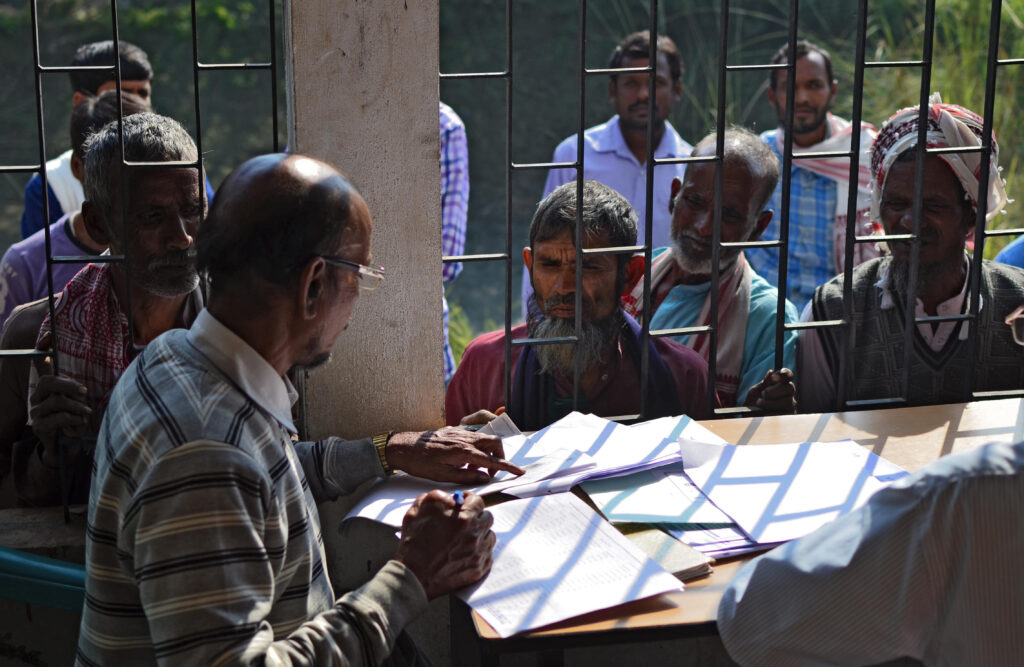
Indian election officials have given voters in Bihar state just weeks to prove their citizenship, requiring documents few possess in a registration revamp set to be applied nationwide, triggering disenfranchisement fears.The Election Commission of India (ECI) announced the revision of the voter rolls in June ahead of upcoming polls in the eastern state.It said the exercise will later be replicated across the nation of 1.4 billion people.According to the ECI, the “intensive revision” was needed in part to avoid the “inclusion of the names of foreign illegal immigrants”.Members of Prime Minister Narendra Modi’s Hindu nationalist Bharatiya Janata Party (BJP) have long claimed that large numbers of undocumented Muslim migrants from neighbouring Bangladesh have fraudulently entered India’s electoral rolls.Critics say the overhaul could render vast numbers of Indian citizens unable to vote.”You are being asked to produce documents that very few people have,” said Asaduddin Owaisi, a prominent Muslim lawmaker.”It will lead to mass disenfranchisement.”Opposition lawmakers say it will impact minorities the hardest, including Muslims and Dalit communities, those on the bottom rung of India’s rigid caste hierarchy.- ‘Engineered exclusions’ -All potential voters in Bihar will have to provide proof of citizenship by July 25.Those registered in 2003, the last time scrutiny of the voter list took place in Bihar, can submit a copy of that.The rest — around 30 million people, according to the ECI’s estimates — have to provide evidence of their place and date of birth.And those born after 1987 must also furnish proof of their parents’ Indian citizenship. The requirement affects more than a third of potential voters in Bihar, India’s third most populous state and its poorest. It is also a crucial election battleground as the only state in India’s northern Hindi-speaking belt where Modi’s BJP has only ever governed in a coalition.Bihar’s main opposition party, the Rashtriya Janata Dal, has challenged the election commission in the Supreme Court, along with other parties and activists.”It is being used to justify aggressive and opaque revisions of electoral rolls that disproportionately target Muslim, Dalit and poor (Indian) migrant communities,” the court petition read.”They are not random patterns but… engineered exclusions.”Unlike many other countries, India does not have a unique national identity card.The widely used biometric-linked “Aadhaar” identity card is not among the documents listed by the ECI as acceptable proof.Documents that can be used include birth certificates, passports and matriculation records.Of these, most people are likely to rely on their matriculation certificates.But even those are in short supply in Bihar, where literacy rates are among the lowest in India. According to an analysis published in The Indian Express newspaper, only 35 percent of people in the state hold such a document. “In Bihar, where literacy is not very high, many people are not likely to have the kind of documents the ECI has demanded,” said Jagdeep Chhokar from the New Delhi-based Association for Democratic Reforms (ADR).”The poor, poorly educated, uneducated and minorities will be the most impacted.”- ‘Foreign infiltrators’ -Detractors say the drive is unprecedented because “documentary proof has never been demanded” of people to vote in India. “Only those who especially wanted their name inserted needed to fill a form,” said political activist and academic Yogendra Yadav. “For the rest, someone would come to their house and get their names registered.””The onus in India was never on the voter but on the ECI officials,” he added.In previous verification drives, modifications were made to the existing rolls, Yadav said.Now, a list is being drawn from scratch. Yadav said the drive was a “de facto” implementation of an earlier plan to put together a list of Indian citizens. The National Register of Citizens (NRC), which was compiled in the eastern state of Assam in 2019, left out almost two million people. Many of them were Muslims.The BJP had said the NRC would be replicated nationwide as it was necessary to detect “foreign infiltrators”, but was forced to backtrack after furious protests. “Everyone has to now prove that they are citizens of India,” said Yadav. “That is exactly what the NRC is… this is NRC by the backdoor.”