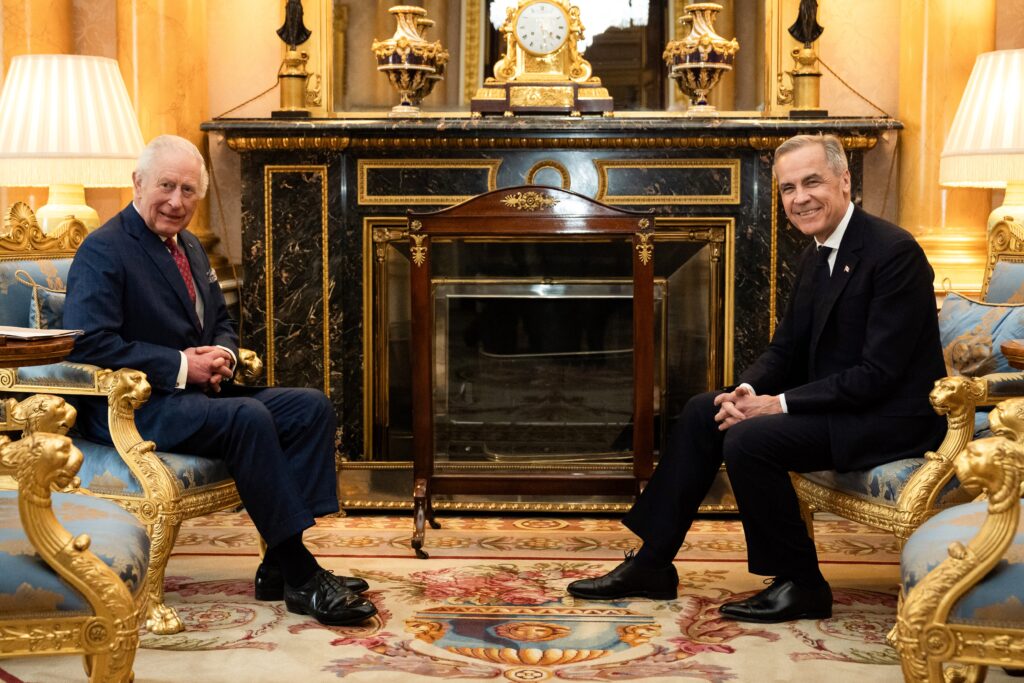
Le roi Charles III et Camilla en visite au Canada les 26 et 27 mai (palais)

Le roi Charles III et son épouse Camilla se rendront les 26 et 27 mai au Canada, pays dont le monarque est le chef d’État, a annoncé vendredi le palais de Buckingham.”Le roi, accompagné de la reine, assistera à l’ouverture officielle du Parlement du Canada, à Ottawa”, écrit le palais dans un communiqué, quelques jours après la victoire de Mark Carney aux élections législatives.Le souverain britannique de 76 ans, qui est soigné depuis février 2024 pour un cancer dont la nature n’a jamais été précisée, prononcera le discours d’ouverture du Parlement, a annoncé M. Carney peu après l’annonce du palais.”Il s’agit d’un honneur historique”, a-t-il souligné. “Cela montre clairement la souveraineté de notre pays”, a-t-il ajouté, allusion aux velléités de Donald Trump de faire du pays le 51ème état américain.Ce voyage est le plus lointain entrepris par le couple depuis sa tournée de onze jours en Australie et aux Samoa fin-octobre pour le sommet du Commonwealth.Charles III, qui a repris ses engagements royaux au printemps 2024 après une brève pause, s’est aussi rendu en visite d’Etat en Italie début avril, pendant laquelle il a notamment rencontré le pape François et donné un discours devant le Parlement.Mercredi, dans un message au ton personnel, il a évoqué le caractère “effrayant” de tout diagnostic de cancer.

US ends duty-free shipping loophole for low-cost goods from China

The United States on Friday ended a tariff exemption for goods shipped from China worth less than $800, dealing a major blow to popular e-commerce sites such as Shein and Temu, whose cheap items consumers have come to rely on.The decision was announced last month, with the White House calling it a “critical step in countering the ongoing health emergency posed by the illicit flow of synthetic opioids” from China to the United States.Starting on Friday, goods shipped commercially will now be subject to new tariffs of 145 percent — the current level of levies imposed on goods coming from China.Items sent through the US Postal Service will be hit with duties of 120 percent of their value, or a $100, which will increase to $200 next month. The elimination of the ‘de minimis’ exemption now subjects even low-value imports to tariffs,” EY chief economist Gregory Daco wrote in a recent note to clients, adding it would squeeze “already-thin margins and driving up end prices.”The measures mark the latest salvo in a burgeoning trade war between the United States and China — the world’s two largest economies.The White House has also slapped additional levies of 25 percent on several sectors including automobiles, steel and aluminum from China.Beijing retaliated with sweeping 125 percent levies on US imports. Most other US trading partners face a baseline tariff of 10 percent, except for Mexico and Canada which face a higher 25 percent tariff on goods not covered by a current North America free-trade deal. The move threatens to hammer the business model of several large firms that ship cheap goods from China — including fast-fashion titans Shein and Temu.However, Chinese e-commerce sites listed on the New York Stock Exchange were largely in the green on Friday, most likely reflecting optimism about trade negotiations between Beijing and Washington, and the fact that many of these changes were already priced into the financial markets.At around 14:40 GMT, PDD, owner of Temu, was up 3.7 percent, while Alibaba was up around 4.0 percent.The Financial Times reported earlier this week that Shein was postponing a long-standing plan to list on public stock markets in London due to the looming de minimis changes.Trump first floated cancelling the exemption in February before backtracking after the move caused logistical disruptions.At the time, Beijing accused the United States of “politicizing trade and economic issues and using them as tools.”burs-da/des

US ends duty-free shipping loophole for low-cost goods from China

The United States on Friday ended a tariff exemption for goods shipped from China worth less than $800, dealing a major blow to popular e-commerce sites such as Shein and Temu, whose cheap items consumers have come to rely on.The decision was announced last month, with the White House calling it a “critical step in countering the ongoing health emergency posed by the illicit flow of synthetic opioids” from China to the United States.Starting on Friday, goods shipped commercially will now be subject to new tariffs of 145 percent — the current level of levies imposed on goods coming from China.Items sent through the US Postal Service will be hit with duties of 120 percent of their value, or a $100, which will increase to $200 next month. The elimination of the ‘de minimis’ exemption now subjects even low-value imports to tariffs,” EY chief economist Gregory Daco wrote in a recent note to clients, adding it would squeeze “already-thin margins and driving up end prices.”The measures mark the latest salvo in a burgeoning trade war between the United States and China — the world’s two largest economies.The White House has also slapped additional levies of 25 percent on several sectors including automobiles, steel and aluminum from China.Beijing retaliated with sweeping 125 percent levies on US imports. Most other US trading partners face a baseline tariff of 10 percent, except for Mexico and Canada which face a higher 25 percent tariff on goods not covered by a current North America free-trade deal. The move threatens to hammer the business model of several large firms that ship cheap goods from China — including fast-fashion titans Shein and Temu.However, Chinese e-commerce sites listed on the New York Stock Exchange were largely in the green on Friday, most likely reflecting optimism about trade negotiations between Beijing and Washington, and the fact that many of these changes were already priced into the financial markets.At around 14:40 GMT, PDD, owner of Temu, was up 3.7 percent, while Alibaba was up around 4.0 percent.The Financial Times reported earlier this week that Shein was postponing a long-standing plan to list on public stock markets in London due to the looming de minimis changes.Trump first floated cancelling the exemption in February before backtracking after the move caused logistical disruptions.At the time, Beijing accused the United States of “politicizing trade and economic issues and using them as tools.”burs-da/des

Renewables sceptic Peter Dutton aims for Australian PM’s job

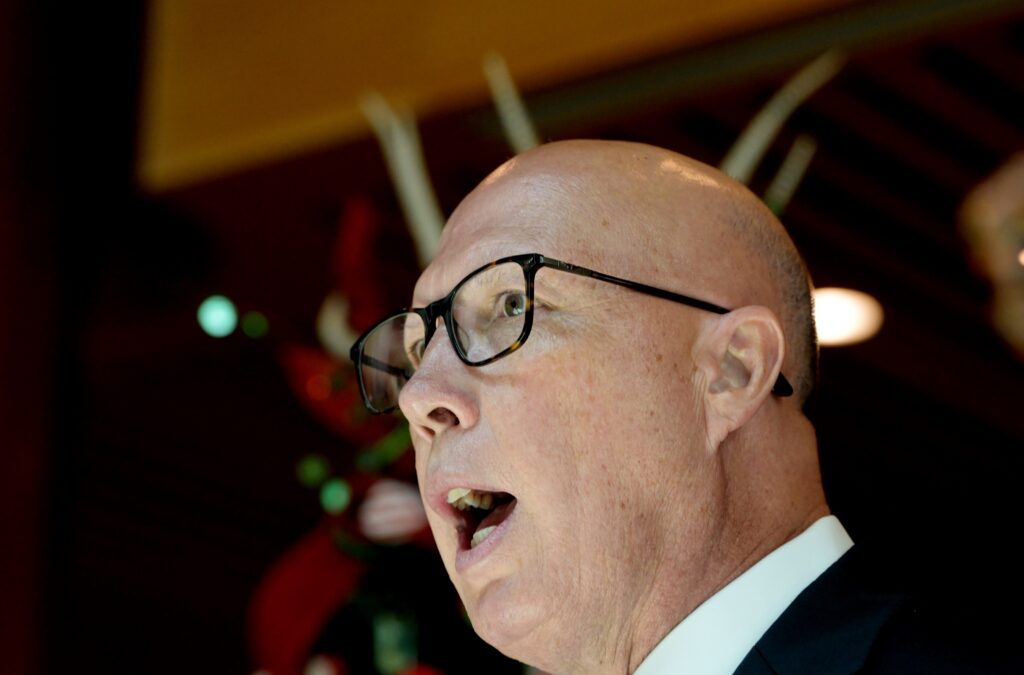
Former policeman Peter Dutton, the rival for the Australian prime minister’s job in Saturday’s election, is a self-professed sceptic of the rush to replace fossil fuels with renewable energy. The 54-year-old leader of the conservative Liberal Party has attacked centre-left Prime Minister Anthony Albanese’s “weak leadership” at a time of rising prices.Dutton — the son of a bricklayer and himself a former Queensland drug squad detective — accuses the government of mismanaging the economy, being weak on defence, and backing a “divisive”, failed referendum on Indigenous peoples’ rights.But one of his starkest policy disagreements with the government is over how to tackle climate change.He has criticised the scale of Albanese’s plans to boost solar and wind-driven electricity to slash Australia’s carbon emissions.Dutton wants to ramp up gas production and overturn a quarter-century ban on nuclear power with a US$200 billion scheme to construct seven industrial-scale nuclear reactors.”The renewables-only energy policy is a wrecking ball through the economy and it’s driving up the cost of food, the cost of everything when you go to the supermarket,” he said this week.Dutton — who has run defence and home affairs in previous conservative administrations — had to apologise in 2015 after a quip about the threat climate change poses to the Pacific was picked up by a microphone.”Time doesn’t mean anything when you’re about to be, you know, have water lapping at your door,” Dutton was caught saying.It is not the only time his rhetoric has caused controversy.- ‘Gang violence’ -In 2018, Dutton claimed people in Melbourne were “scared to go out to restaurants” because of “African gang violence”.As immigration minister for nearly four years from 2017, Dutton oversaw the country’s widely criticised offshore detention regime.After being chosen as opposition leader in 2022, Dutton expressed regret for boycotting a 2008 national apology to Aboriginal Australians forcibly separated from their families as children.At the time he had failed to grasp the “symbolic significance”, he said.US President Donald Trump — who Dutton raised earlier this year as a “big thinker” with “gravitas” on the global stage — became a surprise challenge to his campaign.Some polls suggested Dutton’s polling took a hit after Trump slapped 10-percent trade tariffs on Australia.The opposition leader reassured voters he would stand up for Australia. “If I needed to have a fight with Donald Trump or any other world leader, to advance our nation’s interest, I’d do it in a heartbeat,” he said.Dutton — the married father of three adult children, Rebecca, Harry and Tom — speaks with pride of his blue-collar roots.”I was born into an outer suburbs working-class family — mum and dad, a secretary and bricklayer, didn’t have much money, but they worked every day of their life,” he told party members.Dutton said he worked after school delivering papers, mowing lawns and working in a butcher’s shop.Saving enough money to buy a house at the age of 19 was “one of my proudest achievements”.

Activists say drones attacked aid boat bound for Gaza

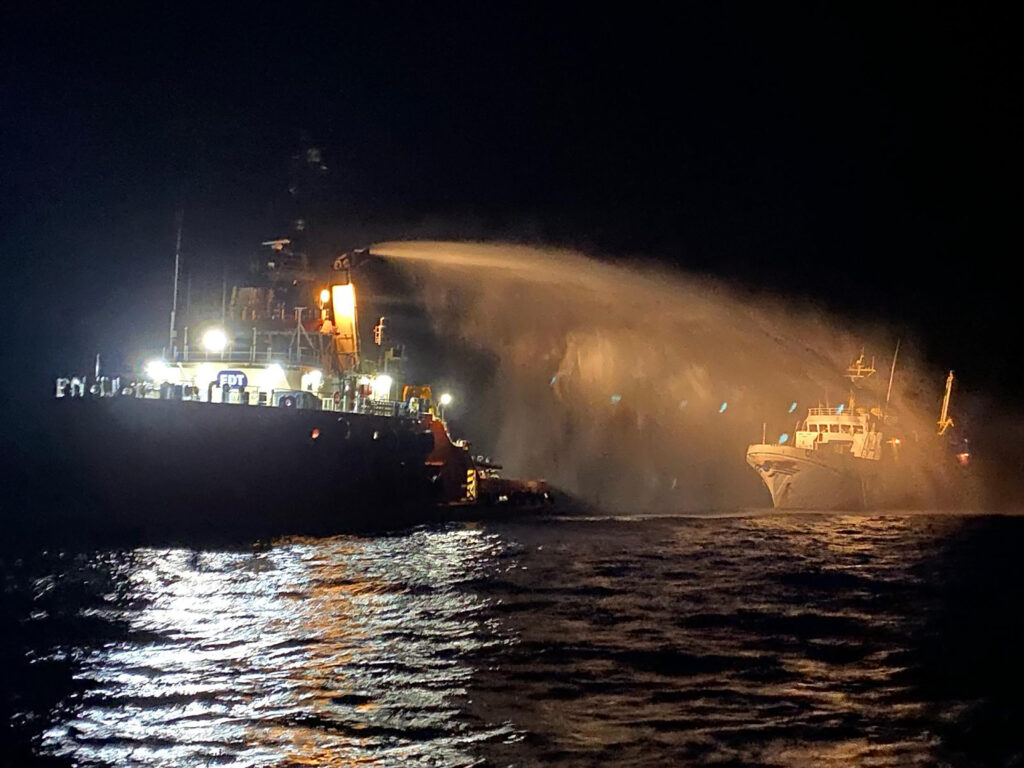
A group of activists organising an aid boat for Gaza said it was attacked on Friday by drones in international waters off Malta as it headed towards the Palestinian territory.The Maltese government and Cypriot rescuers said they had responded to a distress call from the vessel, while Malta said all crew members were safe and made no mention of an alleged attack.The activists said they suspected Israel could be behind the attack, and Cyprus’s rescue agency said it had been informed by the island’s foreign ministry of an Israeli drone strike.The Israeli military did not provide an immediate response when contacted by AFP.”At 00:23 Maltese time (2223 GMT Thursday), the Conscience, a Freedom Flotilla Coalition ship came under direct attack in international waters,” the group said in a statement.”Armed drones attacked the front of an unarmed civilian vessel twice, causing a fire and a substantial breach in the hull.”Israeli ambassadors must be summoned and answer to violations of international law, including the ongoing blockade and the bombing of our civilian vessel in international waters.”Asked whether the group believed Israel was behind the attack, a spokesperson told AFP they “suspected” that was the case.”While we cannot confirm 100%, we suspect it’s Israel,” Hay Sha Wiya said, calling the country “the primary entity interested in keeping us and any aid out of Gaza”.Israel is known for conducting covert operations beyond its borders, including several during the Gaza war that it only acknowledged later.The activists said the strike appeared to target the boat’s generator.Following the distress call, the Malta Vessel Traffic Services body dispatched a tugboat and offered support.”The tug arrived on scene and began firefighting operations. By 0128 hrs, the fire was reported under control,” the Maltese statement said.- ‘Desperately needed aid’ -A Cypriot-owned vessel also responded to the distress call.”The Larnaca Joint Rescue Coordination Centre (JRCC) has been informed by the Ministry of Foreign Affairs of the Republic of Cyprus that a vessel possibly transporting humanitarian aid to Gaza came under missile attack by an Israeli Unmanned Aerial Vehicle (UAV) while sailing within the Search and Rescue (SAR) Region of Malta,” the Cypriot rescue body said.It said a Cypriot-owned vessel in the area “participated in firefighting operations”.The activists were on what they called a “mission to challenge Israel’s illegal and deadly siege of Gaza, and to deliver desperately needed, life-saving aid”.Israel has since March 2 blocked all aid deliveries to Gaza, and resumed major military operations in the territory in mid-March, ending a two-month ceasefire.The International Committee of the Red Cross warned Friday that the humanitarian response in Gaza was on the “verge of total collapse” after two months of aid being blocked.Turkey, which said it had nationals on board the vessel, strongly condemned “this attack on a civilian ship, which threatens freedom of navigation and maritime security in international waters”.”There are allegations that the ship was targeted by Israeli drones. All necessary initiatives will be taken to reveal the details of the attack as soon as possible and to hold the perpetrators accountable,” a foreign ministry statement said.A previous “Freedom Flotilla” sailed from southern Turkey in 2010 but ended in bloodshed when Israeli forces stormed the Mavi Marmara vessel, killing 10 people and wounding 28.Hamas’s attack on Israel in October 2023, which sparked the Gaza war, resulted in the deaths of 1,218 people, mostly civilians, according to an AFP tally based on official figures.The health ministry in Hamas-run Gaza said on Thursday that at least 2,326 people have been killed since Israel resumed strikes, bringing the overall death toll since the war broke out to 52,418.Both Hamas and the Palestine Liberation Organization, which Palestinian president Mahmud Abbas leads, issued statements condemning the disabling of the aid ship off Malta.Hamas said it showed Israel’s “blatant disregard for the will of humanity and justice”.

Les pressions économiques menacent la liberté de la presse dans le monde, alerte RSF

Fermetures massives de médias d’information, domination des GAFAM, mainmise des milliardaires… Les pressions économiques menacent la liberté de la presse, alerte Reporters sans frontières (RSF), pointant notamment une “dégradation inquiétante” aux États-Unis sous le mandat de Donald Trump.D’après le classement annuel de l’ONG, publié vendredi à la veille de la journée mondiale de la liberté de la presse, médias et journalistes sont confrontés à des situations “problématiques”, “difficiles” ou “très graves” dans les trois quarts des 180 pays évalués.”Pour la première fois”, la situation devient “difficile” à l’échelle du monde, souligne RSF, désignant plus particulièrement le poids des contraintes économiques, illustrées par le cas américain. Loin de la Norvège, première du classement pour la neuvième année consécutive, les États-Unis perdent deux places et se retrouvent en 57e position, derrière la Sierra Leone. “La situation n’était déjà pas reluisante” dans le pays, rétrogradé de dix places en 2024, concède auprès de l’AFP la directrice éditoriale de RSF, Anne Bocandé. Mais elle s’est encore aggravée depuis l’investiture en janvier du président américain, auteur d'”attaques quotidiennes” contre la presse. “La liberté de la presse n’est plus un acquis aux États-Unis”, constatait également plus tôt cette semaine le Comité pour la protection des journalistes (CPJ), dans un rapport sur les 100 premiers jours du second mandat de Donald Trump.- “Déserts informationnels” -Ce dernier a signé jeudi un décret demandant de cesser de financer deux réseaux publics emblématiques, PBS et NPR, qu’il accuse d’être biaisés. Il avait auparavant initié le démantèlement des médias publics américains à l’étranger, comme Voice of America, privant “plus de 400 millions de personnes” d’un “accès à une information fiable”, selon RSF.”Le gel des fonds d’aide internationale”, via l’Agence américaine de développement USAID, a en outre “plongé des centaines de médias dans une instabilité économique critique” et contraint certains “à la fermeture, notamment en Ukraine” (62e, -1 place).Parallèlement, de “vastes déserts de l’information” se créent aux États-Unis avec la disparition de nombreux titres locaux en proie à des difficultés financières.Ces “pressions économiques”, moins visibles que les exactions physiques, constituent une “entrave majeure” à la liberté de la presse, insiste RSF, appelant à un “New Deal pour le journalisme”.”Dans près d’un tiers des pays du monde”, dont la Tunisie (129e, -11) et l’Argentine (87e, -21), “des médias d’information ferment régulièrement, sous l’effet des difficultés économiques persistantes”. Une trentaine de pays se distinguent par ailleurs par “des fermetures massives ayant provoqué, ces dernières années, l’exil de journalistes”, comme le Nicaragua (172e, -9) ou l’Afghanistan (175e, +3).  En Palestine (163e,-6), la situation est “désastreuse”, selon RSF, qui accuse l’armée israélienne d’avoir “détruit des rédactions et tué près de 200 journalistes”, tandis que “l’absence de stabilité politique” en Haïti (112e, -18) “plonge l’économie des médias aussi dans le chaos”.- “Asphyxie” -Plus généralement, l’économie du secteur est “mise à mal” par les GAFAM (Google, Apple, Facebook, Amazon et Microsoft), dont les plateformes, “largement non régulées, captent une part croissante des revenus publicitaires” et participent à “la prolifération de contenus manipulés ou trompeurs”.La liberté d’informer est aussi “de plus en plus entravée par des conditions de financement opaques ou arbitraires”, comme en Hongrie (68e, -1) où “le gouvernement asphyxie les titres critiques via la distribution inéquitable de la publicité d’État”. Même dans des pays “bien positionnés” comme la Finlande (5e) ou l’Australie (29e, +10), la concentration des médias, “menace pour le pluralisme”, reste “un point de vigilance”. Ainsi, en France (25e, -4), une “part significative de la presse nationale est contrôlée par quelques grandes fortunes”, relève RSF, s’interrogeant sur “l’indépendance réelle des rédactions”.La situation de la liberté de la presse est qualifiée de “très grave” dans 42 pays, dont sept font leur entrée dans cette catégorie (Jordanie, Hong-Kong, Ouganda, Ethiopie, Rwanda, Kirghizistan et Kazakhstan). L’Eryhtrée reste en dernière position, derrière la Corée du Nord et la Chine. RSF réalise ce classement à partir “d’un relevé quantitatif des exactions commises envers les journalistes” et “d’une étude qualitative” auprès d’experts.