Tokyo-bound United plane returns to Washington after engine fails

A United Airlines Boeing 777 bound for Tokyo had to turn back to Washington’s Dulles International Airport on Saturday after an engine failed during takeoff, igniting a brush fire near the runway, officials said.No injuries were reported among the 275 passengers and 15 crew members aboard the wide-bodied jet, which had to make an emergency landing.”Shortly after takeoff, United Flight 803 returned to Washington Dulles and landed safely to address a power loss issue with one of its engines,” the airline said.The engine failed as the 777-200ER departed for Tokyo’s Haneda Airport at around 12:20 pm (1720 GMT) Saturday, sources told AFP. Transportation Secretary Sean Duffy said on X that a piece of the engine cover “separated and caught fire, sparking a brush fire on the ground.””The fire was extinguished and the flight returned to Dulles, landing safely at about 1:30 pm, when it was checked by airport fire responders,” an airport spokesperson said.According to the official, the affected runway had to be closed for a short time, “but Dulles has multiple runways and other flight operations were not impacted.”The US Federal Aviation Administration (FAA) said it would investigate the incident.Aircraft manufacturer Boeing referred questions to United Airlines. According to specialist site AirLive, the plane dumped its fuel over the city of Fredericksburg in Virginia, “a critical safety procedure used to reduce the plane’s weight to a safe level before attempting an emergency landing.”According to registration information provided by the site, the 777 in Saturday’s incident was delivered in November 1998 to Continental Airlines, which was later absorbed in a corporate takeover by United Airlines. The plane is equipped with two General Electric engines — now known as GE Aerospace.United Flight 803 took off in a different plane later Saturday, six-and-a-half hours after its original departure time, bound for Haneda.

Deja vu? Trump accused of economic denial and physical decline

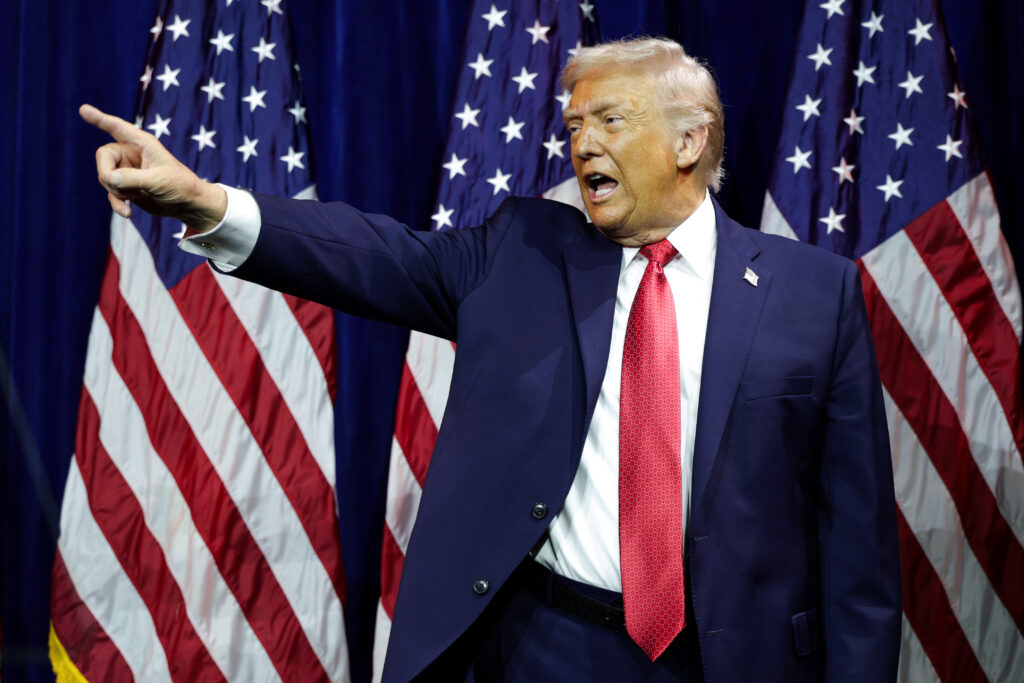
An aging president faces poor poll numbers and suspicions about his health but insists that America is thriving. Joe Biden? No, it’s Donald Trump.The Republican, back in power for nearly a year, continues to compare himself to his predecessor.Biden would be senile, while Trump brims with energy; the Democrat would have driven the country into bankruptcy, but the Republican presides over an economic “golden age” – so Trump says.At a Pennsylvania rally on Tuesday, Trump uttered his rival’s name more than 20 times and even called him a “sleepy son of a bitch.” Yet for the past few weeks, a strong sense of deja vu has colored the billionaire’s presidency. Some of his statements, in the unabashed style that is his hallmark, echo remarks made by Biden. “America has the best economy in the world,” the Democratic president declared in April 2024, a statement running counter to voters’ perceptions.The US economy deserves “A+++++”, Trump declared in an interview with Politico published on Tuesday.He repeated that prices are falling, even though Americans still complain about the high cost of living. “There will always be a portion of his supporters that are going to be with him regardless. If he says the sky is not blue, then they will agree that the sky is not blue,” said Alex Keena, a political science professor at Virginia Commonwealth University. But “that’s not the majority of the American public,” the researcher told AFP. “At the end of the day, people will go out and they will buy things and their experiences are undeniable.”- 31 percent -According to a poll by the University of Chicago for the Associated Press, published Thursday, only 31 percent of Americans are satisfied with Trump’s economic policy.”When will people understand what is happening? When will Polls reflect the Greatness of America at this point in time, and how bad it was just one year ago?” Trump wrote in a post on his Truth Social network. While campaigning, Trump accused Biden of ignoring the struggles of low-income households. Like his predecessor, Trump today is trying to steer some of consumers’ discontent toward big corporations suspected of inflating prices.Like Biden, he is also struggling to generate enthusiasm for his plans to bolster purchasing power. And like the former president, Trump is dogged by questions about his health, though not as intensely as concerns about his rival’s decline — which Trump himself has fueled.- Blue on the hand – By portraying Biden as an old man unfit to govern, Trump is “tapping into a very real frustration” over the aging of America’s political class, Keena noted. But this strategy could backfire on Trump, the oldest president ever elected in the United States.The 79-year-old is now the one whose every public appearance is scrutinized, and who is being attacked on social media. On Thursday, for example, a fake photo showing him with a walker circulated. Was that Trump nodding off during this cabinet meeting, or was he resting his eyes for a moment? And was that bandaged bruise on the back of his hand really the result of countless handshakes, as the White House keeps saying?Biden’s team had furiously denied allegations of declining health, but also increasingly shielded the octogenarian president from public view and journalists’ questions.Trump, for his part, remains much more accessible than his predecessor ever was and frequently engages in lengthy impromptu exchanges with the press. But beware, anyone who dares — as the New York Times recently did — to investigate his work pace and vitality.”I actually believe it’s seditious, perhaps even treasonous, for The New York Times, and others, to consistently do FAKE reports in order to libel and demean ‘THE PRESIDENT OF THE UNITED STATES,'” he wrote on Truth Social. 

China’s smaller manufacturers look to catch the automation wave

In a light-filled workshop in eastern China, a robotic arm moved a partially assembled autonomous vehicle as workers calibrated its cameras, typical of the incremental automation being adopted even across smaller factories in the world’s manufacturing powerhouse.China is already the world’s largest market for industrial robots, and the government is pouring billions of dollars into robotics and artificial intelligence to boost its presence in the sector. The first essentially humanlessfactoriesare already in operation, even as widespread automation raises questions about job losses as well as the cost and difficulty of transition for smaller and medium-sized companies. The answer for many is a hybrid approach, experts and factory owners told AFP. At the autonomous vehicle workshop, manager Liu Jingyao told AFP that humans are still a crucial part of even technologically advanced manufacturing. “Many decisions require human judgement,” said Liu, whose company Neolix produces small van-like vehicles that transport parcels across Chinese cities. “These decisions involve certain skill-based elements that still need to be handled by people.”At the Neolix factory, 300 kilometres (186 miles) north of Shanghai, newly built driverless vehicles zoomed around a testing track simulating obstacles including puddles and bridges.In a closed-off room, workers assembled vehicles’ “brains”, testing their cameras and computer chips.”Automation… primarily serve(s) to assist humans, reducing labour intensity rather than replacing them,” Liu said.But Ni Jun, a mechanical engineering expert at Shanghai’s Jiaotong University, said China’s strategy of focusing on industrial applications for AI means full automation is already feasible in many sectors.Among others, tech giant Xiaomi operates a “dark factory” — where the absence of people means no need for lights — with robotic arms and sensors able to make smartphones without humans.- Digital divide -Ni described a “digital divide” between larger companies with the funds to invest heavily in modernisation, and smaller businesses struggling to keep up.For Zhu Yefeng’s Far East Precision Printing Company, part of China’s vast network of small independent factories employing up to a few dozen people each, full automation is a distant dream.At the company just outside Shanghai, workers in small rooms fed sheets of instruction manuals into folding machines and operated equipment that printed labels for electronic devices.The company used pen and paper to track its workflow until two years ago, with managers having to run around the factory to communicate order information.”Things were, to put it bluntly, a complete mess,” Zhu told AFP.The company has since adopted software that allows employees to scan QR codes that send updates to a factory-wide tracker.On a screen in his office, Zhu can see detailed charts breaking down each order’s completion level and individual employees’ productivity statistics.”This is a start,” Zhu told AFP. “We will move toward more advanced technology like automation, in order to receive even bigger orders from clients.”Financial constraints are a major barrier though.  “As a small company, we can’t afford certain expenses,” said Zhu. His team is trying to develop its own robotic quality testing machine, but for now humans continue to check final products.- Employment pressures -The potential unemployment caused by widespread automation will be a challenge, said Jacob Gunter from the Berlin-based Mercator Institute for China Studies. “Companies will be quite happy to decrease their headcount… but the government will not like that and will be under a lot of pressure to navigate this,” Gunter told AFP.Beijing’s push to develop industrial robots will “intersect with the need for maintaining high employment at a time when employment pressure is considerable”, he added. Going forward, manufacturers must strike a balance “between the technical feasibility, social responsibility, and business necessity”, Jiaotong University’s Ni told AFP.Zhou Yuxiang, the CEO of Black Lake Technologies — the start-up that provided the software for Zhu’s factory — told AFP he thought factories would “always be hybrid”. “If you ask every owner of a factory, is a dark factory the goal? No, that’s just a superficial description,” Zhou said. “The goal for factories is to optimise production, deliver things that their end customers want, and also make money.”

For children of deported parents, lonely journeys to a new home

One recent day at Miami’s international airport, Andy, age 6, was getting ready to fly to Guatemala. He was anxious, this was no year-end vacation to visit his relatives.Andy was moving to his ancestral country to reunite with his father, recently deported as part of President Donald Trump’s aggressive policy to expel undocumented migrants.”They took my brother and I’ve had to take care of the little one,” said Osvaldo, Andy’s uncle who brought him to the airport but was not getting on the plane with him.Andy was making the trip with six other children aged 3 to 15 — three of them US citizens, the others Guatemalans who grew up in Florida. They were all moving to a country where they either had never been, or one which they barely remembered.The sprawling city of Miami on Florida’s east coast is about 70 percent Hispanic, and often called the Gateway to Latin America.Across the United States, cities with large immigrant communities are primary targets of Trump’s virulent anti-immigrant policies and rhetoric.Trump’s administration has deployed heavily armed and masked enforcement agents and onlookers have filmed them in various cities tackling people in the street or dragging them from cars.- ‘I worry about the child’ -Born in the United States, Andy is a US citizen. Until November, he lived with his father Adiner, who had been in Florida for a decade. His mother hasn’t been in his life since the parents separated.One day, when Andy’s father came to pick him up from school, a police officer stopped him. He had neither a visa nor a residency permit.Andy — who wore a backpack and a little cross necklace for the flight to Guatemala City — was happy about being reunited with his father but also “a little nervous” about the trip, said Osvaldo, who did not want his full name published for fear of arrest.”I keep thinking about my brother, about why they nabbed him. And I also worry about the child,” he said.The trip was organized by the Guatemalan-Maya Center, a nonprofit group serving “uprooted children and families” in the Miami area. Mariana Blanco, its director of operations, circulated among the children, checking they had everything needed for the trip.She pointed out Franklin, 3, and his 6-year-old brother Garibaldi, both US citizens. The younger boy wore a Spider Man hoodie, a dinosaur backpack, and an anxious expression.Like Andy, they were travelling to reunite with their deported father, because their mother works long hours in Miami and fears she too will be arrested. – ‘Trampling on children’s rights’ -Two volunteers with the Guatemalan-Maya Center were accompanying the children on the trip.One of them, Diego Serrato, accused the Trump administration of racism and “trampling on children’s rights.” “It’s sad to see worry and fear on their little faces instead of the smiles they should have,” Serrato said.The group also included Mariela, 11, traveling to live with her mother because her father fears arrest; Alexis, 11, who had to stay for a few days with an aunt he’d never met after his father was arrested; and Enrique, 13, about to see his mother for the first time in eight years after his father ended up in an ICE lockup.”No one should go through that, especially not a child,” said Blanco.The children, all of them Mayan, would have to adapt to life in Guatemala, where their families primarily live in impoverished rural areas, Blanco said. Most of the older ones would have to start working because middle school and high school in Guatemala come with expenses that their parents cannot cover, she added. As the group headed towards customs, Andy suddenly turned, hugged his uncle Osvaldo tightly, before rejoining the other children.

Trump boxed in as Republican health care revolt grows

As millions of Americans brace for soaring health care costs, President Donald Trump is confronting an open rupture inside his own party that lawmakers fear could haunt Republicans in the 2026 midterm elections.US patients already face among the highest medical bills in the world, spending more than twice as much on average as people in other wealthy nations, according to the Organisation for Economic Co-operation and Development (OECD).The latest flashpoint is the year-end expiration of Affordable Care Act (ACA) subsidies that help cash-strapped families buy health insurance — a deadline that has laid bare a widening gulf between Trump’s blue-collar coalition and establishment Republicans determined to let the aid lapse.Fiercely opposed to anything resembling support for the ACA — a law nicknamed “Obamacare” for its architect, Democratic former president Barack Obama — Republican leaders insist the subsidies must end on December 31.Trump, whose handling of health care is deeply underwater in public polling, sought to project flexibility in remarks late Thursday, offering to work with Democrats on a long-term fix.But the overture sits uneasily alongside his longstanding opposition to Obamacare and his resistance to extending subsidies — which Republicans argue would further entrench a law they have spent more than a decade trying to dismantle.Tensions burst into the open earlier Thursday when four Republican senators crossed party lines to back an ultimately unsuccessful Democratic bill extending the subsidies for three years.- ‘Under pressure’ -“I hope the message is, ‘We need to do something here,'” Missouri Senator Josh Hawley said, according to The Hill, after voting to advance the Democratic proposal. “We’re all under pressure.”If Congress fails to act in the coming days, insurance costs are expected to spike for roughly 22 million Americans receiving enhanced ACA tax credits.KFF, a health policy research group, projects that they could see their monthly payments more than double, while overall marketplace premiums would rise by an average of 26 percent.The anxiety is spilling into the House, where up to two dozen swing‑district Republicans are openly defying Speaker Mike Johnson by joining Democrats on so-called “discharge petitions” to force votes on reviving the government aid.The rebellion reflects growing fear among frontline lawmakers that allowing premiums to spike on Trump’s watch could hand Democrats a potent campaign weapon.Johnson has made clear he opposes rank-and-file maneuvers to bypass leadership, but moderates warn that rigid party orthodoxy could cost them their seats — and ultimately imperil Trump’s already thin House majority.- Open to talks -Republican leaders, long unable to forge consensus on how America should fund treatment for its sick and infirm, released their own health care funding proposals on Friday, limited to measures they believe have broad support in the party.Slated for a vote next week, the text excludes language extending the expiring Obamacare subsidies, though lawmakers will be allowed a vote on an amendment to keep the aid in place — an effort party leaders expect to fail.Democrats say they’re open to talks on any initiative making health care more affordable but skeptical of Republican resolve.For Trump, the fight carries enormous political risk. Polls show health care as his weakest issue, with his approval — even among Republicans — lagging as voters fault Washington for failing to rein in costs.It is a rare policy arena in which the billionaire’s grip on his party appears to be slipping.Back an extension of a law he once vowed to repeal, or allow premiums to soar in an election year? Either path risks alienating voters, and Republicans across Capitol Hill are signaling they want clear leadership from the president.”House Democrats remain ready, willing and able to sit down with our Republican colleagues anytime, anyplace and anywhere in order to enact a bipartisan agreement,” House Minority Leader Hakeem Jeffries said on Friday. “But Republicans continue to pursue a my-way-or-the-highway approach, which has gotten them nowhere this year.”