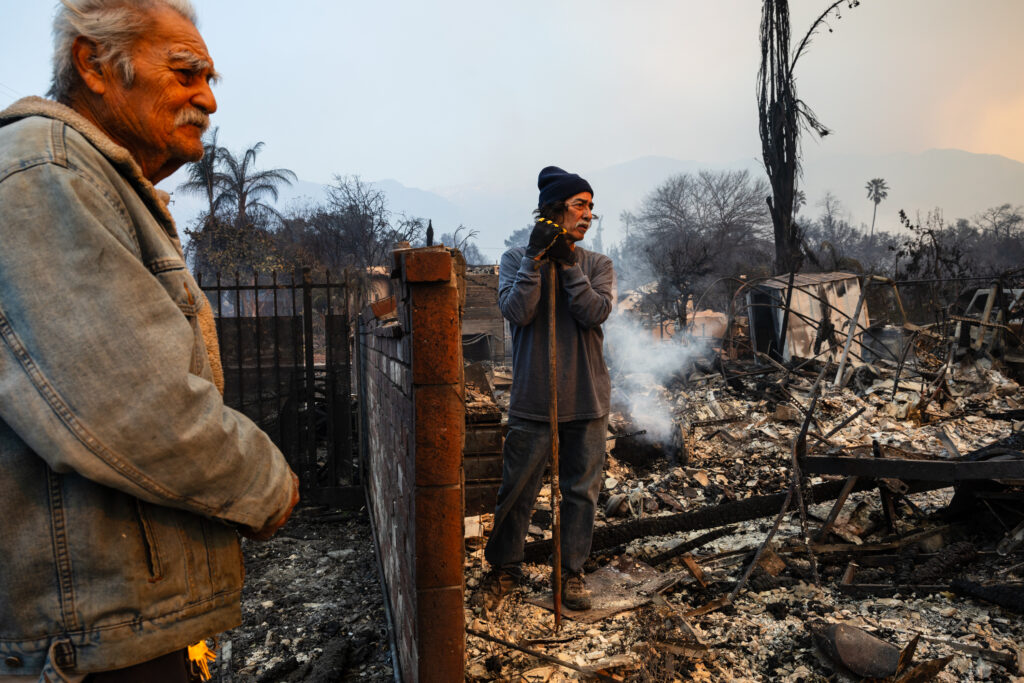
LA fire evacuees told no chance of return until at least Thursday

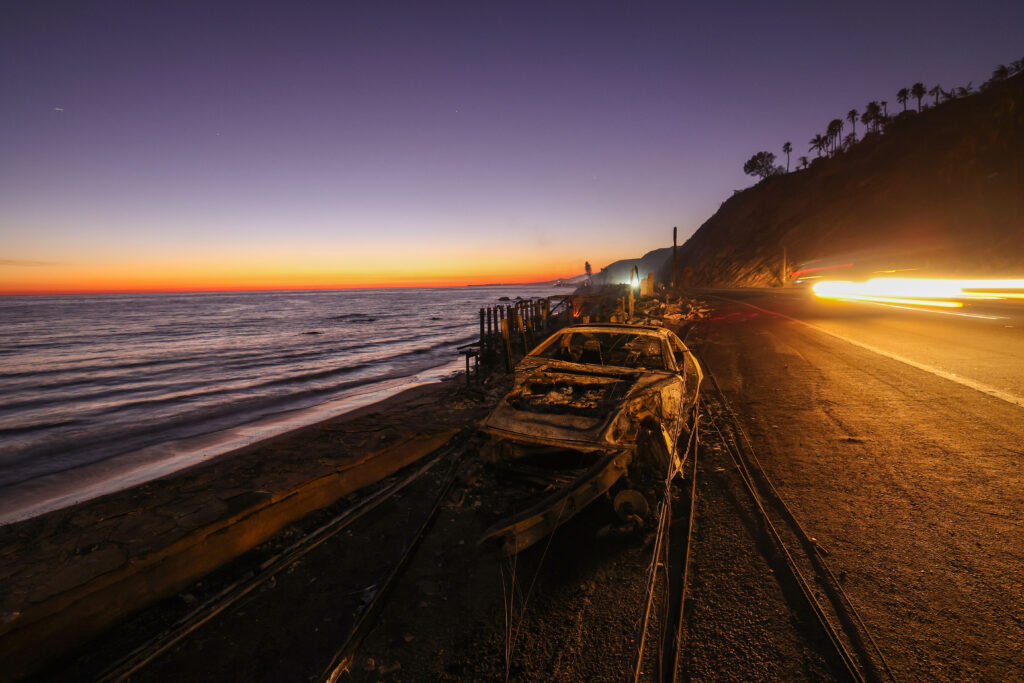
Tens of thousands of people forced from their homes by enormous fires raking Los Angeles will not be able to return for at least four days, officials said Sunday.Frustrated evacuees have formed lines at checkpoints hoping to get into no-go zones barricaded off amid the Palisades Fire and the Eaton Fire.Many are desperate to get back to homes they had to flee with just a few moments’ notice to pick up medicines or clothes they did not have a chance to grab.Others simply want to find out if their houses have survived.But Los Angeles County Fire Chief Anthony Marrone said Sunday that gusting winds forecast this week mean the fire emergency is far from over.”They can’t go home, simply because it’s not safe,” he told a press conference.”It’s our collective priority… to be able to get residents back in their homes just as quickly as possible. “That conversation is not going to occur until the end of the predicted red flag event that’s on its way,” he said, referring to the strong winds expected to last until Wednesday.”Please rest assured that first thing Thursday, we will start talking about repopulation.”Lines several city blocks long have seen people queuing for up to 11 hours for a short escorted visit to their home in an evacuation zone.One woman, who gave her name as Janelle, told broadcaster KTLA she knew her house was gone, but she needed “closure.””I see the photos, I see the videos, and I just want to see it with my own eyes,” she said, her voice breaking.”I know it’s gone, but… I just want to see it for myself.”- Dad’s ashes -Editor Henry Levinson was trying to get to his home in the Pacific Palisades neighborhood.”I wanted to collect my dad’s ashes, which we had to leave behind, as well as my grandma’s ashes, which we also had to leave behind,” he told AFP on Sunday.But even those escorted visits were stopped Sunday, as firefighters fretted about strengthening winds and their potential to reignite smoldering embers.Marrone said a system was being developed to allow evacuated residents to go online to view if their homes were damaged or destroyed.Los Angeles City Councilor Traci Park said she understood the anguish of those affected, but conditions were simply too dangerous.”These are hard decisions, and I know that many of my constituents are disappointed and frustrated, but safety must remain our top priority,” she said.Around 100,000 people remain under compulsory evacuation orders in multiple fire zones, down from a peak of 180,000 last week.Areas hit by fires have been devastated, with whole streets reduced to cinders, and infrastructure badly mangled.Los Angeles County Sheriff Robert Luna said his deputies would continue to keep people out of the zones.”A lot of these areas still look like they were hit by a bomb. There are live electrical wires, gas lines and other hazards,” he said.”I know there’s a lot of folks trying to get back to their houses. We are very empathetic and sensitive to those needs, but your safety comes first.” The latest official death toll from the deadly blazes stood at 24, but was expected to rise as search teams with dogs go house to house.

Asian markets track Wall St losses after blockbuster US jobs report

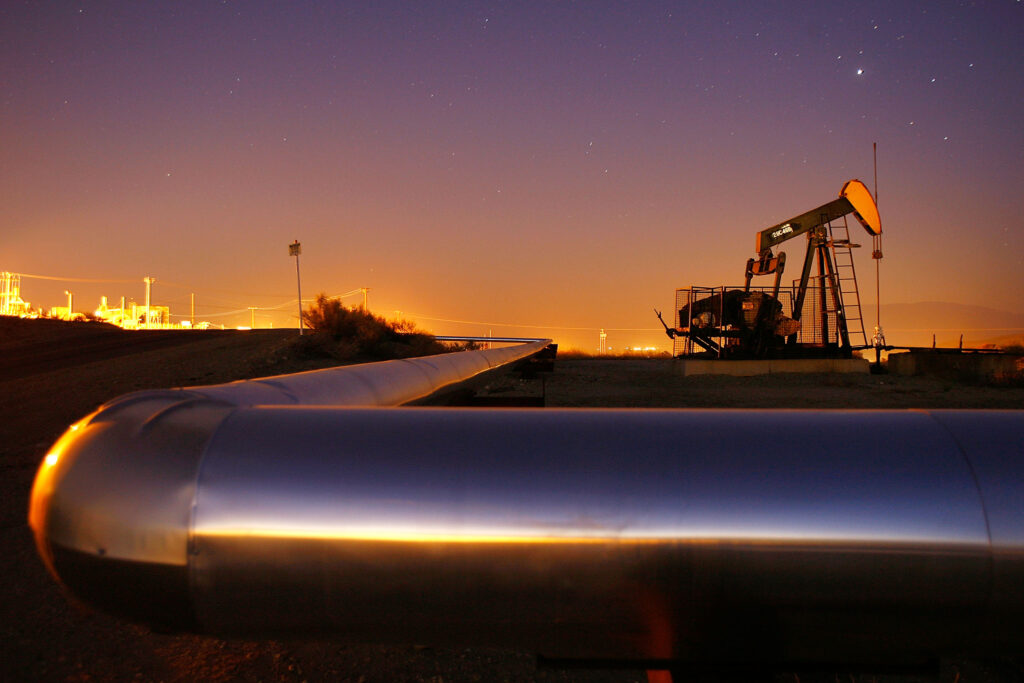
Asian markets tumbled Monday after an outsized US jobs report dealt another blow to hopes for more interest rate cuts, while oil extended a rally sparked by new sanctions on Russia’s energy sector.The equity sell-off tracked hefty losses on Wall Street, where all three main indexes finished more than one percent lower as the new trading year continued to falter.Keenly awaited data on Friday showed the US economy created 256,000 jobs last month, a jump from November’s revised 212,000 and smashing forecasts of 150,000-160,000.The figures followed news that the crucial US services sector picked up in December, with the prices component soaring more than expected to the highest level since last January, while another report showed job openings hit a six-month high in November.Hopes that the Federal Reserve will continue cutting rates through 2025 — having made three last year — were dashed when in December it indicated just two reductions over the next 12 months, down from four tipped previously.The hawkish pivot came as inflation continues to hover above the bank’s two percent target, while there are also concerns that president-elect Donald Trump’s plans to slash taxes, regulations and immigration will reignite prices.”Given a resilient labour market, we now think the Fed cutting cycle is over,” said Bank of America’s Aditya Bhave and other economists.”Inflation is stuck above target: in the December (summary of economic projections), the Fed not only marked up its base case for 2025 significantly, but also indicated that inflation risks were skewed to the upside. Economic activity is robust. “We see little reason for additional easing.”Equities fell across Asia, with Hong Kong, Taipei and Manila off more than one percent each, while Shanghai, Sydney, Singapore, Seoul and Jakarta were also well down. Tokyo was closed for a holiday.Surging oil prices added to unease, with both main contracts jumping around two percent — extending Friday’s gains of more than three percent — after the United States and Britain announced new sanctions against Russia’s energy sector, including oil giant Gazprom Neft.However, commentators do not expect prices to spike too much, even amid speculation that Trump will hit Iran with fresh sanctions.”A significant and perhaps underpriced risk to crude oil prices is the potential for supply to outstrip demand, especially given OPEC+’s intention to reintroduce barrels to the market,” said Stephen Innes at SPI Asset Management.”Even if US sanctions curtail Iranian oil production by 1.5 million barrels a day — a scenario similar to that during Trump’s previous presidency — this amount could easily be compensated by OPEC+, which is currently holding back 5.8 million barrels a day, or 5.3 percent of the total global production capacity.”However, he added that some issues could lead crude to rocket, including an escalation of the Middle East crisis, a significant reduction in Russian output or exports and a strategic about-face by OPEC+ to slash production.- Key figures around 0230 GMT -Hong Kong – Hang Seng Index: DOWN 1.6 percent at 18,765.65Shanghai – Composite: DOWN 0.3 percent at 3,157.92Tokyo – Nikkei 225: Closed for a holidayEuro/dollar: DOWN at $1.0241 from $1.0244 on FridayPound/dollar: DOWN at $1.2186 from $1.2210Dollar/yen: DOWN at 157.63 yen from 157.74 yenEuro/pound: UP at 84.04 pence from 83.90 penceWest Texas Intermediate: UP 2.0 percent at $78.06 per barrelBrent North Sea Crude: UP 1.8 percent at $81.17 per barrelNew York – Dow: DOWN 1.6 percent at 41,938.45 (close)London – FTSE 100: DOWN 0.9 percent at 8,248.49 (close)

Australian mum says son killed in LA fires as water ran out

An Australian mother has spoken of how she tried in vain to save her blind son from the Los Angeles wildfires as water supplies ran dry.Shelley Sykes, a TV production entrepreneur, told Australian media of a desperate battle to save her 32-year-old son Rory, who had cerebral palsy.Wind-fanned wildfires have killed at least 24 people in Los Angeles, consuming communities and destroying homes. Sykes said on social media that she and her son lived on a 6.8-hectare (17-acre) estate in Malibu, a beachside city in Los Angeles County. Rory Sykes, who appeared in British TV show “Kiddy Kapers” in the 1990s, had his own self-contained cottage on the estate, she said.Her son was blind and had difficulty walking.”Rory’s feet with the heat had started to swell, and he couldn’t walk very well. And he also had problems with his tummy. So he didn’t want to be far away from the bathroom,” Sykes told Australia’s Channel Nine on Sunday.”So he said, ‘Mum, you go, I’m staying’.”Sykes said she could not leave her son alone on the estate.”I stayed in the main property with my two peacocks in a bathroom because it was hard to breathe. Sitting on the floor with bottled water and trying to keep wet.”Sykes said she saw embers on the roof of her son’s cottage and tried to extinguish them with a hose, but “there was no water coming out”. – ‘Devastated’ -She then drove to the closest fire station seeking help, but was told they, too, had no access to water. Water hydrants in some Los Angeles neighbourhoods ran dry during the initial effort to fight the blazes, sparking widespread anger among residents. Authorities told the Los Angeles Times newspaper that the water shortages occurred because the scale and duration of the firefighting effort were more than the city’s infrastructure was designed for.When the fire department took Sykes back to her property, she found the cottage had been reduced to “just black ash”.”There was nothing there,” she told Channel Nine.Sykes — who shared her birthday with her son — said she was overwhelmed by his death.”I am just devastated, it is unreal at the moment. I cannot breathe.”Fire authorities said he died from carbon monoxide poisoning, Sykes said.The stricken mother said she had been unable to remove her son from the danger.”I’ve got a broken arm. I couldn’t lift him. I couldn’t move him,” she said in a separate interview with Australia’s Channel 10.Australia’s Department of Foreign Affairs and Trade said it was aware of reports that an Australian man had died and was engaging closely with local authorities. The department said it was providing consular assistance to the man’s family, but was unable to comment further citing “privacy obligations”. 

Fueling the Los Angeles fires: the Santa Ana winds

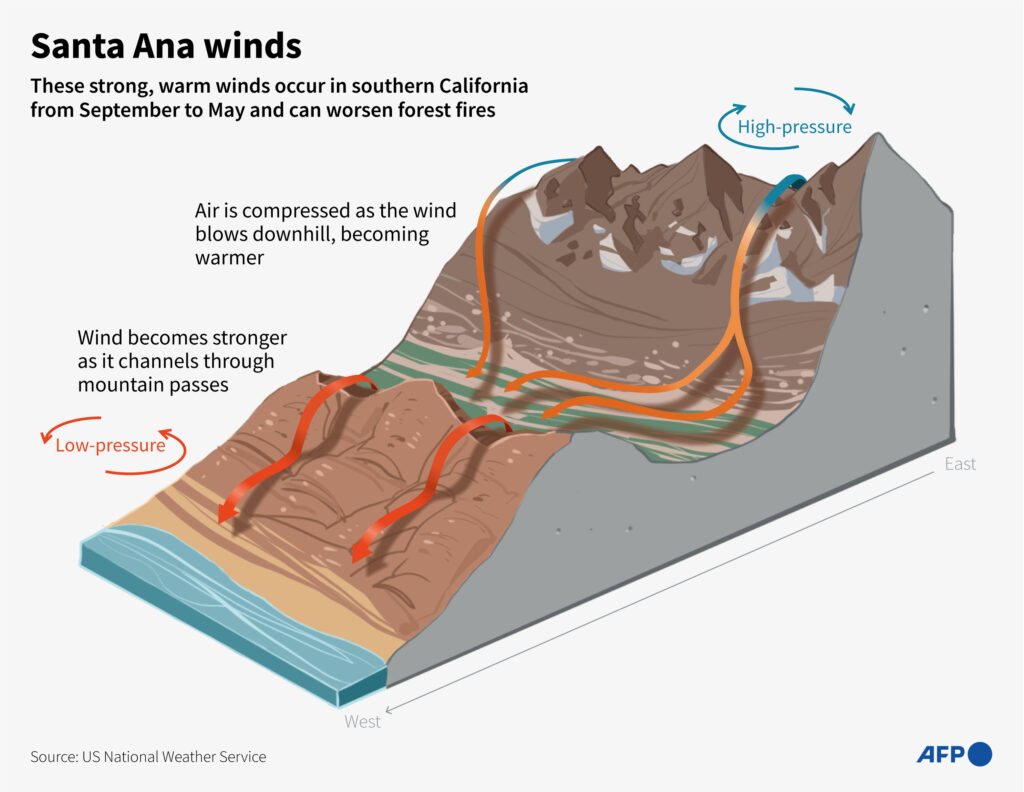
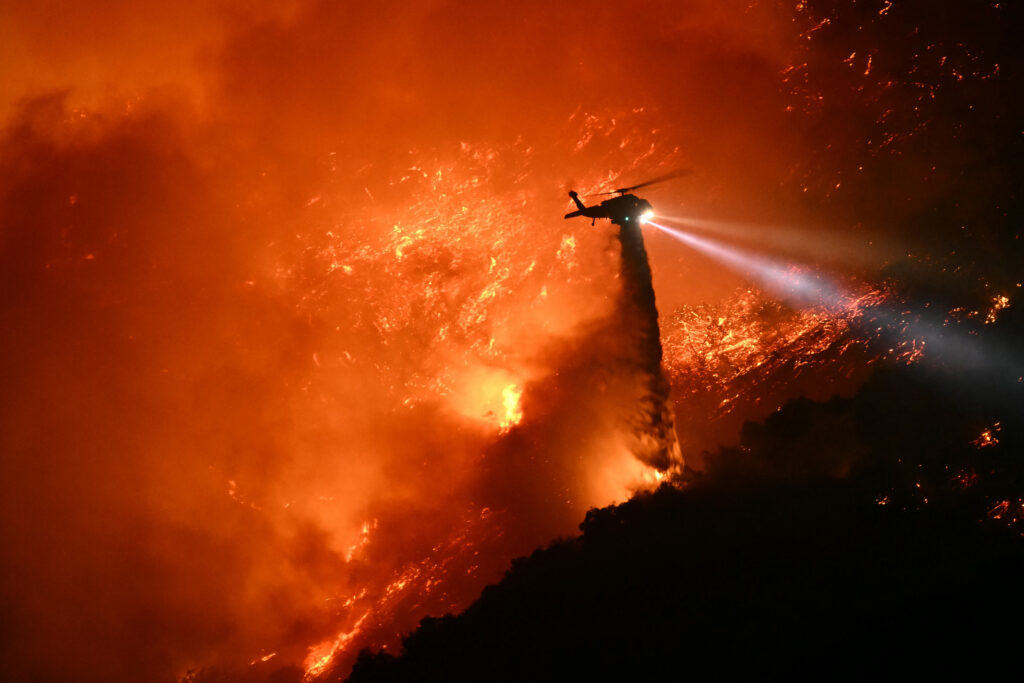
Helping drive the wildfires in the US city of Los Angeles are the so-called Santa Ana winds, a weather phenomenon known to dry out “the hills and the nerves to flash point.”The windstorms occur when cold air gathers in the neighboring states of Nevada and Utah. As it moves west and then rushes down California’s mountains, it heats up — and dries out.- Creating fuel, spreading fires -The Santa Anas can both create the conditions for deadly wildfires and fuel them once they are underway — drying out vegetation when they blow through, and then fanning blazes once they spark.As the 23,700-acre (9,500-hectare) Palisades Fire and 14,000-acre Eaton Fire have raged around Los Angeles, fast-moving winds have exacerbated the situation, throwing hot embers into new patches of dried brush.While firefighters sought to take advantage of a brief lull on Friday and Saturday, heavy winds were back with gusts up to 70 miles per hour (110 kilometers per hour) by Sunday, with harsh conditions forecast to continue this week.- Cold air, hot winds -Santa Ana winds usually occur between September and May, typically for a few days at a time.When a high-pressure system forms over the deserts to California’s east, it pushes air toward the Pacific coast.As they move down the Santa Ana and Sierra Nevada mountains and shoot through valleys, the winds compress — creating a rise in their temperature and a drop in their relative humidity.With hot, dry gusts that can knock down trees or kick up dust and particulate matter, the winds have long caused problems in southern California.The 2017 Thomas Fire, which destroyed more than 1,000 structures, was fueled in part by back-to-back Santa Ana winds.- Frayed nerves -The Washington Post likened the weather pattern to “a giant hair dryer,” and writers have long noted the effect the winds seem to have on residents psychologically.American author Raymond Chandler once described them as so hot they “curl your hair and make your nerves jump and your skin itch.” For Joan Didion, they blew “sandstorms out along Route 66, drying the hills and nerves to flash point.”

Ukraine’s Zelensky offers firefighters to Los Angeles

Ukrainian President Volodymyr Zelensky offered assistance to wildfire-ravaged Los Angeles, saying Ukraine’s firefighters can “help Americans save lives” as the city struggles to combat new blazes. Deadly infernos have ripped through Los Angeles, killing at least 24 people in less than a week, reducing whole communities to scorched rubble and leaving thousands without homes. Conditions could dramatically worsen in the United States’ second-largest city as strong gusts fan flames and whip up embers, with firefighters warning the blazes could move from existing burn zones into new areas.Zelensky said Sunday evening that he had instructed Ukraine’s minister of internal affairs “to prepare for the possible participation of our rescuers in combating the wildfires in California”. “The situation there is extremely difficult, and Ukrainians can help Americans save lives,” he said in a video posted on social media platform X, adding the aid is “currently being coordinated”. “150 of our firefighters are already prepared.”The United States under President Joe Biden has been Kyiv’s biggest wartime backer, providing military aid worth more than $65 billion since Moscow’s invasion in February 2022.Incoming president-elect Donald Trump has promised to resolve the conflict in “24 hours” once in office, raising fears in Ukraine that it will be forced to make major concessions in exchange for peace.

Blue Origin set for first launch of giant New Glenn rocket

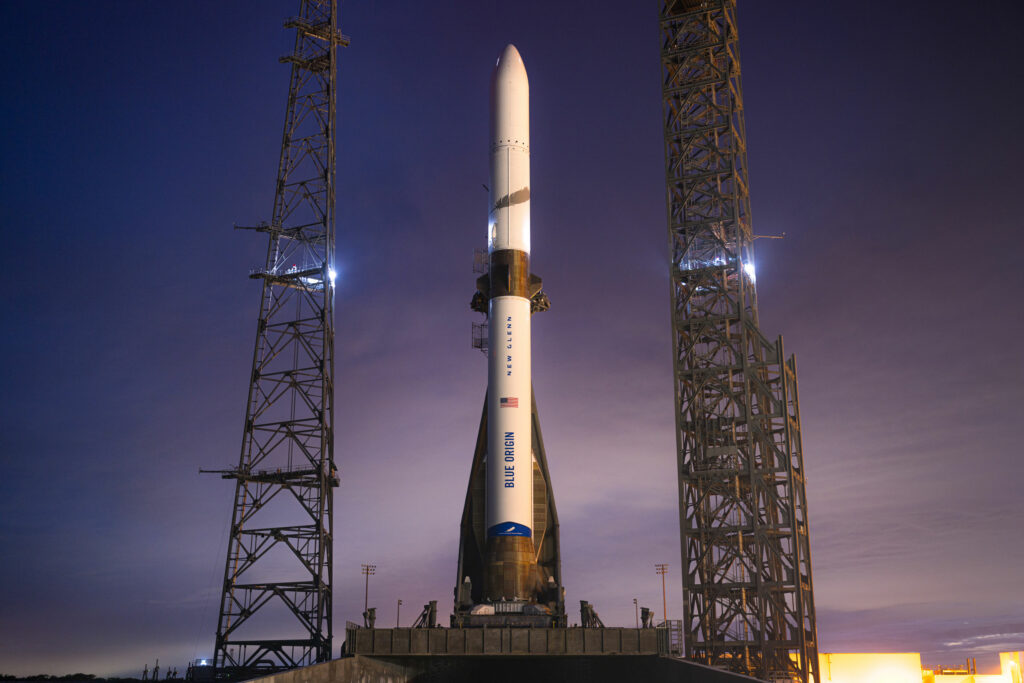
A quarter century after its founding, Jeff Bezos’s Blue Origin is finally ready for its maiden orbital voyage with a brand new rocket the company hopes will shake up the commercial space race. Named New Glenn after legendary astronaut John Glenn, it stands 320 feet (98 meters) tall, roughly equivalent to a 32-story building, and is set to blast off from Cape Canaveral Space Force Station in a launch window that opens at 1:00 am (0600 GMT) Monday.”Pointy end up!” the company’s CEO, Dave Limp posted on X alongside photos of the gleaming white behemoth.With the mission, dubbed NG-1, billionaire Amazon founder Bezos is taking aim at the only man in the world wealthier than him: Elon Musk, whose company SpaceX dominates the orbital launch market through its prolific Falcon 9 rockets, vital for the commercial sector, the Pentagon and NASA.”SpaceX has for the past several years been pretty much the only game in town, and so having a competitor… this is great,” G. Scott Hubbard, a retired senior NASA official, told AFP.SpaceX, meanwhile, is planning the next orbital test of Starship — its gargantuan new-generation rocket — this week, upping the high-stakes rivalry.- Landing attempt -Soon after launch, Blue Origin will attempt to land the first-stage booster on a drone ship named Jacklyn, in honor of Bezos’s mother, stationed about 620 miles (1,000 kilometers) downrange in the Atlantic Ocean. Though SpaceX has long made such landings a near-routine spectacle, this will be Blue Origin’s first shot at a touchdown on the high seas.Meanwhile, the rocket’s upper stage will fire its engines toward Earth orbit, reaching a maximum altitude of roughly 12,000 miles above the surface.A Defense Department-funded prototype spaceship called Blue Ring will remain aboard for the roughly six-hour test flight. Blue Origin has experience landing its New Shepard rockets — used for suborbital tourism — but they are much smaller and land on terra firma rather than a ship at sea.Physically, New Glenn dwarfs the 230-foot Falcon 9 and is designed for heavier payloads. It slots between Falcon 9 and its big sibling, Falcon Heavy, in terms of mass capacity but holds an edge with its wider payload fairing, capable of carrying the equivalent of 20 moving trucks.- Slow v fast development -Blue Origin has already secured a NASA contract to launch two Mars probes aboard New Glenn. The rocket will also support the deployment of Project Kuiper, a satellite internet constellation designed to compete with Starlink.For now, however, SpaceX maintains a commanding lead, while other rivals — United Launch Alliance, Arianespace, and Rocket Lab — trail far behind.Like Musk, Bezos has a lifelong passion for space. But whereas Musk dreams of colonizing Mars, Bezos envisions shifting heavy industry off-planet onto floating space platforms in order to preserve Earth, “humanity’s blue origin.”He founded Blue Origin in 2000 — two years before Musk created SpaceX — but has adopted a more cautious pace, in contrast to his rival’s “fail fast, learn fast” philosophy.If New Glenn succeeds, it will give the US government “dissimilar redundancy” — valuable backup if one system fails, said Scott Pace, a space policy analyst at George Washington University.Musk’s closeness to President-elect Donald Trump has raised concerns about potential conflicts of interest, especially with private astronaut Jared Isaacman — a business associate of Musk — slated to become the next NASA chief.Bezos, however, has been making his own overtures, paying respect to his former foe during a visit to Trump’s Mar-a-Lago residence, while Amazon has said it would donate $1 million to the inauguration committee.