SpaceX set for seventh test of Starship megarocket

Elon Musk’s SpaceX is gearing up for the seventh orbital flight test of Starship, the colossal prototype rocket the company hopes will help humans colonize Mars.A launch window from the company’s Starbase in Boca Chica, Texas, opens at 4:00 pm (2200 GMT) Wednesday and will be carried in a live webcast on Musk’s X platform.Space enthusiasts will be eager to see if SpaceX can replicate the stunning feat of catching the first-stage Super Heavy booster in the launch tower’s “chopstick” arms during descent, approximately seven minutes after liftoff.The maneuver was successfully achieved in October but not during the following flight in November, when President-elect Donald Trump joined Musk to witness the test from mission control.Instead, Super Heavy made a more subdued splashdown in the Gulf of Mexico. This time around, SpaceX announced it had implemented “hardware upgrades to the launch and catch tower to increase reliability for booster catch,” including enhancements to sensor protections on the chopsticks that were damaged during the launch, causing the booster’s offshore diversion.Starship has also undergone several design refinements. Its latest iteration now stands at 403 feet (123 meters) tall, slightly taller than previous versions and roughly 100 feet higher than the Statue of Liberty.Upgrades include a redesigned upper-stage propulsion system capable of carrying 25 percent more propellant, along with modifications to the forward flaps. The flaps have been reduced in size and repositioned to reduce their exposure to intense heat during atmospheric reentry.For the first time, Starship will deploy a payload: 10 Starlink simulators, comparable in size and weight to the company’s internet satellites. Both the simulators and Starship’s upper stage are set to splash down in the Indian Ocean about an hour after launch.- Betting on Starship -SpaceX already dominates the orbital launch market with its Falcon 9 and Falcon Heavy rockets, which serve commercial clients, NASA and the Pentagon.But the company has made it clear it sees Starship as its future, with Chief Operating Officer Gwynne Shotwell recently indicating it would succeed the Falcon rockets around the turn of the next decade. Designed to be fully reusable, Starship’s test flights currently cost around $90 million, according to analytical group Payload Research, though Musk has expressed confidence in eventually reducing that figure to as low as $10 million per launch.The first three test flights ended in dramatic explosions, resulting in the loss of vehicles. However, SpaceX has rapidly iterated on its design, reflecting its “fail fast, learn fast” philosophy.Musk is aiming to drastically ramp up the frequency of tests, requesting permission from the Federal Aviation Administration to carry out 25 in 2025.The FAA is currently holding public meetings over the issue. Critics have accused the company of causing environmental harms, including disruption to nearby ecologically sensitive areas and alleged violations of wastewater regulations at the launch site.But with Musk now part of Trump’s inner circle, the billionaire could find a more favorable regulatory landscape under the incoming administration.

Mozambique inaugurates new president amid deadly unrestWed, 15 Jan 2025 06:18:07 GMT

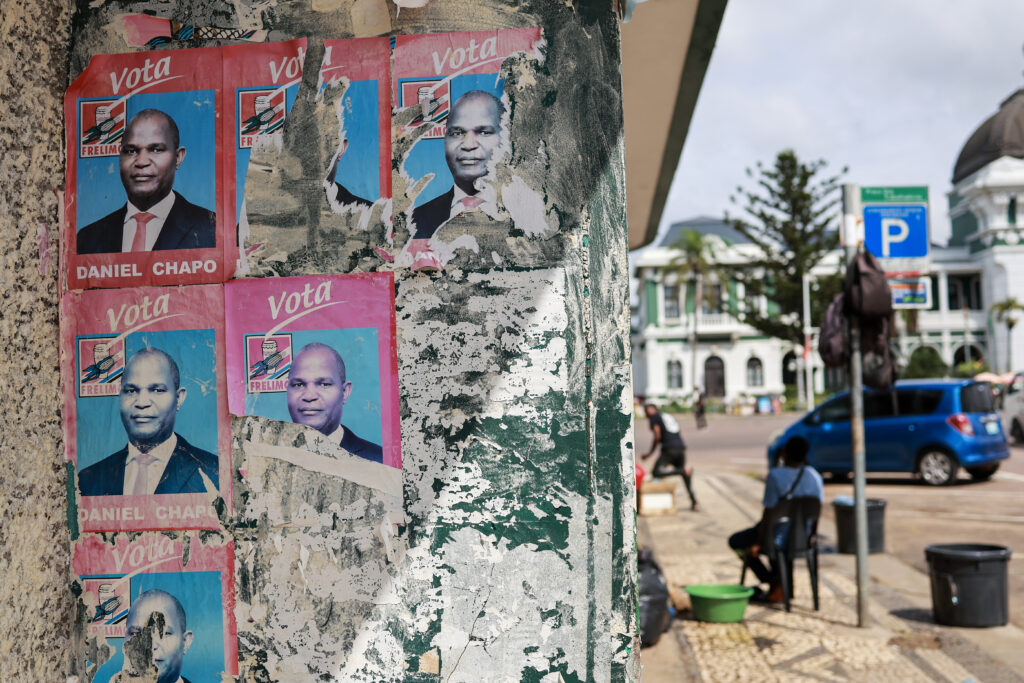
Mozambique President-elect Daniel Chapo will be sworn into office Wednesday after weeks of deadly political unrest but the main opposition leader has vowed to “paralyse” the country with fresh protests against the fiercely disputed election result.Venancio Mondlane had already called for a national strike in the days leading up to the inauguration and threatened on Tuesday …

Mozambique inaugurates new president amid deadly unrestWed, 15 Jan 2025 06:18:07 GMT Read More »

Pakistan’s Imran Khan defiant even as longer sentence looms

Imran Khan, Pakistan’s most popular politician, is facing a 14-year prison term this month in a case his party says is being used to pressure him into silence.The former prime minister, long a source of frustration for the powerful military, has been in custody since August 2023 and faces a slew of legal cases he says are politically motivated.A looming verdict for graft linked to a welfare foundation he set up with his wife, the Al-Qadir Trust, is the longest-running of those cases, with a verdict postponed on Monday for a third time.”The Al-Qadir Trust case, like previous cases, is being dragged on only to pressure me,” Khan said this month in one of his frequent statements railing against authorities and posted on social media by his team.”But I demand its immediate resolution.”Analysts say the military establishment is using the sentence as a bargaining chip with Khan, whose popularity undermines a shaky coalition government that kept his party from power in elections last year.”The establishment’s deal is he comes out and stays quiet, stays decent, until the next election,” said Ayesha Siddiqa, a London-based author and analyst on Pakistan’s military.- ‘Politically motivated’ -Analysts say the military are Pakistan’s kingmakers, although the generals deny interfering in politics.Khan said he had once been offered a three-year exile abroad and was also “indirectly approached” recently about the possibility of house arrest at his sprawling home on the outskirts of the capital. “We can assume from the delays that this is a politically motivated judgement. It is a Damocles sword over him,” Khan’s legal adviser Faisal Fareed Chaudhry told AFP.”The case has lost its credibility,” he said, adding that Khan will not accept any deal to stay silent.Khan has been convicted and sentenced four times in other cases Two cases have been overturned by the Supreme Court, while judges have suspended the sentences from the other two.The specialist anti-graft “accountability court” is set to announce the verdict and sentence in the welfare foundation case on Friday, two days after government envoys are scheduled to meet leaders from Khan’s Pakistan Tehreek-e-Insaf (PTI) party to ease tensions.The PTI has previously sworn to refuse talks with a government its leaders claim is illegitimate, alleging the coalition seized power by rigging February 2024 polls.They say they will only take part if political prisoners are released and an independent inquiry is launched into allegations of a heavy-handed response by authorities to PTI protests.Otherwise, Khan has threatened to pull his party from the negotiations and continue with a campaign of civil disobedience that has frequently brought Islamabad to a standstill.The most recent protests flared around November 26, when the PTI allege at least 10 of their activists were shot dead. The government says five security force members were killed in the chaos.”The government would like to appear legitimate, and for that they need PTI to sit down in talks with them,” said Asma Faiz, associate professor of political science at Lahore University of Management Sciences.”Ideally, they would be looking to offer some relief to Imran Khan and his party to appease the domestic and international criticism,” she told AFP.- ‘PTI won’t budge’ -For now, it appears to be a stalemate, said Michael Kugelman, South Asia Institute director at The Wilson Center in Washington.”The army might be willing to give Khan a deal that gets him out of jail, but Khan wouldn’t accept the likely conditions of his freedom,” he told AFP.”Another problem is I can’t imagine the government agreeing to an investigation of November 26. But PTI won’t budge on that demand.”A stint in exile is common in the trajectory of political leaders in Pakistan who fall out of favour with the military and find themselves before the courts, only to return to power later.Three-time prime minister Nawaz Sharif served only a fraction of a sentence for corruption, spending several years in London before returning to Pakistan in late 2023.Former and current president Asif Ali Zardari moved to Dubai after his party was rebuked by the generals.Both men are now considered the chief architects of the ruling coalition.But exile might not fit with the carefully worked image of Khan, whose political rise was based on the promise of replacing decades of entrenched dynastic politics.”I will live and die in Pakistan,” Khan said in a statement shared by his lawyers. “I will fight for my country’s freedom until my last breath, and I expect my nation to do the same.”

Bangladesh’s Yunus demands return of stolen billions

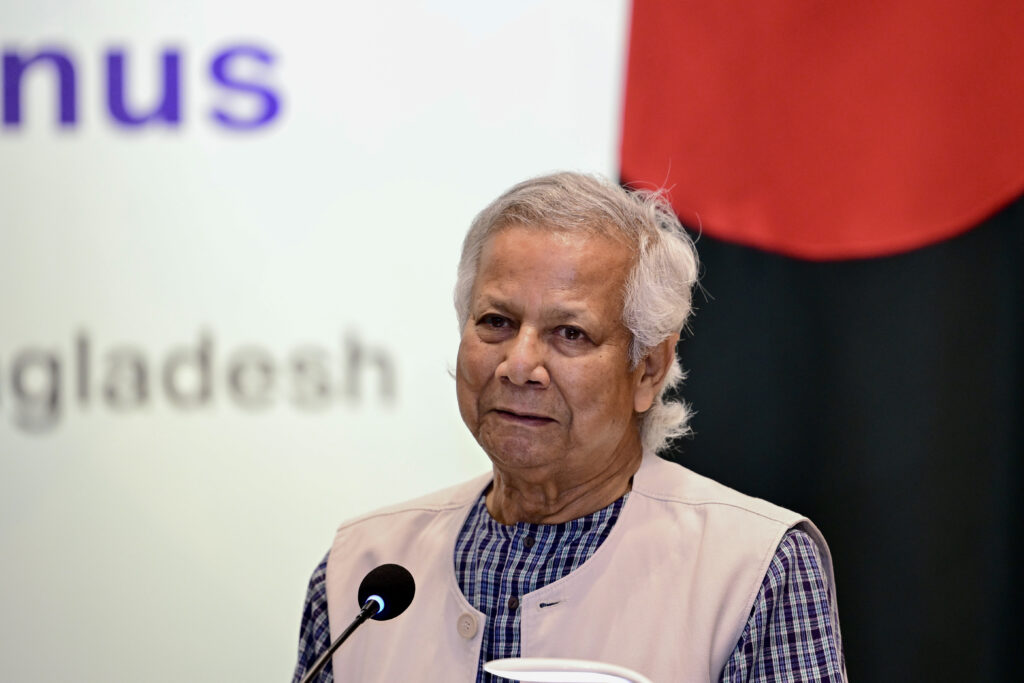
Bangladesh’s interim leader Muhammad Yunus on Wednesday demanded the return of stolen assets, decrying the scale of corruption under the ousted government of Sheikh Hasina, toppled by a revolution last year.Hasina, 77, fled a revolution in August 2024 to neighbouring India, where she has defied extradition requests from Bangladesh to face charges including mass murder.”The theft of billions of dollars in public funds has left Bangladesh with a significant financial deficit,” Yunus said in a statement.”The funds stolen from Bangladesh belong to its people. We will continue to work with our international partners to ensure that justice is done.”Yunus said he expected “assets to be returned”, adding that the stolen funds have “not only robbed the people of Bangladesh, but also disrupted the country’s progress toward economic stability”.Bangladesh’s Anti-Corruption Commission (ACC) is investigating Hasina and her wider family, including her niece, British lawmaker and anti-corruption minister Tulip Siddiq.Siddiq on Tuesday resigned from her position, but repeated her denial that she had done anything wrong.The ACC’s probe of Hasina’s family is linked to the embezzlement of $5 billion connected to a Russian-funded nuclear power plant, as well as an alleged land grab of lucrative plots in a suburb of the capital Dhaka.A British Sunday Times investigation revealed details about the claims Siddiq spent years living in a London flat bought by an offshore company connected to two Bangladeshi businessmen.The flat was eventually transferred as a gift to a Bangladeshi lawyer with links to Hasina, her family and her ousted government, according to the newspaper.It also reported Siddiq and her family were given or used several other London properties bought by members or associates of Hasina’s Awami League party.”Tulip Siddiq may not have fully understood the origins of the money and properties she enjoyed in London,” Yunus said.”However, now that she knows, she should seek forgiveness from the people of Bangladesh.”

Comment le monde a découvert l’existence des camps de la mort nazis

A la fin de la Seconde guerre mondiale, la libération des premiers camps de la mort nazis a peu de retentissement. Mais les images de ce que les Alliés y découvrent, d’abord censurées, vont faire prendre conscience au monde de l’horreur de la Shoah.La libération des camps de concentration et d’extermination nazis intervient dans le sillage de l’avancée vers Berlin des armées alliées.Le premier camp majeur découvert est, le 24 juillet 1944, celui de Majdanek (dans la banlieue de Lublin, Pologne), libéré par l’Armée rouge. Les derniers le sont le 9 mai 1945, au lendemain de la capitulation allemande, avec la libération de Theresienstadt (ou Terezin en tchèque) au nord de Prague et de Stutthof, près de l’actuelle ville de Gdansk (Pologne).Dès le mois de juin 1944, le Reichsführer-SS Heinrich Himmler avait ordonné l’évacuation des camps avant l’arrivée des Alliés et le transfert des détenus vers d’autres camps.L’ordre concernait en premier lieu les camps situés dans les pays baltes, menacés par l’avancée de l’Armée rouge. Avant de prendre la fuite, les officiers SS avaient pour consigne d’effacer les traces de leurs crimes.Ainsi la libération par l’Armée rouge d’Auschwitz-Birkenau (en Pologne occupée), le 27 janvier 1945, a-t-elle été précédée par la dissolution progressive du complexe à partir de l’été 1944 et par l’évacuation de plus de 60.000 détenus.Lorsque les Soviétiques arrivent, ils ne découvrent que quelque 7.000 prisonniers qui avaient été incapables de marcher et de suivre leurs camarades dans les “Marches de la mort”.- La censure, puis le choc -La découverte des premiers camps n’a guère de retentissement auprès du grand public. Des commissions d’enquête russes et polonaises prennent bien des photos à Majdanek et à Auschwitz et les services photographiques de l’armée américaine réalisent un reportage sur le Struthof, seul camp de concentration nazi situé sur le territoire français actuel.Mais les images ne sont pas diffusées auprès du grand public.En France en particulier, les autorités ne veulent pas alarmer les familles sur le sort des “absents” (déportés, prisonniers de guerre, requis du travail obligatoire).Un véritable tournant dans le traitement médiatique intervient le 6 avril 1945 avec la découverte du camp d’Ohrdruf, une annexe de Buchenwald (Allemagne). Quand les Américains, accompagnés du correspondant de guerre Meyer Levin et du photographe français de l’AFP Eric Schwab, y pénètrent, ils voient les brasiers encore fumants, les prisonniers décharnés exécutés d’une balle dans la tête.Le 12 avril, une visite officielle d’Ohrdruf est organisée pour les généraux Patton, Bradley et Eisenhower. “Je n’ai jamais de ma vie éprouvé un choc aussi profond”, dit ce dernier. Leur décision est immédiate: “Toute censure doit sauter”.Le soir même, le quotidien français Ce Soir publiera à sa Une la réaction du général Patton – “Plus de pitié pour les bourreaux” – et l’image d’un charnier.

Vigilante fire clean-up launched by local Los Angeles contractor

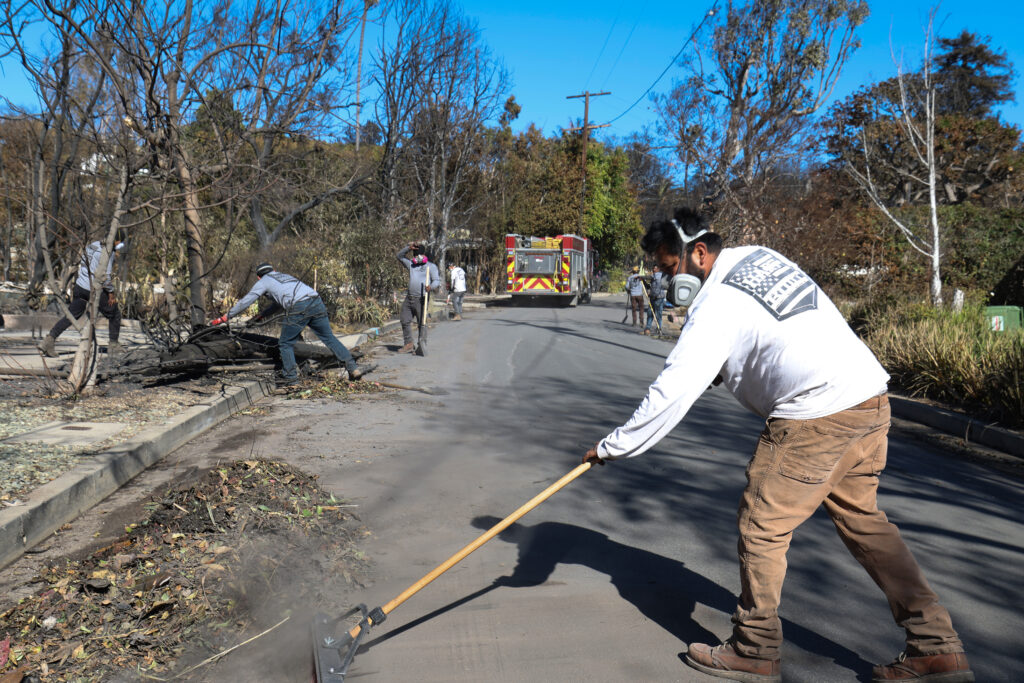
The deadly Palisades fire is still raging in Los Angeles, but Chuck Hart and his construction crew are already several days into their self-appointed mission to clean up and rebuild their shattered community.”We never left,” said the local contractor, taking a brief pause from shouting directions to his army of workers, as they shovel  scorched debris from the roads and sidewalks into giant pickup trucks and trailers.”We’re going to do everything we can to get this place back up and running as quickly as possible.”At least eight people died in the Palisades fire alone, of 25 across Los Angeles. It razed entire blocks of this upscale neighborhood, and left much more shrouded in an unlivable carnage of ash, mud and collapsed structures.Hart and his team of employees are not being paid or contracted by officials to do this clean-up work.In fact, they are not technically even meant to be here. Due to roadblocks barring entry to Pacific Palisades, they cannot leave because they would not be able to re-enter, and they are “having to sneak in materials and supplies” in order to carry out their work.”We’re staying at my house. We’re sleeping on the floors, on my jiu jitsu mats, couches, beds… no hot water, cold shower, 31 dudes — it’s gnarly,” he said.When the fire broke out, Hart and his crew were working on a construction site within the neighborhood.Hearing that his mother’s house was close to encroaching flames, Hart told his team to “stop everything you’re doing,” and rallied them to protect her property with hoses.”We just rock-and-rolled,” he said.”We were fighting fires. And then we went round all the houses… cleaning debris up out of the streets. “We’ve just been doing that non-stop ever since.”- ‘Vouched for me’ -As far as Hart is aware, nobody else has begun clearing up Pacific Palisades.So far, his team are not touching any private property, focusing on roads and sidewalks.He appears to have the tacit approval of the police and fire officials who regularly circle the streets, checking for smoldering hotspots or looters. A local fire station even shared their meals with his workers. “People in this community that know me really well, that know the higher ups, have vouched for me 100 percent,” he said.For the first few days, he paid his crew out of his own pocket, but has now launched a GoFundMe, which has so far raised $170,000.Still, Hart said convincing his crew to stay was never an issue, many of whom “are like family” and have worked for him for as long as 25 years.”I stayed to protect the area where I work, and also save the company, because that’s where my employer’s house is,” said Raul Lopez Acosta.While the Palisades’ affluent residents might “have the money” to rebuild, “there are many things besides the construction — many memories, feelings, people, who have been living here for two or three generations,” he said. With no access to waste disposal sites to dump the mountains of debris, Hart and his team have “hi-jacked” a neighbor’s lot that had already been totally wiped out by the fire.He has not been able to make contact with the owner to ask permission, but intends to haul out the rubble as soon as the roads are opened.And in any case, he is confident that they will understand, given the extraordinary circumstances.”We’ll get it straightened out. It’s an emergency,” he said.- ‘Uniquely positioned’ -Hart is adamant that Pacific Palisades — where his great-grandparents first settled — will rebuild. He believes that many fellow residents are itching to return and help, but are currently being slowed down by bureaucracy.Officials have warned that the area could reignite, along with other dangers such as downed power lines, and has no safe water or electricity.Jackie Irwin, who represents the Palisades in California’s state assembly, said Tuesday that the official debris cleanup would be “done as quickly as possible.”But Hart does not want to wait — particularly with his construction company’s resources, from dump trucks and trailers to skid steers and grapple buckets, so readily at hand.”I am uniquely positioned to be of maximum service to my community, and I’m going to do it,” he said.”I got all the trucks. I got all the equipment. I got the guys.”Is there anything more he would like?”I really wish we could go home and take a hot shower.”

A close-up of a stack of newspapers resting on a desk, symbolizing information and media.

Pas de répit dans les incendies à Los Angeles, où le vent souffle

Los Angeles ne connaît pas de répit: des vents chauds et puissants continuent de souffler dans la nuit de mardi à mercredi et d’attiser plus encore les flammes qui défigurent la deuxième ville des Etats-Unis depuis une semaine et ont fait au moins 25 morts.Les services de météo américains (NWS) ont mis en garde contre des rafales pouvant atteindre les 110 km/h entre 03H00 du matin (11H00 GMT) et 15H00 (23h00 GMT) mercredi.Des parties du comté de Los Angeles et de celui — voisin — de Ventura ont été placées en statut de “situation particulièrement dangereuse”.Le taux d’humidité, très faible, et la végétation, très sèche, peuvent conduire à une “expansion ultrarapide du feu” dans certaines zones, mettent en garde les météorologues, qui ont aussi placé une grande partie du sud de la Californie en alerte rouge.Les dégâts sont immenses: plus de 12.000 habitations, bâtiments et véhicules ont été détruits ou endommagés, et des quartiers entiers rasés. Quelque 88.000 personnes sont toujours déplacées et au moins 25 décédées, selon un nouveau bilan.Refusant de quitter le complexe d’appartements qu’il gère à Pacific Palisades, Jeff Ridgway a expliqué à l’AFP l’avoir préservé des flammes en puisant des seaux d’eau dans la piscine pour éteindre un eucalyptus dangereusement proche.”C’était la guerre”, a raconté ce sexagénaire. “Mais j’étais têtu, je me suis battu”.Fred Busche, un autre habitant, a eu moins de chance. “Ma maison a brûlé, je le sais. J’ai vu des photos: il ne reste que la cheminée. Mais j’ai besoin de le voir de mes propres yeux pour y croire”, a-t-il confié à l’AFP.- “Tout va bien se passer” -Les deux principaux incendies ont parcouru 9.700 hectares dans le quartier huppé de Pacific Palisades, et plus de 5.700 dans la ville d’Altadena, juste au nord de Los Angeles.Une enquête visant à déterminer les causes des incendies a été lancée mardi par les autorités fédérales, qui ont toutefois averti que cela prendrait du temps. “Nous savons que vous voulez des réponses, (vous) le méritez. L’ATF vous donnera (des) réponses une fois l’enquête terminée et approfondie”, a déclaré Jose Medina, représentant cette agence en charge notamment des explosifs et des armes.Depuis des jours, des équipes accompagnées de chiens recherchent des victimes dans les ruines. Lundi, 1.800 habitations ont été inspectées, selon le shérif du comté de Los Angeles, Robert Luna. “La bonne nouvelle c’est que n’avons trouvé aucun corps”, a-t-il indiqué. Ces incendies, parmi les pires de l’histoire de la Californie, pourraient être les plus coûteux jamais connus: entre 250 et 275 milliards de dollars selon les estimations provisoires de la société privée AccuWeather. Des centaines de milliers d’enfants ont repris l’école lundi, mais les établissements scolaires situés dans les zones évacuées restent fermés.Au total, des milliers de pompiers sont à pied d’oeuvre. Des renforts humains et matériels, dont des dizaines de camions citernes, ont été acheminés.Ils ont été mobilisés notamment sur un nouveau foyer qui s’est déclenché tard lundi, à Oxnard, à 80 km de Los Angeles.- “Poussière fine” -Après des problèmes pour combattre les flammes dans le secteur de Pacific Palisades en raison de bouches d’incendie à sec ou avec une faible pression, qui ont notamment entraîné des critiques sur la gestion des feux, le chef des pompiers Anthony Marrone a assuré mardi qu’il y avait bien de “l’eau et de la pression” dans le secteur d’Altadena.Cible de ces critiques, venant notamment du prochain président républicain des Etats-Unis Donald Trump, le gouverneur démocrate de Californie Gavin Newsom a demandé “un examen indépendant complet” des services de distribution d’eau de Los Angeles.Il a par ailleurs ordonné mardi aux équipes de déblayage de se tenir prêtes à intervenir, les autorités craignant que des orages hivernaux ne provoquent des coulées de boue.Le services de santé ont par ailleurs alerté sur les risques sanitaires liés aux fumées et aux cendres générées par les brasiers et déplacées par les vents.”Les cendres ne sont pas que de la saleté. C’est de la poussière fine qui peut irriter ou endommager votre système respiratoire et d’autres parties de votre corps”, a prévenu Anish Mahajan, du service de santé publique du comté. Les autorités ont appelé la population à porter un masque.Les vents de Santa Ana, qui ont attisé les flammes à une vitesse folle, sont un classique des automnes et des hivers californiens. Mais ils ont atteint cette fois une intensité inédite depuis 2011, selon les météorologues, avec des rafales soufflant jusqu’à 160 km/h la semaine passée.De quoi propager le feu à la vitesse de l’éclair, d’autant que deux années très pluvieuses avaient fait naître une végétation luxuriante, qui s’est ensuite desséchée au cours de huit mois sans précipitation.Les scientifiques rappellent régulièrement que le changement climatique augmente la fréquence des événements météorologiques extrêmes.