La Chine envoie un nouvel équipage de trois astronautes sur sa station spatiale

Le vaisseau spatial Shanzhou-21 avec trois astronautes à bord s’est arrimé à la station spatiale chinoise Tiangong moins de quatre heures après avoir été propulsé vendredi par la fusée Longue Marche-2F depuis un pas du nord-ouest du pays.L’arrimage a eu lieu à 19H22 GMT, selon l’agence publique Chine NouvelleL’engin avait décollé depuis le centre de lancement de satellites de Jiuquan, situé dans une zone désertique du nord-ouest de la Chine, à 23H44 locales (15H44 GMT).Les trois astronautes de Shenzhou-21 doivent remplacer l’équipage actuel de Shenzhou-20, qui rentrera sur Terre d’ici quelques jours. Leur mission durera six mois et vise notamment à mener des expériences scientifiques.Ils doivent également effectuer des sorties dans l’espace et installer des boucliers anti-débris à l’extérieur de Tiangong.L’ingénieur Wu Fei, tout juste 32 ans, est en passe de devenir le plus jeune astronaute chinois à partir en mission dans l’espace. Il s’est dit jeudi devant la presse “incroyablement chanceux” de participer à l’aventure.L’équipage sera dirigé par le pilote Zhang Lu, 48 ans, qui avait déjà participé à la mission Shenzhou-15. Ils seront épaulés par Zhang Hongzhang, spécialiste de charge utile et âgé de 39 ans.- Quatre souris -Quatre souris — deux mâles et deux femelles — font également partie du voyage et serviront pour les premières expériences menées en orbite par la Chine sur des rongeurs.Avant leur départ, les astronautes, vêtus de leurs combinaisons blanches, avaient été salués par leurs collègues et leurs familles dans les rues du centre de lancement, construit en plein désert et aux airs de petite ville, avec restaurants, immeubles d’habitation et écoles.La Chine a considérablement développé ses programmes spatiaux depuis une trentaine d’années, injectant des milliards d’euros dans ce secteur afin d’arriver au niveau des Etats-Unis, de la Russie ou de l’Europe.Tiangong en est un projet emblématique. La construction de la station a été achevée en 2022 et elle devrait être opérationnelle au total pendant au moins dix ans. – “Tests cruciaux” -Devenue une puissance de l’espace, la Chine avait posé en 2019 un engin spatial (la sonde Chang’e-4) sur la face cachée de la Lune, une première mondiale. Elle avait aussi fait atterrir en 2021 un petit robot sur Mars.L’agence chinoise chargée des vols habitées, la CMSA, a assuré jeudi à la presse qu’elle “maintenait fermement” l’objectif d’envoyer des humains sur la Lune d’ici 2030.Une série de “tests cruciaux” seront menés à cet égard, notamment sur un atterrisseur lunaire et un vaisseau spatial habité, a-t-elle indiqué.Durant leur séjour, les astronautes de Shenzhou-21 devraient également mener des activités de vulgarisation scientifique afin de promouvoir l’intérêt du public pour l’exploration spatiale.La Chine est formellement exclue de la Station spatiale internationale (ISS) depuis 2011, date à laquelle les Etats-Unis ont interdit à la Nasa de collaborer avec Pékin. Cela a poussé le géant asiatique à développer son propre projet de station spatiale.

Thousands gather to urge closure of Tunisia chemical plantFri, 31 Oct 2025 21:16:23 GMT

Thousands of demonstrators gathered in Gabes in southern Tunisia on Friday, calling for the closure of facilities at an ageing chemical factory blamed for hundreds of cases of poisoning.Anger has reignited in the city over pollution from the plant and its toll on residents’ health, while authorities push to expand the output of fertiliser, produced …

Thousands gather to urge closure of Tunisia chemical plantFri, 31 Oct 2025 21:16:23 GMT Read More »

Thousands gather to urge closure of Tunisia chemical plant

Thousands of demonstrators gathered in Gabes in southern Tunisia on Friday, calling for the closure of facilities at an ageing chemical factory blamed for hundreds of cases of poisoning.Anger has reignited in the city over pollution from the plant and its toll on residents’ health, while authorities push to expand the output of fertiliser, produced at the complex, to boost Tunisia’s struggling economy.Videos circulating online of children with apparent breathing issues prompted tens of thousands of people to take to the streets in Gabes on October 21 in an unprecedented mobilisation, according to activists.Protesters were out again in force on Friday.”The people demand the dismantling of polluting units,” chanted demonstrators marching towards the Tunisian Chemical Group (GCT) complex, carrying placards reading “Deserve to Breathe”.Khayreddine Debaya, coordinator of Stop Pollution, an NGO working for decades in Gabes, said: “The people have decided — these units must be dismantled as soon as possible.”One resident, Hassani Essouai, said protestors wanted to see a “total dismantling” of the site rather than “repairs or renovation”.Another local, Abderrazak Ounis, said: “No official is responding to our demands. Even still, the smoke is getting worse every day.”The plant, inaugurated in 1972, processes phosphate to make fertilisers, and some of the gases and waste it discharges into the open air and the Mediterranean are radioactive and can cause cancer, researchers have found.Production also emits sulfur gases, nitrogen, and fluorine, according to an audit carried out in July 2025 for the African Development Bank, which reported “major non-compliance” in terms of air and marine pollution.Various studies have highlighted a loss of more than 90 percent of marine biodiversity in the Gulf of Gabes.Doctors and local residents report a higher incidence of respiratory diseases and cancers than elsewhere in Tunisia.Tunisian President Kais Saied recently said he “shares the pain and aspirations” of the city’s inhabitants, promising solutions and that “every Tunisian will soon breathe clean air, free from all forms of pollution”.Authorities have been caught between efforts to develop the strategic sector and a 2017 promise to gradually close the Gabes plant.Equipment Minister Salah Zouari recently announced the implementation of “urgent measures” within “three to six months” after Chinese companies were appointed “to deal with gas emissions”.The GCT did not respond to requests for comment from AFP.According to several experts, the rehabilitation of polluting units, planned more than 15 years ago, remains possible but costly in a country with a debt level of around 80 percent of GDP.

Trump says Christians in Nigeria face ‘existential threat’Fri, 31 Oct 2025 21:15:38 GMT

US President Donald Trump said Friday that Christians in Nigeria face an “existential threat,” as right-wing political allies including Senator Ted Cruz push claims of “Christian mass murder” that experts say are false.Narratives of “Christian genocide” and “persecution” in Nigeria have been bubbling up on social media in recent months, finding purchase among the American …

Trump says Christians in Nigeria face ‘existential threat’Fri, 31 Oct 2025 21:15:38 GMT Read More »

Trump says Christians in Nigeria face ‘existential threat’

US President Donald Trump said Friday that Christians in Nigeria face an “existential threat,” as right-wing political allies including Senator Ted Cruz push claims of “Christian mass murder” that experts say are false.Narratives of “Christian genocide” and “persecution” in Nigeria have been bubbling up on social media in recent months, finding purchase among the American and European far right.Africa’s most populous country is embroiled in numerous conflicts that experts say have killed both Christians and Muslims without distinction.But according to Trump, “Christianity is facing an existential threat in Nigeria.””Thousands of Christians are being killed. Radical Islamists are responsible for this mass slaughter,” he said in a post on his Truth Social platform, without providing evidence to support his claims.Trump said he is naming Nigeria a “country of particular concern” — a State Department designation for nations “engaged in severe violations of religious freedom.”Claims of Christian persecution have also been pushed by some in Nigeria, where ethnic, religious and regional divisions have flared with deadly consequences in the past and still shape the country’s modern politics.Nigeria is almost evenly divided between a Muslim-majority north and largely Christian south.Its northeast has been in the grip of jihadist violence for more than 15 years by the Islamist Boko Haram group, which has claimed more than 40,000 lives and forced two million people from their homes.The northwest is rife with gangs known as “bandits” who attack villages, killing and kidnapping residents.Central Nigeria sees frequent clashes between mostly Muslim herders and mainly Christian farmers — giving the violence there an air of religious tension, in a region that has seen sectarian violence in the past.Experts say the conflict is primarily over land, which is being squeezed by expanding populations and climate change.- ‘Indiscriminate’ violence -Massad Boulos, Trump’s senior advisor for Arab and African affairs, said in mid-October that “Boko Haram and Islamic State “are killing more Muslims than Christians.”Ladd Serwat, a senior Africa analyst at the US-based monitoring group Armed Conflict Location and Event Data (ACLED), told AFP that jihadist violence in Nigeria is “indiscriminate.”According to ACLED data, 52,915 civilians have been killed through targeted political killings since 2009, including those carried out by Boko Haram, Islamic State West Africa Province, “ethnic/communal militias in the central and northern regions, violence by groups commonly described as ‘bandits,’ and self-defence militias.”The data also showed there have been at least 389 instances of violence targeted at Christians between 2020 and 2025, with at least 318 fatalities. There were 197 violent attacks against Muslims during the same period, with more than 400 deaths.Trump’s comments come as a lobbying effort is underway on behalf of Nigerian separatists.Moran Global Strategies, representing the Biafra Republic Government in Exile, wrote to US congressional staffers in March warning of the “persecution of Christians” in the country, according to documents disclosed as part of American foreign lobbying rules.Biafra was the name of a short-lived breakaway state that declared independence in 1967, sparking a brutal civil war that lasted until 1970.

Food stamps, the bulwark against hunger for over 40 mn Americans

The ongoing budget deadlock in the United States is threatening food security of around 42 million Americans who receive food stamps at the start of each month to help get by. The US Department of Agriculture had said that no money could be paid out on Saturday due to the shutdown.But on Friday, a federal judge helped ease some of the uncertainty at the last minute by ordering the government to use emergency funds to ensure the continuity of the Supplemental Nutrition Assistance Program (SNAP), which has helped low-income Americans for more than 60 years.The idea that SNAP assistance could be paused is “truly unprecedented,” Meredith Niles, a professor specializing in food policy at the University of Vermont, told AFP.”This has never happened in more than 50 years of the program, despite numerous other government shutdowns,” she said. Here’s how SNAP works, and what its absence could mean for those affected. – How does it work?While food stamps date back to the 1930s during the Great Depression, the SNAP program was created in 1964 and expanded nationwide in 1974, according to Niles from the University of Vermont.Today, around one-in-eight Americans receive SNAP benefits each month based on income, according to the Department of Agriculture. This costs the federal budget nearly $100 billion. Beneficiaries have a payment card, similar to a debit card, which they can use in supermarkets, grocery stores, and some farmers’ markets. The cards are usually reloaded automatically on the first day of the month.To qualify for SNAP, along with being low-income, recipients must meet certain requirements — which can vary from working at least 30 hours a week to being medically deemed unable to work due to disability.  “It is an important program for many Americans,” Niles said, adding that recipients receive an average of around $6 per person day.Every day items like fruit, vegetables, canned goods, chips, and pasta are covered by SNAP, while alcohol and pre-prepared meals are not. From January 2026, around ten states also plan to exclude the purchase of soft drinks using SNAP vouchers.- Impact of SNAP pause – Nationwide, around nine percent of grocery purchases are paid for using SNAP, according to Niles, with a quarter of all purchases using the vouchers made at the retail giant Walmart.”We’re talking about billions and billions of dollars that aren’t going to be in the economy,” if SNAP payments are frozen in future, she added. If SNAP payments are halted, Niles said she expects people will try to compensate by dipping into their savings, skipping meals, or deferring other expenses like repaying loans or attending medical appointments.Households will receive retroactive benefits once the suspension is lifted and federal funding is made available again, according to a US Department of Agriculture document shared with AFP. – Beyond party politics -SNAP is an issue that transcends politics, with millions of Democrats and Republicans registered to receive the support. Close to 24 million SNAP recipients live in states that voted for the current Republican President Donald Trump, while approximately 18 million beneficiaries live in places that voted Democrat in last year’s presidential race, according to AFP analysis. In the event of non-payment, states have invited recipients to make use of food banks — which could be swiftly overwhelmed by the demand.According to the latest available data, 13.5 percent of American households did not have guaranteed access to sufficient quantity and quality of food in 2023, the highest level since 2014. In September of this year, the Department of Agriculture announced it would stop gathering the data for this report. 

Pays-Bas: le centriste Rob Jetten revendique la victoire électorale

Le dirigeant centriste néerlandais Rob Jetten a revendiqué vendredi la victoire dans une élection serrée face à l’extrême droite, affirmant que son succès surprise montrait que les mouvements populistes pouvaient être vaincus en Europe.A 38 ans, le chef du parti D66 au visage juvénile est en passe de devenir le plus jeune Premier ministre, et …

Pays-Bas: le centriste Rob Jetten revendique la victoire électorale Read More »

Déchéance historique pour Andrew, la famille royale appelée à davantage de transparence

La décision historique du roi Charles III de priver son frère Andrew de ses titres a été largement saluée vendredi au Royaume-Uni, sans éteindre pour autant les questions sur l’avenir du prince déchu et la nécessité de contrôler davantage la famille royale.Les liens entre Andrew, 65 ans, et le financier, délinquant sexuel et pédocriminel américain …

Déchéance historique pour Andrew, la famille royale appelée à davantage de transparence Read More »

Trump keeps world guessing with shock nuclear test order

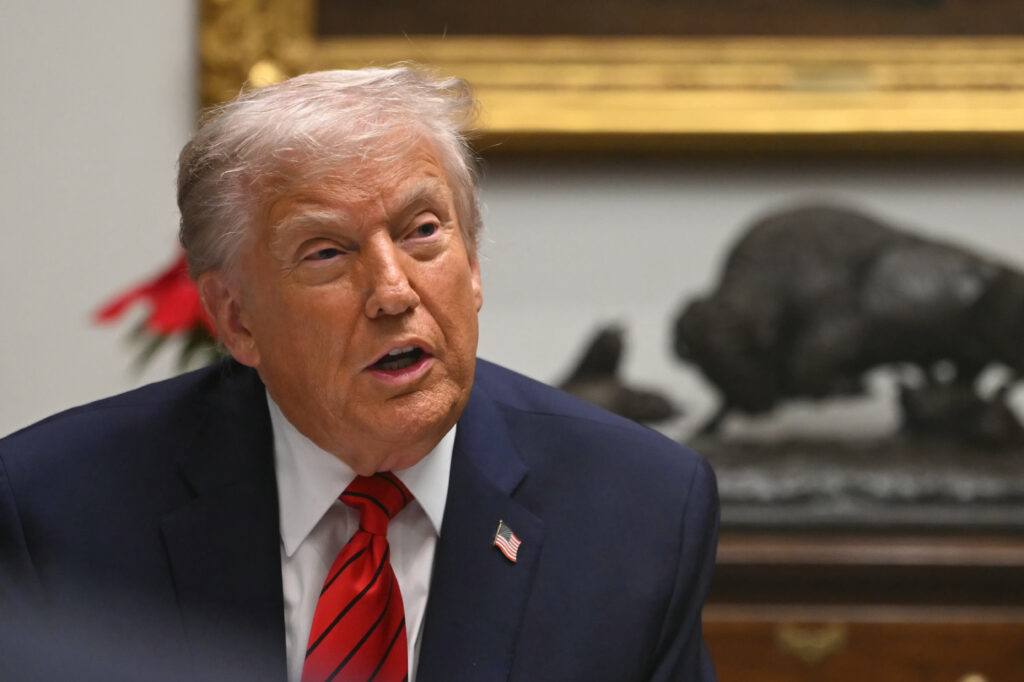
President Donald Trump reiterated Friday that he wants testing of US nuclear weapons, but again failed to clarify whether he meant live explosions in an order that has provoked global tension and confusion..Asked by an AFP journalist whether he meant conducting underground blasts for the first time in the United States since 1992, Trump told reporters aboard Air Force One: “I am not going to say.””You’ll find out very soon, but we’re going to do some testing, yeah. Other countries do it. If they’re going to do it, we’re going do it,” he said on his way to spend Halloween at his golf resort in Florida.No country other than North Korea has conducted an explosive nuclear weapon test for decades. Russia and China have not carried out such tests since 1990 and 1996 respectively.The 79-year-old Republican first made his surprise testing announcement by social media post on Thursday, minutes before entering a summit with Chinese leader Xi Jinping in South Korea.The announcement came in the wake of Russia saying it had tested a new nuclear-powered cruise missile, the Burevestnik, and a nuclear-powered and nuclear-capable underwater drone.Iran, whose own controversial nuclear program was bombed by US forces on Trump’s orders earlier this year, called Trump’s directive “regressive and irresponsible.””A nuclear-armed bully is resuming testing of atomic weapons. The same bully has been demonizing Iran’s peaceful nuclear program,” Foreign Minister Abbas Araghchi posted on social media.- ‘Pretty responsible’ -Japanese atomic bomb survivors group Nihon Hidankyo sent a letter of protest to the US embassy in Japan.The order “directly contradicts the efforts by nations around the world striving for a peaceful world without nuclear weapons and is utterly unacceptable,” the Nobel Peace Prize-winning group said in the letter obtained by AFP.Amid concern abroad and some in the US Congress, Defense Secretary Pete Hegseth said the Pentagon was moving “quickly” to follow Trump’s orders and said testing was “responsible.””The president was clear. We need to have a credible nuclear deterrent,” he told reporters in Kuala Lumpur. “Resuming testing is a pretty responsible, very responsible way to do that. I think it makes nuclear conflict less likely.”But China’s foreign ministry spokesman Guo Jiakun urged the United States to “earnestly abide” by a global nuclear testing ban.United Nations chief Antonio Guterres said through a spokesman that “nuclear testing can never be permitted under any circumstances.”The United States has been a signatory since 1996 to the Comprehensive Nuclear-Test-Ban Treaty, which bans all atomic test explosions, whether for military or civilian purposes.- Russia pushes back -Russia pushed back against any idea that its recent weapon systems tests could justify a return to live test explosions.The Kremlin questioned whether Trump was well-informed — and implied Russia would conduct its own live detonations if Trump does so first.The recent weapons drills “cannot in any way be interpreted as a nuclear test,” spokesman Dmitry Peskov told journalists. “We hope that the information was conveyed correctly to President Trump.”According to the Stockholm International Peace Research Institute, the Russian stockpile of deployed and stored warheads is 4,309, compared to 3,700 for the United States and 600 for China — figures that don’t take into account hundreds of other warheads scheduled for dismantling.The United States conducted 1,054 nuclear tests between July 16, 1945, when the first was conducted in New Mexico, and 1992.Its two nuclear attacks on Japan during World War II make it the only country to have used the weapons in combat.The last US nuclear test explosion was in September 1992, a 20-kiloton underground detonation at the Nevada Nuclear Security Site.Then-president George H.W. Bush imposed a moratorium on further tests in October 1992 that has been continued by successive administrations.burs-sms-dk/bjt