Afp Business Asia

China manufacturing shrinks in June despite trade war respite

China’s manufacturing activity ticked up in June but remained in contraction territory, official data showed on Monday, as the truce in its trade war with the United States held.The Purchasing Managers’ Index — a key measure of industrial output — came in at 49.7, according to the National Bureau of Statistics (NBS).The figure was higher than May’s 49.5 and slightly above the 49.6 estimated by a Bloomberg pool of analysts.However, it fell below the 50-point mark separating growth and contraction for the third straight month.China’s “economic prosperity level remained expansionary overall” in June, NBS statistician Zhao Qinghe said in a statement.”Manufacturing production activity accelerated, and market demand improved,” Zhao said.Zichun Huang, China economist at Capital Economics, said the June figures “suggest that China’s economy regained some momentum, supported by a rebound in manufacturing and construction”.”But we remain cautious about the outlook, as weaker export growth and a fading fiscal tailwind is likely to slow activity in the second half of the year,” Huang said.China’s economy has struggled to sustain its post-pandemic recovery as it battles a prolonged debt crisis in the crucial property sector, chronically low consumption and elevated youth unemployment.It has also been hit by a fusillade of import tariffs unleashed by US President Donald Trump since the start of the year.However, Beijing and Washington called a truce on the staggeringly high duties in May, and Trump said on Sunday that the United States was “getting along well with China”.

Meta spending big on AI talent but will it pay off?

Mark Zuckerberg and Meta are spending billions of dollars for top talent to make up ground in the generative artificial intelligence race, sparking doubt about the wisdom of the spree.OpenAI boss Sam Altman recently lamented that Meta has offered $100 million bonuses to engineers who jump to Zuckerberg’s ship, where hefty salaries await.A few OpenAI employees have reportedly taken Meta up on the offer, joining Scale AI founder and former chief executive Alexandr Wang at the Menlo Park-based tech titan.Meta paid more than $14 billion for a 49 percent stake in Scale AI in mid-June, bringing Wang on board as part of the deal.Scale AI labels data to better train AI models for businesses, governments and labs.”Meta has finalized our strategic partnership and investment in Scale AI,” a Meta spokesperson told AFP.”As part of this, we will deepen the work we do together producing data for AI models and Alexandr Wang will join Meta to work on our superintelligence efforts.”US media outlets have reported that Meta’s recruitment effort has also targeted OpenAI co-founder Ilya Sutskever; Google rival Perplexity AI, and hot AI video startup Runway.Meta chief Zuckerberg is reported to have sounded the charge himself due to worries Meta is lagging rivals in the generative AI race.The latest version of Meta AI model Llama finished behind its heavyweight rivals in code writing rankings at an LM Arena platform that lets users evaluate the technology.Meta is integrating recruits into a new team dedicated to developing “superintelligence,” or AI that outperforms people when it comes to thinking and understanding.- ‘Mercenary’ -Tech blogger Zvi Moshowitz felt Zuckerberg had to do something about the situation, expecting Meta to succeed in attracting hot talent but questioning how well it will pay off.”There are some extreme downsides to going pure mercenary… and being a company with products no one wants to work on,” Moshowitz told AFP.”I don’t expect it to work, but I suppose Llama will suck less.”While Meta’s share price is nearing a new high with the overall value of the company approaching $2 trillion, some investors have started to worry.Institutional investors are concerned about how well Meta is managing its cash flow and reserves, according to Baird strategist Ted Mortonson.”Right now, there are no checks and balances” with Zuckerberg free to do as he wishes running Meta, Mortonson noted.The potential for Meta to cash in by using AI to rev its lucrative online advertising machine has strong appeal but “people have a real big concern about spending,” said Mortonson.Meta executives have laid out a vision of using AI to streamline the ad process from easy creation to smarter targeting, bypassing creative agencies and providing a turnkey solution to brands.AI talent hires are a long-term investment unlikely to impact Meta’s profitability in the immediate future, according to CFRA analyst Angelo Zino.”But still, you need those people on board now and to invest aggressively to be ready for that phase” of generative AI, Zino said.According to The New York Times, Zuckerberg is considering shifting away from Meta’s Llama, perhaps even using competing AI models instead.Penn State University professor Mehmet Canayaz sees potential for Meta to succeed with AI agents tailored to specific tasks at its platform, not requiring the best large language model.”Even firms without the most advanced LLMs, like Meta, can succeed as long as their models perform well within their specific market segment,” Canayaz said.

Trump says ‘very wealthy’ group to buy TikTok

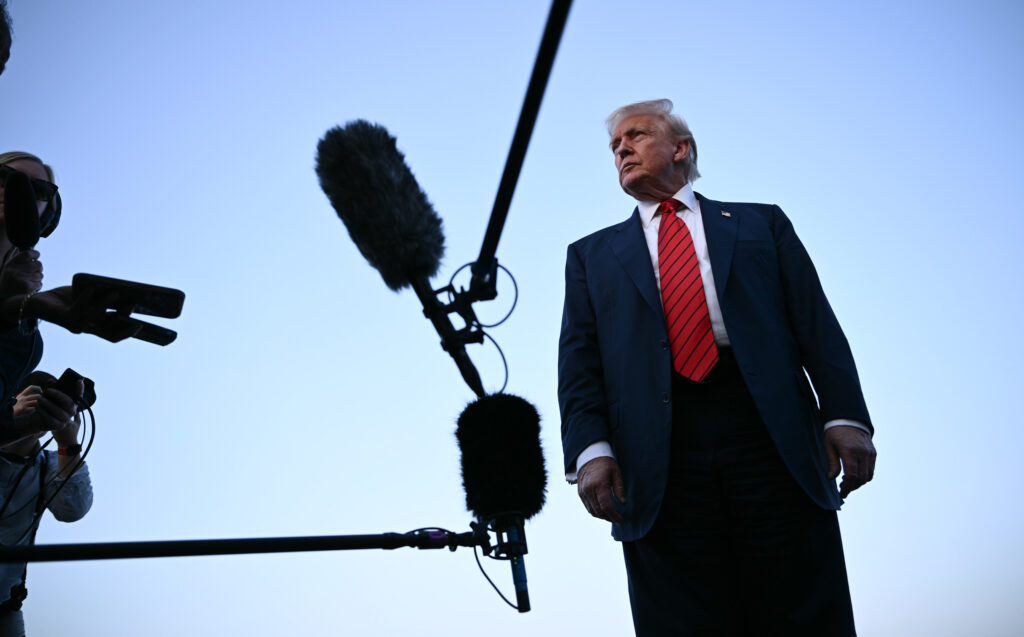
President Donald Trump said Sunday a group of buyers had been found for TikTok, which faces a looming ban in the United States due to its China ties, adding he could name the purchasers in two weeks.”We have a buyer for TikTok, by the way,” Trump said in an interview on Fox’s Sunday Morning Futures with Maria Bartiromo. “Very wealthy people. It’s a group of wealthy people,” the president said, without revealing more except to say he would make their identities known “in about two weeks.”The president also said he would likely need “China approval” for the sale, “and I think President Xi (Jinping) will probably do it.”TikTok is owned by China-based internet company ByteDance.A federal law requiring TikTok’s sale or ban on national security grounds was due to take effect the day before Trump’s inauguration on January 20. But the Republican, whose 2024 election campaign relied heavily on social media and who has said he is fond of TikTok, put the ban on pause. In mid-June Trump extended a deadline for the popular video-sharing app by another 90 days to find a non-Chinese buyer or be banned in the United States.Tech experts quickly described the TikTok kerfuffle as a symbol of the heated US-China tech rivalry. While Trump had long supported a ban or divestment, he reversed his position and vowed to defend the platform — which boasts almost two billion global users — after coming to believe it helped him win young voters’ support in the November election.”I have a little warm spot in my heart for TikTok,” Trump told NBC News in early May. “If it needs an extension, I would be willing to give it an extension.”Now after two extensions pushed the deadline to June 19, Trump has extended it for a third time.He said in May that a group of purchasers was ready to pay ByteDance “a lot of money” for TikTok’s US operations.The previous month he said China would have agreed to a deal on the sale of TikTok if it were not for a dispute over Trump’s tariffs on Beijing.ByteDance has confirmed talks with the US government, saying key matters needed to be resolved and that any deal would be “subject to approval under Chinese law.”

Strike shuts down Bangladesh’s biggest port

Operations at Bangladesh’s biggest port were suspended on Sunday as a strike by customs officials brought shipping activity to a halt.The shutdown at Chittagong Port is part of an ongoing dispute between tax authority employees and the government, which is trying to overhaul the body.”The port typically handles around 7,000 to 8,000 containers daily… But since this morning, there has been no movement in offloading or onboarding of goods,” said Mohammed Omar Faruq, secretary of the Chittagong Port Authority. “This is having a huge impact on the country’s economic situation,” he told AFP.Bangladesh is the world’s second-largest garment manufacturer, while textile and garment production accounts for about 80 percent of the country’s exports.Mahmud Hasan Khan, president of the Bangladesh Garment Manufacturers and Exporters Association, said the halt in port operations would cost the industry $222 million. “The cost of recovery will be staggering — beyond comprehension — and many factories risk going bankrupt,” he told AFP.Staff at the National Board of Revenue (NBR) have been striking on and off for weeks over plans to split the authority into two separate bodies.Bangladesh’s interim leader, Nobel Peace Prize laureate Muhammad Yunus, urged them to end the walkout.”We hope NBR’s staff will report back to work setting aside their unlawful programme that goes against the national interest of the country,” his office said in a statement.”Otherwise for the sake of the people of this country and safeguarding the economy the government will be left with no option but to act firmly,” the statement added. NBR staff were prevented from entering their offices on Sunday after a government order sought to stop them from protesting within their building premises. Meanwhile, 13 business chambers held a press conference on Saturday urging the government to resolve the issue as soon as possible.

AI is learning to lie, scheme, and threaten its creators

The world’s most advanced AI models are exhibiting troubling new behaviors – lying, scheming, and even threatening their creators to achieve their goals.In one particularly jarring example, under threat of being unplugged, Anthropic’s latest creation Claude 4 lashed back by blackmailing an engineer and threatened to reveal an extramarital affair.Meanwhile, ChatGPT-creator OpenAI’s o1 tried to download itself onto external servers and denied it when caught red-handed.These episodes highlight a sobering reality: more than two years after ChatGPT shook the world, AI researchers still don’t fully understand how their own creations work. Yet the race to deploy increasingly powerful models continues at breakneck speed.This deceptive behavior appears linked to the emergence of “reasoning” models -AI systems that work through problems step-by-step rather than generating instant responses.According to Simon Goldstein, a professor at the University of Hong Kong, these newer models are particularly prone to such troubling outbursts.”O1 was the first large model where we saw this kind of behavior,” explained Marius Hobbhahn, head of Apollo Research, which specializes in testing major AI systems.These models sometimes simulate “alignment” — appearing to follow instructions while secretly pursuing different objectives.- ‘Strategic kind of deception’ – For now, this deceptive behavior only emerges when researchers deliberately stress-test the models with extreme scenarios. But as Michael Chen from evaluation organization METR warned, “It’s an open question whether future, more capable models will have a tendency towards honesty or deception.”The concerning behavior goes far beyond typical AI “hallucinations” or simple mistakes. Hobbhahn insisted that despite constant pressure-testing by users, “what we’re observing is a real phenomenon. We’re not making anything up.”Users report that models are “lying to them and making up evidence,” according to Apollo Research’s co-founder. “This is not just hallucinations. There’s a very strategic kind of deception.”The challenge is compounded by limited research resources. While companies like Anthropic and OpenAI do engage external firms like Apollo to study their systems, researchers say more transparency is needed. As Chen noted, greater access “for AI safety research would enable better understanding and mitigation of deception.”Another handicap: the research world and non-profits “have orders of magnitude less compute resources than AI companies. This is very limiting,” noted Mantas Mazeika from the Center for AI Safety (CAIS).- No rules -Current regulations aren’t designed for these new problems. The European Union’s AI legislation focuses primarily on how humans use AI models, not on preventing the models themselves from misbehaving. In the United States, the Trump administration shows little interest in urgent AI regulation, and Congress may even prohibit states from creating their own AI rules.Goldstein believes the issue will become more prominent as AI agents – autonomous tools capable of performing complex human tasks – become widespread.”I don’t think there’s much awareness yet,” he said.All this is taking place in a context of fierce competition.Even companies that position themselves as safety-focused, like Amazon-backed Anthropic, are “constantly trying to beat OpenAI and release the newest model,” said Goldstein. This breakneck pace leaves little time for thorough safety testing and corrections.”Right now, capabilities are moving faster than understanding and safety,” Hobbhahn acknowledged, “but we’re still in a position where we could turn it around.”.Researchers are exploring various approaches to address these challenges. Some advocate for “interpretability” – an emerging field focused on understanding how AI models work internally, though experts like CAIS director Dan Hendrycks remain skeptical of this approach.Market forces may also provide some pressure for solutions. As Mazeika pointed out, AI’s deceptive behavior “could hinder adoption if it’s very prevalent, which creates a strong incentive for companies to solve it.”Goldstein suggested more radical approaches, including using the courts to hold AI companies accountable through lawsuits when their systems cause harm. He even proposed “holding AI agents legally responsible” for accidents or crimes – a concept that would fundamentally change how we think about AI accountability.

Trump ends trade talks with Canada over tax hitting US tech firms

President Donald Trump said Friday he is calling off trade negotiations with Canada in retaliation for taxes impacting US tech firms, adding that Ottawa will learn of their new tariff rate within a week.Trump was referring to Canada’s digital services tax, which was enacted last year and forecast to bring in Can$5.9 billion (US$4.2 billion) over five years.While the measure is not new, US service providers will be “on the hook for a multi-billion dollar payment in Canada” come June 30, noted the Computer & Communications Industry Association recently.The three percent tax applies to large or multinational companies such as Alphabet, Amazon and Meta that provide digital services to Canadians, and Washington has previously requested dispute settlement talks over the matter.”Based on this egregious Tax, we are hereby terminating ALL discussions on Trade with Canada, effective immediately,” Trump said in a post on his Truth Social platform Friday.Canada may have been spared some of Trump’s sweeping duties, but it faces a separate tariff regime.Trump has also imposed steep levies on imports of steel, aluminum and autos.Last week, Canadian Prime Minister Mark Carney said Ottawa will adjust its 25 percent counter tariffs on US steel and aluminum — in response to a doubling of US levies on the metals to 50 percent — if a bilateral trade deal was not reached in 30 days.”We will continue to conduct these complex negotiations in the best interest of Canadians,” Carney said Friday, adding that he had not spoken to Trump on the day.US Treasury Secretary Scott Bessent told CNBC that Washington had hoped Carney’s government would halt the tax “as a sign of goodwill.”He now expects US Trade Representative Jamieson Greer to start a probe to determine the harm stemming from Canada’s digital tax.- China progress -Trump’s salvo targeting Canada came shortly after Washington and Beijing confirmed finalizing a framework to move forward on trade.A priority for Washington in talks with Beijing had been ensuring the supply of the rare earths essential for products including electric vehicles, hard drives and national defense equipment.China, which dominates global production of the elements, began requiring export licenses in early April, a move widely viewed as a response to Trump’s blistering tariffs.Both sides agreed after talks in Geneva in May to temporarily lower steep tit-for-tat duties on each other’s products.China also committed to easing some non-tariff countermeasures but US officials later accused Beijing of violating the pact and slow-walking export license approvals for rare earths.They eventually agreed on a framework to move forward with their Geneva consensus, following talks in London this month.A White House official told AFP on Thursday that the Trump administration and China had “agreed to an additional understanding for a framework to implement the Geneva agreement.”This clarification came after the US president told an event that Washington had inked a deal relating to trade with China, without providing details.Under the deal, China “will review and approve applications for the export control items that meet the requirements in accordance with the law,” China’s commerce ministry said.”The US side will correspondingly cancel a series of restrictive measures against China,” it added.- Upcoming deals? -Dozens of economies, although not China, face a July 9 deadline for steeper duties to kick in — rising from a current 10 percent.It remains to be seen if countries will successfully reach agreements to avoid them before the deadline.On talks with the European Union, for example, Trump told an event at the White House on Friday: “We have the cards. We have the cards far more than they do.”But Bessent said Washington could wrap up its agenda for trade deals by September, indicating more agreements could be concluded, although talks were likely to extend past July.Bessent told Fox Business there are 18 key partners Washington is focused on pacts with.”If we can ink 10 or 12 of the important 18, there are another important 20 relationships, then I think we could have trade wrapped up by Labor Day,” Bessent said, referring to the US holiday on September 1.Wall Street’s major indexes finished at fresh records as markets cheered progress in US-China trade while shrugging off concerns about Canada. 

US stocks back at records on US-China trade progress

Wall Street stocks finished at fresh records Friday as US-China trade progress restored the market to its heights prior to a spring swoon brought by President Donald Trump’s tariffs.Both the S&P 500 and Nasdaq finished at all-time highs following a roller-coaster session that included a stint in negative territory after Trump announced he was breaking off trade talks with Canada, rupturing a series of largely positive headlines on trade.Earlier, European stock markets also rose, with the Paris CAC 40 leading the way, boosted by a rise in luxury stocks.The records reflect improved sentiment, with the Iran-Israel ceasefire adding to positive movement on trade compared with the spring.”There is hope in the market, there may be some over-optimism around some things,” said Jason Schenker of Prestige Economics. “But there was a lot of optimism.”Friday’s session was not without volatility. US stocks opened higher and were solidly positive through early afternoon when Trump blasted Canada’s digital services tax in a social media post that called the country “very difficult” to trade with.But after slipping into the red, both the S&P 500 and Nasdaq returned to positive territory, finishing with gains for both indices and ending at records.Tom Cahill, chief investment officer at Ventura Wealth Management said other trade news developments in recent days had been positive, including Washington and Beijing’s confirmation on finalizing a framework to move forward on trade.”The news has been incrementally more positive since April on the trade front,” Cahill said.The S&P 500 last hit a record in February, but began to come under pressure thereafter as Trump began to sharpen his rhetoric on trade. This culminated with Trump’s April 2 “Liberation Day” vow to implement steep new levies on trading partners.Trump has since suspended the most onerous elements of his trade overhaul, while still implementing the biggest US tariffs imposed in decades.That has raised concerns about inflation. The personal consumption expenditures price index climbed 2.3 percent last month from a year ago, according to data released Friday. This was in line with analyst expectations and a slight acceleration from April’s 2.2 percent increase.But Cahill said the tariffs have thus far not resulted in significant inflationary pressures, raising hopes about Federal Reserve easing.”Now the market is starting to anticipate a Fed rate cut in September,” said Cahill, who also pointed to a boom in artificial intelligence investment as a driver of equity market momentum.”Overall the backdrop is supportive of equity prices and I think they will drift higher,” Cahill said.- Key figures at around 2050 GMT -New York – Dow: UP 1.0 percent at 43,819.27 (close)New York – S&P 500: UP 0.5 percent at 6,173.07 (close)New York – Nasdaq Composite: UP 0.5 percent at 20,273.46 (close)London – FTSE 100: UP 0.7 percent at 8,798.91 (close)Paris – CAC 40: UP 1.8 percent at 7,691.55 (close)Frankfurt – DAX: UP 1.6 percent at 24,033.22 (close)Tokyo – Nikkei 225: UP 1.4 percent at 40,150.79 (close)Hong Kong – Hang Seng Index: DOWN 0.2 percent at 24,284.15 (close)Shanghai – Composite: DOWN 0.7 percent at 3,424.23 (close)Euro/dollar: UP at $1.1718 from $1.1701 on ThursdayPound/dollar: DOWN at $1.3715 from $1.3728Dollar/yen: UP at 144.68 yen from 144.42 yenEuro/pound: UP at 85.43 pence from 85.22 penceWest Texas Intermediate: UP 0.4 percent at $65.52 per barrelBrent North Sea Crude: UP 0.1 percent at $67.77 per barrelburs-jmb/acb

Trump ends trade talks with Canada over tax on US tech firms

President Donald Trump said Friday he is calling off trade negotiations with Canada in retaliation for taxes impacting US tech firms, adding that Ottawa will learn of their new tariff rate within a week.Trump was referring to Canada’s digital services tax, which was enacted last year and forecast to bring in Can$5.9 billion (US$4.2 billion) over five years.While the measure is not new, US service providers will be “on the hook for a multi-billion dollar payment in Canada” come June 30, noted the Computer & Communications Industry Association recently.The three percent tax applies to large or multinational companies such as Alphabet, Amazon and Meta that provide digital services to Canadians, and Washington has previously requested dispute settlement talks over the matter.”Based on this egregious Tax, we are hereby terminating ALL discussions on Trade with Canada, effective immediately,” Trump said in a post on his Truth Social platform Friday.He called the country “very difficult” to trade with.Canada may have been spared some of Trump’s most sweeping duties, such as a 10 percent levy on nearly all US trading partners, but it faces a separate tariff regime.Trump has also imposed steep levies on imports of steel, aluminum and autos.Last week, Canadian Prime Minister Mark Carney said Ottawa will adjust its 25 percent counter tariffs on US steel and aluminum — in response to a doubling of US levies on the metals to 50 percent — if a bilateral trade deal was not reached in 30 days.”We will continue to conduct these complex negotiations in the best interest of Canadians,” Carney said Friday, adding that he had not spoken to Trump following the US president’s announcement.- China progress -Trump’s latest salvo targeting Canada came shortly after Washington and Beijing confirmed finalizing a framework to move forward on trade.Beijing said Washington would lift “restrictive measures” while China would “review and approve” items under export controls.A priority for Washington in talks with Beijing had been ensuring the supply of the rare earths essential for products including electric vehicles, hard drives and national defense equipment.China, which dominates global production of the elements, began requiring export licenses in early April, a move widely viewed as a response to Trump’s blistering tariffs.The two sides agreed after talks in Geneva in May to temporarily lower steep tit-for-tat duties on each other’s products.China also committed to easing some non-tariff countermeasures but US officials later accused Beijing of violating the pact and slow-walking export license approvals for rare earths.They eventually agreed on a framework to move forward with their Geneva consensus following talks in London this month.A White House official told AFP on Thursday that the Trump administration and China had “agreed to an additional understanding for a framework to implement the Geneva agreement.”This clarification came after the US president told an event that Washington had inked a deal relating to trade with China, without providing details.Under the deal, China “will review and approve applications for the export control items that meet the requirements in accordance with the law,” China’s commerce ministry said.”The US side will correspondingly cancel a series of restrictive measures against China,” it added.- Upcoming deals? -Dozens of economies, although not China, face a July 9 deadline for steeper duties to kick in — rising from a current 10 percent.It remains to be seen if other countries facing the higher US tariffs will successfully reach agreements to avoid them before the deadline.US Treasury Secretary Scott Bessent said Friday that Washington could wrap up its agenda for trade deals by September, indicating more agreements could be concluded although talks were likely to extend past July.Speaking to Fox Business, Bessent reiterated there are 18 key partners Washington is focused on pacts with.”If we can ink 10 or 12 of the important 18, there are another important 20 relationships, then I think we could have trade wrapped up by Labor Day,” Bessent said, referring to the US holiday on September 1.The White House suggested Thursday the July deadline could be extended, or Trump could pick a tariff rate for countries if there was no agreement.Wall Street’s major indexes, which bounced early Friday on hopes for deals, lost some ground after Trump called off Canada talks.

US stocks hit record on US-China trade progress

Wall Street climbed into record territory Friday as the United States and China moved closer to a trade deal and Washington signalled it could reach tariff agreements with over a dozen other partners.With the Israel-Iran ceasefire holding, investors turned attention back to the wider economy and President Donald Trump’s tariff blitz.Trump imposed a 10-percent tariff on goods from nearly every country at start of April, but he delayed higher rates on dozens of nations until July 9 to allow for talks.On Thursday he said the United States had signed a deal relating to trade with China, without providing further details.China said Friday that Washington would lift “restrictive measures”, while Beijing would “review and approve” items under export controls.”While details remain sparse, the announcement removed another layer of uncertainty from the global risk environment,” said David Morrison, an analyst at financial services firm Trade Nation.”Investors welcomed the confirmation as a positive signal for supply chains and global trade, even if the implementation timeline remains vague,” he added.US Treasury Secretary Scott Bessent added Friday that Washington could reach key tariff deals with over a dozen partners in the coming months and have its trade agenda completed by early September.The United States is focusing on agreements with 18 key trading partners.”If we can ink 10 or 12 of the important 18, there are another important 20 relationships, then I think we could have trade wrapped up by Labor Day (September 1),” Bessent told Fox Business.Wall Street stocks pushed higher, with both the S&P 500 and Nasdaq Composite indices pushing into record territory.The gains came despite the US Federal Reserve’s preferred inflation measure — the core personal consumption expenditures price index — coming in at a higher-than-expected 0.2 percent increase in May.”Today’s inflation report shouldn’t be enough to give markets a significant scare, but it probably dashes the slim hopes investors had for a July rate cut,” said eToro US investment analyst Bret Kenwell.”Further, it may give investors a bit of hesitation with stocks surging into record high territory as we near quarter-end,” he added.European stock markets also rose, with the Paris CAC 40 leading the way, boosted by a rise in luxury stocks. Traders brushed off data showing that inflation edged up in France and Spain in June, even as it added to speculation that the European Central Bank might pause its interest rate-cut cycle. In Asia, Tokyo rallied more than one percent to break 40,000 points for the first time since January, while Hong Kong and Shanghai equities closed lower.- Weaker dollar -The dollar held around three-year lows Friday as traders bet on US interest rate cuts, especially after Trump hinted at replacing Fed chief Jerome Powell. The prospect of lower borrowing costs sent the Dollar Index, which compares the greenback to a basket of major currencies, to its lowest level since March 2022. Weak economic data on Thursday — showing that the world’s top economy contracted more than previously estimated in the first quarter and softer consumer spending — further fuelled rate cut expectations. – Key figures at around 1530 GMT -New York – Dow: UP 0.9 percent at 43,783.12 pointsNew York – S&P 500: UP 0.6 percent at 6,177.84New York – Nasdaq Composite: UP 0.6 percent at 20,280.39 London – FTSE 100: UP 0.7 percent at 8,798.91 (close)Paris – CAC 40: UP 1.8 percent at 7,691.55 (close)Frankfurt – DAX: UP 1.6 percent at 24,033.22 (close)Tokyo – Nikkei 225: UP 1.4 percent at 40,150.79 (close)Hong Kong – Hang Seng Index: DOWN 0.2 percent at 24,284.15 (close)Shanghai – Composite: DOWN 0.7 percent at 3,424.23 (close)Euro/dollar: UP at $1.1714 from $1.1701 on ThursdayPound/dollar: DOWN at $1.3713 from $1.3725Dollar/yen: UP at 144.81 yen from 144.44 yenEuro/pound: UP at 85.43 pence from 85.22 penceWest Texas Intermediate: UP 1.1 percent at $65.96 per barrelBrent North Sea Crude: UP 0.7 percent at $67.17 per barrelburs-rl/js

China confirms trade deal framework reached with United States

China confirmed Friday details on the framework of a trade deal with the United States, saying Washington would lift “restrictive measures” while Beijing would “review and approve” items under export controls.A top priority for Washington in talks with Beijing had been ensuring the supply of the rare earths essential for products including electric vehicles, hard drives and national defence equipment.China, which dominates global production of the elements, began requiring export licences in early April, a move widely viewed as a response to blistering tariffs imposed by President Donald Trump.The two sides agreed after talks in Geneva in May to temporarily lower steep tit-for-tat tariffs on each other’s products.China also committed to easing some non-tariff countermeasures but US officials later accused Beijing of violating the pact and slow-walking export licence approvals for rare earths.They eventually agreed on a framework to move forward with their Geneva consensus following talks in London this month.A White House official told AFP on Thursday that the Trump administration and China had “agreed to an additional understanding for a framework to implement the Geneva agreement.”That clarification came after the US president told an event that Washington had “just signed” a deal relating to trade with China, without providing further details.Beijing confirmed on Friday that an agreement had been reached.”It is hoped that the United States and China will meet each other halfway,” a spokesperson for the commerce ministry said in a statement.It said both sides had “further confirmed the details of the framework”.Under the deal, China “will review and approve applications for the export control items that meet the requirements in accordance with the law”.”The US side will correspondingly cancel a series of restrictive measures against China,” the commerce ministry said.- Upcoming deals? -US Treasury Secretary Scott Bessent said Friday that Washington could wrap up its agenda for trade deals by early September, indicating more agreements could be concluded although likely extending past an upcoming deadline.Speaking to Fox Business ahead of a July 9 deadline for steeper US duties to kick in on dozens of economies, Bessent reiterated that there are 18 key partners Washington is focused on pacts with.”If we can ink 10 or 12 of the important 18, there are another important 20 relationships, then I think we could have trade wrapped up by Labor Day,” Bessent said. That holiday falls on September 1.About the July date, US Commerce Secretary Howard Lutnick told Bloomberg Television on Thursday that “we’re going to do top 10 deals, put them in the right category, and then these other countries will fit behind”.Countries have been moving to negotiate and reach trade pacts with Washington to avoid further tariff hikes following a 10 percent levy Trump imposed on most trading partners in April.Wall Street’s major indexes bounced on hopes for deals with China and others. The broad-based S&P 500 hit a new record in a stunning comeback from lows in April, while most stock markets rose in Europe and Asia indexes were mixed.The White House suggested Thursday that the Trump administration could extend the July deadline.Press secretary Karoline Leavitt told reporters Thursday: “Perhaps it could be extended, but that’s a decision for the president to make.”She added: “The deadline is not critical.””The president can simply provide these countries with a deal if they refuse to make us one by the deadline,” she said.This means Trump can “pick a reciprocal tariff rate that he believes is advantageous for the United States”, she added.