Afp Business Asia

Global stocks drop as US tariff uncertainty lingers

Global stock markets mostly slipped Wednesday as investors digested conflicting signals from President Donald Trump about his coming wave of tariffs.In New York, the Dow was little changed but the wider S&P 500 and the tech-heavy Nasdaq were lower in midday deals. In Europe, Paris and Frankfurt closed down while London edged up as data showed an unexpected slowdown to UK annual inflation.With the White House’s so-called “Liberation Day” on April 2 fast approaching, investors are bracing for a wave of sweeping levies on imports amid warnings of crippled global trade, recession and a fresh spike in inflation.But Trump has alternated between tough talk about imposing tariffs across the board to suggesting he may allow some carve-outs to spare US consumers the full brunt of their impact on prices.The result has been a drop in economic sentiment as consumers expect higher prices. “All the tariff talk uncertainty has led to a sharp drop in confidence,” said David Morrison, analyst at Trade Nation. The president told Newsmax on Tuesday that he did not “want to have too many exceptions” but added: “I’ll probably be more lenient than reciprocal, because if I was reciprocal, that would be very tough for people.”The Conference Board reported Tuesday that its closely watched gauge of consumer confidence dived to its lowest level since 2021 — during the Covid pandemic — as concerns grow over higher prices.”Recent survey data has painted a gloomy outlook for the US economy. But this pessimism has yet to show up in hard data, such as unemployment, while corporate earnings continue to beat expectations,” Morrison said.The figures come as the Federal Reserve re-evaluates its monetary policy in light of Trump’s tariffs agenda, with some analysts warning it might have to hold off any interest rate cuts this year.The next major clue on its outlook comes Friday with the release of a key inflation indicator.While almost all European markets fell, defence stocks bucked the trend as one country after another pledges to boost military spending, with Spain and Sweden being the latest to do so Wednesday.France’s Thales, Germany’s Rheinmetall and Italy’s Leonardo were all sharply higher.London’s stock market rose after news that the country’s annual consumer inflation slowed to 2.8 percent in February from 3.0 percent in January.The market held onto its gains even after finance minister Rachel Reeves cut the country’s growth forecast in half to one percent as she announced spending cuts, as she raised the outlook for the subsequent three years.”She appears to have done the trick of not unnerving investors further,” said Susannah Streeter, head of money and markets at Hargreaves Lansdown.  Trump’s talk of tariff exemptions had earlier helped some Asian markets edge higher after recent slumps. Copper futures traded on New York’s Comex exchange touched a record high after Trump said he could impose duties on imports of the commodity within weeks, leading some investors to shift supply to the United States to avoid any eventual levies.- Key figures around 1700 GMT -New York – Dow: DOWN 0.1 percent at 42,543.75 points New York – S&P 500: DOWN 0.9 percent at 5,726.12 New York – Nasdaq Composite: DOWN 1.7 percent at 17,964 London – FTSE 100: UP 0.3 percent at 8,689.59 (close) Paris – CAC 40: DOWN 1.0 percent at 8,030.68 (close)Frankfurt – DAX: DOWN 1.2 percent at 22,839.03 (close) Tokyo – Nikkei 225: UP 0.7 percent at 38,027.29 (close)Hong Kong – Hang Seng Index: UP 0.6 percent at 23,483.32 (close)Shanghai – Composite: FLAT at 3,368.70 (close)Euro/dollar: UNCHANGED from Tuesday at $1.0790 Pound/dollar: DOWN at $1.2897 from $1.2943Dollar/yen: UP at 150.54 yen from 149.90 yenEuro/pound: UP at 83.67 pence from 83.37 penceBrent North Sea Crude: UP 1.2 percent at $73.88 per barrelWest Texas Intermediate: UP 1.3 percent at $69.87 per barrel

Apple says Indonesia iPhone sales ban ends in April

Teach giant Apple announced on Wednesday the iPhone 16 will be available in Indonesia from next month, indicating the sales ban in Southeast Asia’s biggest economy had been lifted.The government in October prohibited the marketing and sale of the model over the US tech titan’s failure to meet regulation requiring 40 percent of phones be made from local parts. However, Apple struck a deal with the Indonesian government last month to invest in the country of 280 million after months of deadlock. “Today, Apple announces that all iPhone 16 series… will be available starting from Friday, April 11,” the company said in a statement.The industry ministry did not respond to AFP’s request for comment.The ministry said this month it had approved local certificates for more than a dozen Apple products. Last week, The Ministry of Communication and Digital Affairs said Apple has also obtained a certificate needed for all telecommunication devices with transmission. Jakarta rejected a $100 million investment proposal from Apple in November, saying it lacked the “fairness” required by the government. Apple later agreed to invest $150 million in building two facilities — one in Bandung in West Java province to produce accessories, and another in Batam for AirTags. Industry Minister Agus Gumiwang Kartasasmita said last month that Apple had also committed to building a semiconductor research and development centre in Indonesia, calling it a “first of its kind in Asia”. Despite the ban on iPhone sales in Indonesia, the government had allowed the devices to be brought in if they were not being traded commercially. Indonesia has also banned the sale of Google Pixel phones for failing to meet the 40 percent local parts requirement.

Global stocks mixed as US tariff uncertainty lingers

Global stock markets diverged Wednesday as investors remained cautious following conflicting signals from President Donald Trump about his coming wave of tariffs.New York’s main indexes opened mixed while shares in Paris and Frankfurt dropped.London edged up as data showed an unexpected slowdown to UK annual inflation.With the White House’s “Liberation Day” on April 2 fast approaching, investors are bracing for a wave of sweeping levies on imports amid warnings of crippled global trade, recession and a fresh spike in inflation.But Trump has alternated between tough talk about imposing tariffs across the board to suggesting he may allow some carve-outs to spare US consumers the full brunt of their impact on prices.”All the tariff talk uncertainty has led to a sharp drop in confidence,” said David Morrison, analyst at Trade Nation. “Recent survey data has painted a gloomy outlook for the US economy. But this pessimism has yet to show up in hard data, such as unemployment, while corporate earnings continue to beat expectations,” Morrison added.The president told Newsmax on Tuesday that he did not “want to have too many exceptions” but added: “I’ll probably be more lenient than reciprocal, because if I was reciprocal, that would be very tough for people.”The Conference Board reported Tuesday that its closely watched gauge of consumer confidence dived to its lowest level since 2021 — during the Covid pandemic — as concerns grow over higher prices.The figures come as the Federal Reserve re-evaluates its monetary policy in light of Trump’s tariffs agenda, with some analysts warning it might have to hold off any interest rate cuts this year.Wall Street’s Dow index was up in morning trading, the wider S&P 500 was unchanged, and the tech-heavy Nasdaq was down slightly.While almost all European markets were lower in mid-afternoon trading on the tariff uncertainty, defence stocks bucked the trend as one country after another pledges to boost military spending, with Spain and Sweden being the latest to do so Wednesday.France’s Dassault Aviation and Thales, Germany’s Rheinmetall, and Italy’s Leonardo were all sharply higher.London’s stock market rose after news that the country’s annual consumer inflation slowed to 2.8 percent in February from 3.0 percent in January.While that was a boost to finance minister Rachel Reeves, prices later gave up some of their gains after the country’s growth forecast was cut in half to one percent as she announced spending cuts. Trump’s talk of tariff exemptions had earlier helped some Asian markets edge higher after recent slumps. Copper futures traded on New York’s Comex exchange touched a record high after Trump said he could impose duties on imports of the commodity within weeks, leading some investors to shift supply to the US to avoid any eventual levies.- Key figures around 1340 GMT -New York – Dow: UP 0.4 percent at 42,753.15 points New York – S&P 500: FLAT at 5,778.45 New York – Nasdaq Composite: DOWN 0.2 percent at 18,230.40 London – FTSE 100: UP 0.2 percent at 8,683.18 Paris – CAC 40: DOWN 0.8 percent at 8,046.20Frankfurt – DAX: DOWN 0.7 percent at 22,939.11 Tokyo – Nikkei 225: UP 0.7 percent at 38,027.29 (close)Hong Kong – Hang Seng Index: UP 0.6 percent at 23,483.32 (close)Shanghai – Composite: FLAT at 3,368.70 (close)Euro/dollar: DOWN at $1.0772 from $1.0791 on TuesdayPound/dollar: DOWN at $1.2875 from $1.2943Dollar/yen: UP at 150.45 yen from 149.90 yenEuro/pound: UP at 83.65 pence from 83.37 penceBrent North Sea Crude: UP 1.0 percent at $73.77 per barrelWest Texas Intermediate: UP 1.0 percent at $69.72 per barrel

China drinks chain Mixue profits spike 40% in 2024

Chinese drinks company Mixue Group, which has surpassed McDonald’s and Starbucks in store count to become the world’s largest food and beverage chain, reported a spike in profits on Wednesday as it laid out further expansion plans.The results came after Mixue raised $444 million in a bumper Hong Kong listing, with the stock jumping more than 40 percent on its March 3 debut and trading at around double its offer price this week.The firm — known for beverages usually priced around $1 — had 41,584 stores in China and another 4,895 spread across 11 countries as of the end of last year, Mixue said in an exchange filing on Wednesday.Revenue increased 22 percent to $3.4 billion in 2024, which the company attributed mostly to “increased revenue generated from sales of goods and equipment, and to a lesser extent, from franchise and related services”.Profit for the year jumped 40 percent to $613 million.Mixue, whose name translates to “honey snow ice city”, was founded by two brothers in the Chinese hinterland province of Henan in 1997 as a shaved ice shop.The Zhengzhou-headquartered firm quickly expanded across China and became a hit with frugal young consumers, disrupting a sector once dominated by premium brands.Mixue stores — recognisable by their bright red signs and smiling snowman mascot — became ubiquitous in lower-income Chinese cities, offering freshly made fruit drinks, tea drinks, ice cream and coffee.Nearly 60 percent of Mixue stores in China are in cities categorised by the company as “third-tier or below”.Mixue says it relies on a franchise model to grow its brick-and-mortar network, but “franchise and related service fees are not our primary sources of revenue”.Instead, it makes most of its money from supplying food materials, equipment and packaging needed to run its stores.The company said Wednesday that it will “continue to elevate the breadth and depth of our supply chain” in China, while remaining “focused on cultivating the Southeast Asia market”.

Lula says Mercosur, Japan to discuss trade deal

Brazil’s President Luiz Inacio Lula da Silva said Wednesday that he expects talks between South America’s Mercosur bloc and Japan on a trade deal to begin in the second half of the year.”I expect to launch negotiations for an agreement with Japan during Brazil’s presidency of Mercosur the next semester,” Lula told reporters in a joint news conference with Japanese Prime Minister Shigeru Ishiba in Tokyo.Earlier Lula portrayed such an agreement as a way for the two economies to boost trade in the face of growing protectionism under US President Donald Trump.”Our countries have more to gain from integration than from protectionist practices,” he said at an economic forum attended by business and political figures from Brazil and Japan.”We cannot go back to relying on protectionism. We do not want a second Cold War,” Lula said.”We want free trade so that we can ensure that democracy, economic growth and wealth distribution become established in our countries,” he added.Four Mercosur members — Argentina, Brazil, Paraguay and Uruguay — in December struck a free-trade deal with the European Union although it still faces hurdles before final approval.Business groups in Japan, the world’s fourth-largest economy, have been pressing the government also to strike an agreement with the South American bloc.The Keidanren business federation “urgently” called in November for “expedited efforts” towards a deal calling the potential benefits “immense”.But an agreement may be politically hard because of fears about the impact on Japanese farmers of large-scale agricultural imports, particularly from Brazil and Argentina.Ishiba told the joint news conference that Japan and Brazil would “soon” set up a Japan-Mercosur strategic partnership.”We agreed that… we will promote discussions with a view to deepening our trade relationships under that framework,” Ishiba said.”As the international community’s division deepens, our cooperation with Brazil — our partner to lead the global society into harmony — is essential,” he said.Lula, 79, arrived in Japan on Monday accompanied by a 100-strong business delegation. On Tuesday he was given a full state dinner with the Japanese emperor.Lula and Ishiba, 68, were also expected to discuss the joint development of biofuels ahead of November’s COP30 UN climate summit in the Brazilian Amazon.”By taking advantage of our mutual strengths — Brazil’s biofuel and Japan’s high-quality mobility — we agreed that we will lead decarbonisation efforts in the world’s auto industry,” Ishiba said.”The recent decision to increase the use of biofuels in transport and aviation in Japan opens up space to work together on the energy transition,” said Lula.”Decarbonisation is a path of no return and is perfectly compatible with the objective of energy security.”kh-mas-tmo-stu/rsc

Stocks mostly rise on trade optimism, but Trump uncertainty lingers

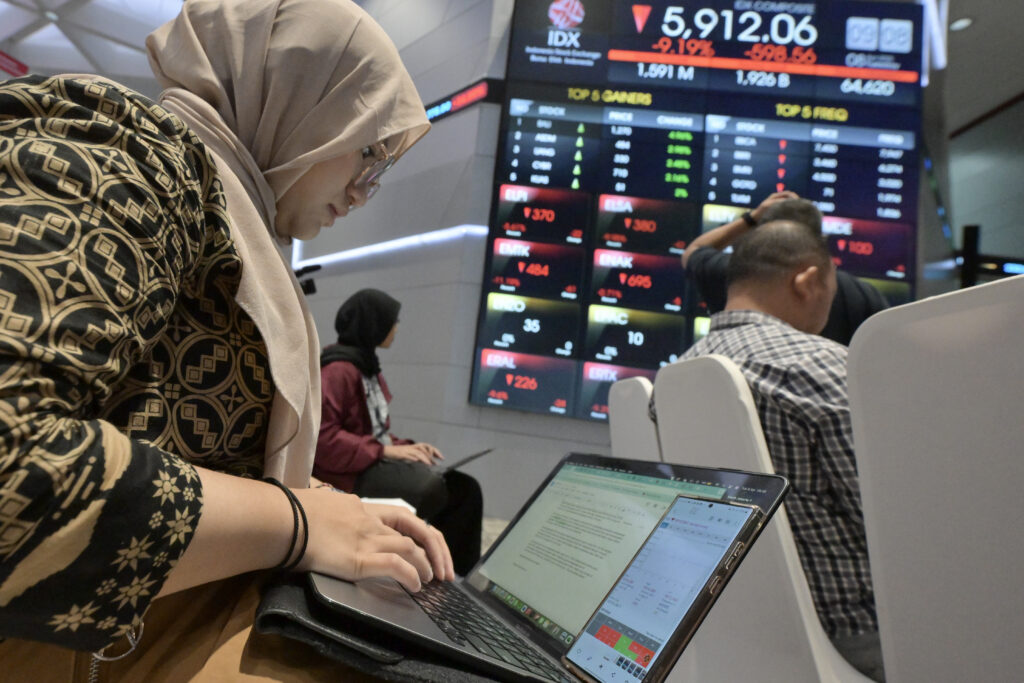
Lingering hopes that Donald Trump’s planned tariff blitz next week will not be as painful as feared lifted most Asian markets Wednesday, though uncertainty about the president’s policies and the US economy tempered optimism.With the White House’s “Liberation Day” on April 2 approaching, investors have been bracing for a wave of sweeping levies on imports amid warnings of crippled global trade, recession and a fresh spike in inflation.But suggestions from Trump and others in Washington that the measures could be more targeted, with some countries hit harder than others, have provided a sliver of hope that the worst-case scenario can be avoided.The president told Newsmax that “I don’t want to have too many exceptions” but added: “I’ll probably be more lenient than reciprocal, because if I was reciprocal, that would be very tough for people”.Signs of a less severe approach helped Wall Street record two successive days of gains, paring hefty losses suffered in recent weeks fuelled by fears that the hardball US policies would hit companies’ bottom lines.Hong Kong battled to edge higher a day after tanking more than two percent on profit-taking and selling in the tech sector, while Tokyo, Sydney, Seoul, Singapore, Bangkok, Manila and Wellington also advanced.Jakarta jumped more than three percent after a hefty sell-off this year fuelled by worries over the Indonesian economy. However, the country’s rupiah remained stuck around its lowest levels since the Asian financial crisis at the end of the last century.London, Paris and Frankfurt rose at the open.Shanghai was flat while Taipei and Mumbai edged down. Copper futures traded on New York’s Comex exchange touched a record high after Trump said he could impose duties on imports of the commodity within weeks.While there is some hope over tariffs, Americans’ fears about the economic outlook indicated the United States could be in for a bumpy ride.The Conference Board’s closely watched gauge of consumer confidence dived to its lowest level since 2021 — during the pandemic — as concerns grow over higher prices.Meanwhile, another reading on expectations for the next six months hit a 12-year low.The figures come as the Federal Reserve re-evaluates its monetary policy in light of Trump’s tariffs agenda, with some analysts warning it might have to hold off any interest rate cuts this year.At the end of a volatile first quarter, Charu Chanana, chief investment strategist at Saxo, said it had “challenged conventional thinking”.”While rate cut hopes dominated headlines early in the year, markets moved on quickly as economic resilience, sector rotation, geopolitical shifts, and regional divergences took centre stage,” she wrote in a commentary.”Trade policy returned to focus as the US election narrative picked up. Even without concrete tariffs, the potential for disruption hit sentiment across global sectors.”There was little major reaction to news that Russia and Ukraine had agreed to halt military strikes in the Black Sea and on energy sites following talks brokered by Washington.The Kremlin said the deal could come into force only after the lifting of restrictions on its agriculture sector.- Key figures around 0815 GMT -Tokyo – Nikkei 225: UP 0.7 percent at 38,027.29 (close)Hong Kong – Hang Seng Index: UP 0.6 percent at 23,483.32 (close)Shanghai – Composite: FLAT at 3,368.70 (close)London – FTSE 100: UP 0.3 percent at 8,691.37Euro/dollar: DOWN at $1.0789 from $1.0791 on TuesdayPound/dollar: DOWN at $1.2908 from $1.2943Dollar/yen: UP at 150.36 yen from 149.90 yenEuro/pound: UP at 83.58 pence from 83.37 penceWest Texas Intermediate: UP 0.2 percent at $69.16 per barrelBrent North Sea Crude: UP 0.2 percent at $73.16 per barrelNew York – Dow: FLAT at 42,587.50 (close)

US imposes trade restrictions on dozens of entities with eye on China

The United States added dozens of entities to a trade blacklist Tuesday, its Commerce Department said, in part to disrupt Beijing’s artificial intelligence and advanced computing capabilities.The action affects 80 entities from countries including China, the United Arab Emirates and Iran, with the department citing their “activities contrary to US national security and foreign policy.”Those added to the “entity list” are restricted from obtaining US items and technologies without government authorization.”We will not allow adversaries to exploit American technology to bolster their own militaries and threaten American lives,” said US Commerce Secretary Howard Lutnick.The entities targeted include 11 based in China and one in Taiwan, accused of engaging in the development of advanced AI, supercomputers and high-performance AI chips for China-based users “with close ties to the country’s military-industrial complex.”They include the Beijing Academy of Artificial Intelligence and subsidiaries of IT giant Inspur Group.Others were included for “contributions to unsafeguarded nuclear activities” or ballistic missile programs.The aim is to prevent US technologies and goods from being misused for activities like high performance computing, hypersonic missiles and military aircraft training, said Under Secretary of Commerce for Industry and Security Jeffrey Kessler.Two entities in Iran and China were also added to the list for seeking to procure US items for Iran’s defense industry and drone programs, the Commerce Department said.Beijing condemned the blacklisting of its firms, accusing Washington of “weaponizing” trade and technology in a “typical act of hegemonism”.”We urge the US side to stop generalizing the concept of national security… and stop abusing all kinds of sanctions lists to unreasonably suppress Chinese enterprises,” foreign ministry spokesman Guo Jiakun said at a daily news conference.China would take “necessary measures” to defend its firms’ rights, Guo added.Several of the blacklisted companies did not respond to AFP’s request for comment on Wednesday.

Lula urges Mercosur-Japan deal to counter Trump protectionism

Brazil’s President Luiz Inacio Lula da Silva called Wednesday for a trade deal between South America’s Mercosur bloc and Japan to counter growing US protectionism.”I am certain that we need to move forward in signing an Economic Partnership Agreement between Japan and Mercosur,” Lula said during a multi-day visit to Tokyo.”Our countries have more to gain from integration than from protectionist practices,” he said at an economic forum attended by business and political figures from Brazil and Japan.Mercosur’s four members — Argentina, Brazil, Paraguay and Uruguay — in December struck a free-trade deal with the European Union although it still faces hurdles before final approval.Business groups in Japan, the world’s fourth-largest economy, have been pressing the government to also strike an agreement with the bloc.The Keidanren business federation “urgently” called in November for “expedited efforts” towards a Japan-Mercosur Economic Partnership Agreement (EPA), an accord similar to a free trade deal.”The benefits that a Japan-Mercosur EPA would bring to both parties are immense,” the group said, noting the South American bloc’s population of 300 million people and economic output approaching $3 trillion.But an agreement may be politically hard because of fears about the impact on Japanese farmers of large-scale agricultural imports, particularly from Brazil and Argentina.Japanese Prime Minister Shigeru Ishiba said on Wednesday that he and Lula will “strongly push towards more smooth bilateral trade and investment”.”Business circles of both countries have pushed for early agreement on a Japan-Mercosur EPA. While listening to these voices, we will continue talks towards strengthening bilateral and economic ties,” he said.Lula, 79, arrived in Japan on Monday accompanied by a 100-strong business delegation.He and Ishiba were expected to restate their commitment to free trade — in light of US President Donald Trump’s levies on steel and other imports — in a joint statement expected later Wednesday.”We cannot go back to relying on protectionism. We do not want a second Cold War,” Lula said Wednesday.”We want free trade so that we can ensure that democracy, economic growth and wealth distribution become established in our countries,” he added.Lula and Ishiba, 68, were also expected to discuss the joint development of biofuels ahead of November’s COP30 UN climate summit in the Brazilian Amazon.

Asian stocks rise on trade optimism, but US policy uncertainty lingers

Lingering hopes that Donald Trump’s planned tariff blitz next week will not be as painful as feared helped lift Asian markets Wednesday, though uncertainty about the president’s policies and the US economy tempered optimism.With the White House’s “Liberation Day” on April 2 approaching, investors have been bracing for a wave of sweeping levies on imports amid warnings of crippled global trade, recession and a fresh spike in inflation.But suggestions from Trump and others in Washington that the measures could be more targeted, with some countries hit harder than others, have provided a sliver of hope that the worst-case scenario can be avoided.The president told Newsmax that “I don’t want to have too many exceptions” but added: “I’ll probably be more lenient than reciprocal, because if I was reciprocal, that would be very tough for people”.Signs of a less severe approach helped Wall Street record two successive days of gains, paring hefty losses suffered in recent weeks fuelled by fears that the hardball US policies would hit companies’ bottom lines.And after a mixed day Monday, Asia followed suit. Hong Kong pushed higher a day after tanking more than two percent on profit-taking and selling in the tech sector, while Tokyo, Sydney, Shanghai, Seoul, Singapore and Wellington also advanced.Jakarta jumped almost three percent after a hefty sell-off this year fuelled by worries over the Indonesian economy. However, the country’s rupiah remained stuck around its lowest levels since the Asian financial crisis at the end of the last century.Taipei and Manila edged down.But while there is some hope over tariffs, Americans’ fears about the economic outlook indicated the United States could be in for a bumpy ride.The Conference Board’s closely watched gauge of consumer confidence dived to its lowest level since 2021 — during the pandemic — as concerns grow over higher prices.Meanwhile, another reading on expectations for the next six months hit a 12-year low.The figures come as the Federal Reserve re-evaluates its monetary policy in light of Trump’s tariffs agenda, with some analysts warning it might have to hold off any interest rate cuts this year.At the end of a volatile first quarter, Charu Chanana, chief investment strategist at Saxo, said it had “challenged conventional thinking”.”While rate cut hopes dominated headlines early in the year, markets moved on quickly as economic resilience, sector rotation, geopolitical shifts, and regional divergences took centre stage,” she wrote in a commentary.”Trade policy returned to focus as the US election narrative picked up. Even without concrete tariffs, the potential for disruption hit sentiment across global sectors.”There was little major reaction to news that Russia and Ukraine had agreed to halt military strikes in the Black Sea and on energy sites following talks brokered by Washington.The Kremlin said the deal could come into force only after the lifting of restrictions on its agriculture sector.- Key figures around 0230 GMT -Tokyo – Nikkei 225: UP 0.3 percent at 37,890.15 (break)Hong Kong – Hang Seng Index: UP 0.2 percent at 23,391.53Shanghai – Composite: UP 0.1 percent at 3,371.91Euro/dollar: UP at $1.0794 from $1.0791 on TuesdayPound/dollar: UP at $1.2944 from $1.2943Dollar/yen: UP at 150.14 yen from 149.90 yenEuro/pound: UP at 83.40 pence from 83.37 penceWest Texas Intermediate: UP 0.4 percent at $69.25 per barrelBrent North Sea Crude: UP 0.3 percent at $73.24 per barrelNew York – Dow: FLAT at 42,587.50 (close)London – FTSE 100: UP 0.3 percent at 8,663.80 (close)

US judge sets June 23 trial date over Boeing crashes

A US federal judge on Tuesday set a trial date of June 23 in the Justice Department’s criminal case against aircraft manufacturing giant Boeing over two deadly 737 MAX crashes in 2018 and 2019.In two court filings in Texas, Judge Reed O’Connor said he was vacating an April 11 deadline for Boeing and prosecutors to announce progress on a plea deal, and moving ahead with the trial over the two crashes, in which 346 people died.In a statement, Boeing said it was still engaged in “good faith discussions” with the Justice Department regarding an “appropriate” resolution of the matter.The Justice Department declined to comment on the case.”I am so happy that Judge O’Connor of Texas… has put an end to the delaying tactics of Boeing and the Department of Justice,” said Catherine Berthet, whose daughter Camille died in one of the crashes. “Finally (there is) going to be a trial,” Berthet told AFP. Boeing agreed last July to plead guilty to fraud after the Justice Department found the company failed to improve its compliance and ethics program, in breach of a deferred prosecution agreement following the two deadly MAX crashes.That deal was concluded in January 2021 to address the disasters in Ethiopia and Indonesia.But in December, a judge in Texas rejected the 2024 settlement over apparent flaws in the selection process for a monitor to ensure Boeing’s compliance, sending the company and the government back to continue discussions.”For years we have been fighting, and I am fighting, on behalf of the victims and my daughter Camille, for truth and justice,” said Berthet.”A trial is necessary to bring this truth to light.”It was not immediately clear why O’Connor decided to cancel the April 11 deadline for the plea deal and move directly to trial.