AFP USA

Sabrina Carpenter condemns ‘evil’ use of her music in White House video

US pop singer Sabrina Carpenter on Tuesday disavowed the use of one of her songs in a video shared by the White House on social media, describing the clip depicting immigration enforcement raids as “evil and disgusting.”The video, posted Monday, features Carpenter’s 2024 song “Juno” accompanying footage of Immigration and Customs Enforcement (ICE) agents in action, tackling people and clipping handcuffs onto detainees.”This video is evil and disgusting. Do not ever involve me or my music to benefit your inhumane agenda,” Carpenter wrote in response to the White House post.White House spokeswoman Abigail Jackson retorted: “Here’s a Short ‘n Sweet message for Sabrina Carpenter: we won’t apologize for deporting dangerous criminal illegal murderers, rapists, and pedophiles from our country. Anyone who would defend these sick monsters must be stupid, or is it slow?”Several other artists have protested President Donald Trump and his team’s use of their music. American singer and guitarist Kenny Loggins recently demanded the removal of a video posted by the president that used his hit “Danger Zone” from the movie “Top Gun.” The video used AI-generated images of Trump as a fighter pilot dropping excrement on political opponents.In 2024, Celine Dion condemned the use of one of her songs, “My Heart Will Go On,” in a campaign video, and Beyonce reacted similarly over use of her song “Freedom” the same year.

Doctor to be sentenced for supplying Matthew Perry with ketamine

A doctor who supplied “Friends” star Matthew Perry with ketamine in the months before he fatally overdosed, is to be sentenced in Los Angeles on Wednesday.Salvador Plasencia, 43, one of five people charged over Perry’s death, has admitted to four counts of distribution of ketamine.He faces up to 40 years in prison as well as a fine that could run into millions of dollars. He will also surrender his medical license.At an earlier hearing, Plasencia’s attorney, Karen Goldstein, said her client regretted his actions.”Dr. Plasencia is profoundly remorseful for the treatment decisions he made while providing ketamine to Matthew Perry,” Goldstein said in a statement.”He is fully accepting responsibility…acknowledging his failure to protect Mr. Perry, a patient who was especially vulnerable due to addiction.”Plasencia did not provide Perry with the fatal dose of ketamine but supplied the actor with the drug in the weeks before he was found dead in a hot tub at his Los Angeles home.Another doctor, Mark Chavez, pleaded guilty in October to conspiring to distribute ketamine to Perry.Plasencia allegedly bought ketamine off Chavez and sold it to the American-Canadian actor at hugely inflated prices.”I wonder how much this moron will pay,” Plasencia wrote in one text message presented by prosecutors.The four other people who have also admitted their part in supplying drugs to the actor will be sentenced over the coming months.They include Jasveen Sangha, the alleged “Ketamine Queen” who supplied drugs to high-end clients and celebrities, who could be jailed for up to 65 years.Perry’s live-in personal assistant and another man pleaded guilty in August to charges of conspiracy to distribute ketamine.- Addiction struggles -The actor’s lengthy struggles with substance addiction were well-documented, but his death at age 54 sent shockwaves through the global legions of “Friends” fans.A criminal investigation was launched soon after an autopsy discovered he had high levels of ketamine — an anesthetic — in his system.In his plea deal with prosecutors, Plasencia said he went to Perry’s home to administer ketamine by injection and distributed 20 vials of the drug over a roughly two-week period in autumn 2023.Perry had been taking ketamine as part of supervised therapy for depression.But prosecutors say that before his death he became addicted to the substance, which also has psychedelic properties and is a popular party drug.”Friends,” which followed the lives of six New Yorkers navigating adulthood, dating and careers, drew a massive following and made megastars of previously unknown actors.Perry’s role as the sarcastic man-child Chandler brought him fabulous wealth, but hid a dark struggle with addiction to painkillers and alcohol.In 2018, he suffered a drug-related burst colon and underwent multiple surgeries.In his 2022 memoir “Friends, Lovers and the Big Terrible Thing,” Perry described going through detox dozens of times.”I have mostly been sober since 2001,” he wrote, “save for about sixty or seventy little mishaps.”

Trump administration dismisses eight immigration judges in New York

The US Department of Justice has dismissed eight immigration judges in New York City, the association representing them said Tuesday, amid tensions with the courts as President Donald Trump’s administration cracks down on undocumented migrants.According to the National Association of Immigration Judges (NAIJ), which confirmed media reports, the eight judges all worked at 26 Federal Plaza in Manhattan. The address houses a court that reviews cases of migrants attempting to regularize their status.For months, masked federal officers have been patrolling the hallways of the Jacob K. Javitz Federal Building daily. The officers make arrests of migrants as they leave hearings, but under the watchful eye of the press, which is frequently present.Images of scuffles with police and of immigrant families being separated have gone viral around the world, making 26 Federal Plaza a symbolic site of the Trump administration’s crackdown on migrants nationwide. It’s unclear what led to the eight New York judges being dismissed. However, they join approximately 90 judges who were dismissed over the year across the country out of about 600, according to a report by the New York Times.As migrant advocacy groups see them, these dismissals are aimed at replacing the outgoing judges with others who are more aligned with the administration’s immigration policy.The dismissals took place after several dozen people gathered in Manhattan over the weekend to try to prevent a possible raid by the Immigration and Customs Enforcement Agency (ICE) against street vendors. The New York police made several arrests.As a so-called sanctuary city for migrants, New York City voluntarily limits cooperation between its local authorities and federal immigration services. However, it does not prevent their operations.

San Francisco sues producers over ultra-processed food

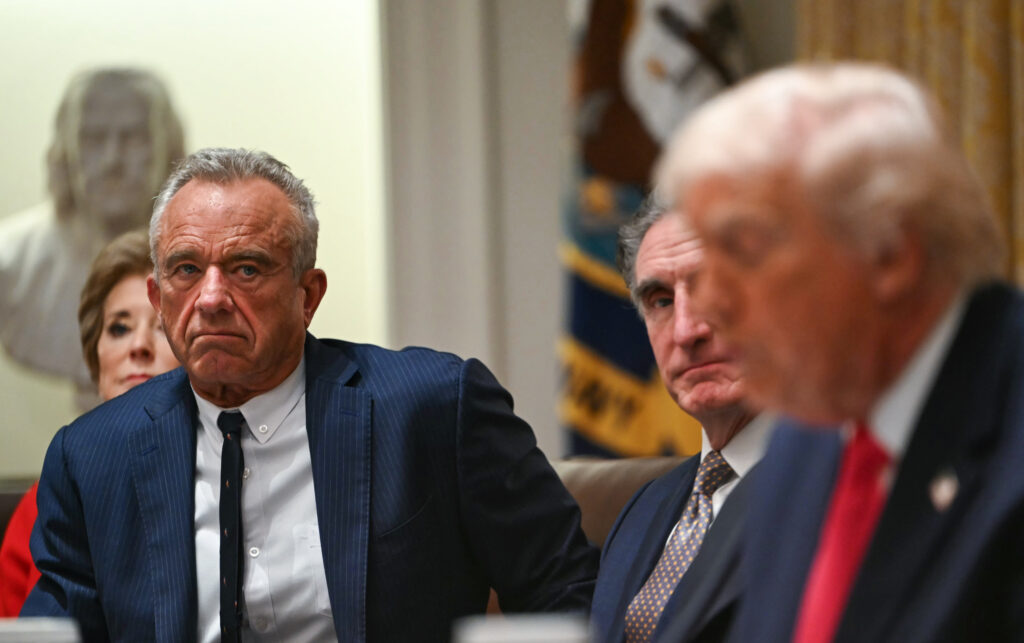
San Francisco is suing makers of the ultra-processed food that health experts say has led millions of Americans into obesity during decades of over-consumption, the city said Tuesday.In what officials said was a first-of-a-kind lawsuit, the liberal California city is taking to task some of the largest names in groceries, including Kraft Heinz, Coca-Cola, Nestle and Kellogg.”These companies created a public health crisis with the engineering and marketing of ultra-processed foods,” San Francisco City Attorney David Chiu said. “They took food and made it unrecognizable and harmful to the human body.”Ultra-processed food, including candies, chips, sodas and breakfast cereals, are typically made from ingredients that have been broken down, chemically modified and combined with artificial additives.They frequently contain colors, flavor enhancers, sweeteners, thickeners, foaming agents and emulsifiers, and typically cannot be produced in the home.”Americans want to avoid ultra-processed foods, but we are inundated by them. These companies engineered a public health crisis, they profited handsomely, and now they need to take responsibility for the harm they have caused,” Chiu said.- A common cause -With its lawsuit, lodged in San Francisco Superior Court, the Democratic-run city is making common cause with the Make America Healthy Again (MAHA) movement that has coalesced around Health and Human Services Secretary Robert Kennedy.The movement is a significant part of the fractious coalition that President Donald Trump rode to the White House for his second term in office.Kennedy has frequently taken aim at processed foods, calling them “poison” and blaming them for rising obesity, chronic illness and poor health, especially among young people.The US Centers for Disease Control says 40 percent of Americans are obese, and almost 16 percent have diabetes, a condition that can result from being excessively overweight.The lawsuit lodged Tuesday, which is demanding unspecified damages, claims that around 70 percent of the products sold in US supermarkets are ultra-processed.It says manufacturers employed a similar strategy to that of tobacco companies, pushing a product they knew was harmful with marketing that ignored or obscured the risks.”Just like Big Tobacco, the ultra-processed food industry targeted children to increase their profits,” a statement said.”The companies surrounded children with consistent product messages and inundated them with advertising using cartoon mascots like Tony the Tiger and Fred Flintstone.”Despite having actual knowledge of the harm they had caused, the ultra-processed food industry continued to inundate children with targeted marketing and make increasingly addictive products with little nutritional value.Sarah Gallo of the Consumer Brands Association, an umbrella grouping of many of the companies targeted in the suit, said manufacturers “support Americans in making healthier choices and enhancing product transparency.””There is currently no agreed upon scientific definition of ultra-processed foods and attempting to classify foods as unhealthy simply because they are processed, or demonizing food by ignoring its full nutrient content, misleads consumers and exacerbates health disparities.”Companies adhere to the rigorous evidence-based safety standards established by the (government) to deliver safe, affordable and convenient products that consumers depend on every day.”

Afghan man pleads not guilty in US National Guard shooting

An Afghan man accused of shooting two members of the National Guard near the White House, killing one, pleaded not guilty on Tuesday to murder charges.Rahmanullah Lakanwal, 29, who was injured during last month’s attack, entered the plea by video feed from a hospital bed, US media reported.Lakanwal is charged with first-degree murder for the death of Sarah Beckstrom, 20, a National Guard member from West Virginia, as well as assault with intent to kill and firearms offenses.Andrew Wolfe, another National Guardsman from West Virginia, was wounded in the November 26 attack and is in critical condition.Magistrate Judge Renee Raymond ordered Lakanwal detained until the next hearing in the case on January 14.- Death penalty sought -Attorney General Pam Bondi has said she plans to seek the death penalty for Lakanwal, who entered the United States as part of a resettlement program following the American military withdrawal from Afghanistan in 2021.Lakanwal had been part of a CIA-backed “partner force” fighting the Taliban in Afghanistan, according to US officials.According to a criminal complaint filed on Tuesday, Lakanwal ambushed Beckstrom and Wolfe while they were on a routine patrol outside a metro station in downtown Washington.Another National Guard member who was on the scene was quoted in the complaint as saying that he saw Lakanwal open fire and scream “Allahu Akbar!”The National Guard soldier drew his weapon, shot and wounded Lakanwal and then restrained him as he attempted to reload his gun, the complaint said.US Homeland Security Secretary Kristi Noem said over the weekend that Lakanwal may have been radicalized after entering the United States.A resident of the western US state of Washington, he allegedly drove cross-country to carry out the shooting — an attack that shocked Americans on the eve of the Thanksgiving holiday. President Donald Trump’s administration suspended visas for all Afghan nationals following the attack and froze decisions in all asylum cases.Lakanwal was granted asylum in April 2025, under the Trump administration, but officials have blamed what they called lax vetting by the government of Trump’s predecessor Joe Biden for his admission to US soil during the Afghan airlift.The Justice Department announced meanwhile that an Afghan man has been charged in Texas with threatening to build a bomb and carry out a suicide attack on Americans.Mohammad Dawood Alokozay, 30, of Fort Worth, allegedly praised the Taliban and made the threats in a November 23 video that he shared on TikTok, X and Facebook, the department said in a statement.”Thanks to public reports of a threatening online video, the FBI’s Joint Terrorism Task Force apprehended this individual before he could commit an act of violence,” FBI Dallas special agent in charge Joseph Rothrock said.Alokozay faces up to five years in prison if convicted of making a threatening interstate communication.

Steve Witkoff, neophyte diplomat turned Trump’s global fixer

The American at the forefront of negotiating an end to the Ukraine war is not a veteran diplomat or the US secretary of state but a billionaire real estate developer, Steve Witkoff.Much like President Donald Trump — for years his friend and golfing partner — Witkoff came to the world stage without traditional experience. Instead, he relies on what the two men believe is a successful instinct in human relations and deal-making.For Trump, the 68-year-old Witkoff brings the quality the president most cherishes: personal loyalty. But Witkoff has drawn wide criticism from those who believe he is out of his depth and has shown too much deference to Russian President Vladimir Putin, whom he met in Moscow on Tuesday.”I liked him. I thought he was straight up with me,” Witkoff said in March after meeting Putin, who has ruthlessly targeted opponents at home and abroad.”I don’t regard Putin as a bad guy. That is a complicated situation, that war, and all the ingredients that led up to it,” Witkoff said.More recently, Bloomberg News reported a telephone conversation in which Witkoff offered advice to one of Putin’s advisors on the best way to present to Trump a plan to end the Ukraine war.According to the transcript, Witkoff said during the call that he believes Russia — which started the war in Ukraine by launching a full-scale invasion in February 2022 — “has always wanted a peace deal” and that he has “the deepest respect for President Putin.”Witkoff flew to Moscow with Trump’s son-in-law, Jared Kushner, after meeting Ukrainian negotiators in Florida. An initial version of the plan would ask Ukraine to cede territory that Russia has not won on the battlefield in return for security promises to Ukraine that fall well short of Kyiv’s hopes to join NATO.Trump has fumed about billions of dollars in US assistance to Ukraine and mused in the past that time was on Russia’s side.- Unorthodox approach -It was the latest trip this year to Russia by Witkoff, who was tapped after Trump’s election victory last year as his special envoy on the Middle East and quickly expanded his remit beyond negotiating two ceasefires in Gaza.Witkoff quickly showed he was willing to break traditions to get deals. He worked alongside the outgoing administration of Joe Biden for the first of the ceasefires.At one point, Witkoff flew from the discussions in Qatar to Israel to personally press Israeli Prime Minister Benjamin Netanyahu to accept. It was an unusual meeting held on Saturday, when official Israel is closed due to the Jewish Sabbath — Witkoff is also Jewish.In another break with protocol, Witkoff has met directly with representatives of Hamas, which the United States bans as a terrorist group, to push them on a deal.After Israel targeted Hamas leaders meeting in September in Qatar, a close US partner, Witkoff personally offered condolences in Cairo to the top Hamas negotiator, Khalil al-Haya, whose son was killed in the Israeli strike.”I told him that I had lost a son, and that we were both members of a really bad club, parents who have buried children,” Witkoff later told CBS News program “60 Minutes.” Witkoff often speaks of his son Andrew, who died of an opioid overdose at age 22 in 2011.Witkoff was born in the Bronx and made his fortune in real estate, first as a lawyer and later as head of a property group. Forbes estimates his wealth at $2 billion.

Tech boss Dell gives $6.25bn to ‘Trump accounts’ for kids

Computer tycoon Michael Dell and his wife Susan said Tuesday they were giving $6.25 billion to children’s trust funds under a scheme set up by US President Donald Trump.So-called “Trump accounts” containing $1,000 for all children born after January 1, 2025 were part of the “One Big Beautiful Bill” that the Republican president pushed through Congress in July.But the Dell donation will now fund $250 deposits in saving accounts for at least 25 million children aged 10 and under, who were born before the cut-off point for the original program.”This will give millions of children a stake in American prosperity, a benefit from the rising stock market, and a better shot at the American dream,” Trump said in a ceremony at the White House.”This is truly one of the most generous acts in the history of our country.”The Dell Technologies founder and CEO, 60, said he hoped the accounts would teach children to save for their own futures.”We kind of started with a smaller amount to be honest” but then decided to donate more money, Michael Dell said.”We believe this is the greatest investment we can possibly make in children,” added Susan Dell.The “Trump accounts” will be available to children once they turn 18.The Dells’ gift will reach nearly 80 percent of children aged 10 and under, particularly targeting those in areas with the lowest income, their charitable foundation said in a fact sheet.The “Trump accounts” for newborns were part of the unpopular tax and spending bill that Trump pushed Republicans to get through a reluctant Congress and cement his second term agenda.The bill also included massive new funding for Trump’s migrant deportation drive, while gutting health and welfare support and sparking concerns that it would balloon the US national debt.

Trump hints economic adviser Hassett may be Fed chair pick

US President Donald Trump on Tuesday hinted that he wants to nominate his chief economic adviser Kevin Hassett to replace outgoing Federal Reserve Chairman Jerome Powell next year.Introducing guests at a White House event attended by Hassett, Trump said: “It’s a great group, and I guess a potential Fed chair is here too.”He added: “I don’t know, are we allowed to say that, potential? He’s a respected person that I can tell you. Thank you, Kevin.”At a meeting of his cabinet earlier in the day, Trump said he would announce his pick “probably early next year for the new chairman of the Fed.””I think we probably looked at 10 and we have it down to one,” he said.Hassett, a PhD economist, is currently chair of the National Economic Council, a White House body which advises the president and his cabinet on policymaking.He frequently appears on television touting the president’s policies.During Trump’s first term, he served as chair of the Council of Economic Advisers, another body more dedicated to research and analysis.While Hassett’s loyalty to Trump could open the doors to a Fed nomination, it is also likely to be a key discussion topic among the political and financial class as he seeks confirmation by the Republican-controlled Senate.He will have to convince Senators — and markets — that he is capable of preserving the central bank’s independence and won’t let inflation spiral out of control in the world’s biggest economy.He has joined Trump in publicly criticizing the Fed over its interest-rate decisions, calling for more cuts this year, though he has not used harsh language against Powell like the president.The term of current Fed Chair Powell ends in May 2026.Trump tried unsuccessfully to hasten Powell’s departure, hurling insults and recriminations at the man he picked for the job during his first term in the White House.Since then, Trump has said he bitterly regrets this choice as Powell has resisted pressure to lower interest rates quickly enough.On Tuesday, Trump referred to the Fed chairman as a “stubborn ox” and alleged that the decision to not lower rates more quickly was motivated by personal animus.

US medical agency will scale back testing on monkeys

The United States will scale back certain drug-safety testing requirements on monkeys, federal regulators said Tuesday, as President Donald Trump’s administration pushes ahead with its pledge to reduce animal use in research.Under new draft guidance from the Food and Drug Administration (FDA), computer models, lab-grown mini-organs, and human studies will replace six-month repeat-dose toxicity tests in monkeys for monoclonal antibodies — lab-engineered proteins used to treat cancers, autoimmune conditions and more.”We are delivering on our roadmap commitment to eliminate animal testing requirements in drug evaluation and our promise to accelerate cures and meaningful treatments for Americans,” FDA Commissioner Marty Makary said in a statement.The statement added that typical nonclinical programs involving monoclonal antibodies could include more than 100 macaque monkeys — apes are no longer used in any invasive research in the US — yet often do not yield human-approved treatments.The move was welcomed by animal-advocacy groups.Zaher Nahle, a former animal researcher who is now the senior scientific advisor for nonprofit Center for a Humane Economy, told AFP the move was an “important step.””These primates are not reliable in terms of predicting the toxicity, so you can get at least equal or better results in terms of your accuracy in predicting toxicology using other approaches,” he added.What’s more, he noted, studies show that more than 90 percent of drugs deemed safe and effective in animals fail to win approval for human use.The FDA’s announcement follows a report in the journal Science last month that the Centers for Disease Control and Prevention (CDC) would close its primate labs, and comes amid broader efforts by federal agencies to shift animal research toward newer technologies.It “moves us one step closer to wiping out the federal government’s wasteful monkey business,” Justin Goodman of White Coat Waste Project told AFP.But the National Institutes of Health (NIH) — the country’s primary biomedical research agency — remains a notable “outlier,” he added. According to public data collected by his organization, 7,700 primates are confined in federal government labs and breeding facilities, of which 6,700 are at NIH.- ‘We still need animals’ -Among researchers, the move sparked concern about moving too far, too fast.Deborah Fuller, director of the Washington National Primate Research Center — one of seven such centers established by the NIH in the 1960s — said the FDA’s decision to reduce antibody-toxicity testing in monkeys was “very reasonable” noting that non-animal methods are suitable for this purpose.But she warned that moving too quickly in other areas could jeopardize drug development.”This needs to be driven by the science and the data, not by (the) ideology of people just wanting to suddenly end animal research because it feels good and sounds good,” she told AFP.”In terms of the next cures and biomedical advances, we still need animals,” she said, adding that non-animal methods aren’t yet as capable and that preclinical animal safety testing is the reason “you’re not hearing about people dying” during clinical trials.Proponents of animal testing also argue the research has been indispensable for major medical advances, including vaccines for diphtheria, yellow fever, measles and Covid-19.Critics counter that decades-old laws have created regulatory lock-in, that publication incentives reward animal studies in top journals, and that a lucrative “animal-industrial complex” has helped entrench the status quo.

Defense challenge evidence in killing of US health insurance CEO

The defense for the 27-year-old suspect accused of killing a top health insurance executive in New York sought to exclude evidence presented by the prosecution as he appeared in court for a second day Tuesday.Luigi Mangione is charged with the second-degree murder of Brian Thompson, the CEO of UnitedHealthcare, the largest US health insurer. Thompson, 50, was shot dead on a Manhattan street on December 4, 2024.Mangione, who comes from a wealthy Boston family, has become a lightning rod for anger against the US commercial healthcare system, but also a reminder of growing incidents of deadly violence perpetrated against public figures in the country.His lawyers requested a preliminary hearing in the murder case brought by the State of New York.Mangione was arrested at a McDonald’s restaurant in the state of Pennsylvania, days after last year’s shooting.Police found in his backpack a pistol equipped with a silencer and a notebook where he wrote grievances against the healthcare system.According to police, the bullet shell casings at the murder scene matched the weapon Mangione was carrying.But Mangione’s lawyers argue that the defendant’s rights were violated.In their motion, seen by AFP, they say that the evidence recovered from his backpack “must be suppressed because law enforcement failed to obtain a search warrant before searching the backpack.”They also argue that Mangione’s statements to police inside the McDonald’s should be excluded “as they were the result of custodial interrogation without Miranda warnings” about his rights.  In September, a judge threw out two terror charges against Mangione, but he is still accused of second degree murder. If convicted he could face life imprisonment without parole. He also faces federal charges.