AFP USA

SpaceX Starship explodes during routine test

One of Elon Musk’s SpaceX Starships exploded during a routine test in Texas late Wednesday, law enforcement officials said, in the latest setback to the billionaire’s dream of turning humanity into an interplanetary species.The Starship 36 suffered “catastrophic failure and exploded” at the Starbase launch facility shortly after 11:00 pm (0400 GMT Thursday), a Facebook post by Cameron County authorities said.A video shared with the post showed the megarocket attached to the launch arm and then a flash and a towering, fiery explosion.Musk’s Space X said the rocket was preparing for the tenth flight test when it “experienced a major anomaly while on a test stand at Starbase,” without elaborating on the nature of the complication.”A safety clear area around the site was maintained throughout the operation and all personnel are safe and accounted for,” Space X said on social media.”There are no hazards to residents in surrounding communities, and we ask that individuals do not attempt to approach the area while safing operations continue.” The Starship was not scheduled for launch on Wednesday evening when the explosion occurred during a “routine static fire test,” according to the Cameron County authorities. During a static fire, part of the procedures preceding a launch, the Starship’s Super Heavy booster would be anchored to the ground to prevent it from lifting off during the test-firing.Starbase, on the south Texas coast near the border with Mexico, is the headquarters for Musk’s space project.Musk appeared to downplay the incident early on Thursday.”Just a scratch,” he posted on his social media platform X, although without context it was unclear if he was referring to the fiery explosion of the rocket.- Megarocket -Standing 403 feet (123 meters) tall, Starship is the world’s largest and most powerful rocket and is central to Musk’s long-term vision of colonizing Mars.The Starship is billed as a fully reusable rocket with a payload capacity of up to 150 metric tons.The latest setback follows the explosion of a prototype Starship over the Indian Ocean in late May.The biggest and most powerful launch vehicle ever built had lifted off from the Starbase facility on May 27, but the first-stage Super Heavy booster blew up instead of executing its planned splashdown in the Gulf of Mexico.The previous two outings also ended poorly, with the upper stage disintegrating over the Caribbean.However, the failures will likely do little to dent Musk’s spacefaring ambitions.SpaceX has been betting that its “fail fast, learn fast” ethos, which has helped it dominate commercial spaceflight, will eventually pay off.The company has caught the Super Heavy booster in the launch tower’s giant robotic arms three times — a daring engineering feat it sees as key to rapid reusability and slashing costs.NASA is also increasingly reliant on SpaceX, whose Dragon spacecraft is vital for ferrying astronauts to and from the International Space Station.The Federal Aviation Administration approved an increase in annual Starship rocket launches from five to 25 in early May, stating that the increased frequency would not adversely affect the environment.The decision overruled objections from conservation groups that had warned the expansion could endanger sea turtles and shorebirds.burs-abs/aha/pbt

Govts scramble to evacuate citizens from Israel, Iran

Governments around the world are evacuating thousands of their nationals caught up in the rapidly spiralling Israel-Iran conflict, organising buses and planes and in some cases assisting people crossing borders on foot. Foreigners have rushed to leave both countries after Israel launched an unprecedented bombing campaign last Friday targeting Iran’s nuclear and military facilities, sparking retaliation from Tehran.With Israel’s air space closed and the two countries exchanging heavy missile fire, many people are being evacuated via neighbouring countries. – Europe -European countries have already repatriated hundreds of their citizens from Israel.The Czech Republic and Slovakia said Tuesday they had taken 181 people home on government planes.”It was not possible to send the army plane straight to Israel,” the Czech defence ministry said in a statement, citing the air space closure.”The evacuees were taken to an airport in a neighbouring country by buses. They crossed the border on foot.”The German government said flights were scheduled for Wednesday and Thursday via Jordan, while Poland said the first of its citizens were due to arrive back on Wednesday.Greece said it had repatriated 105 of its citizens plus a number of foreign nationals via Egypt, while a private plane with 148 people landed in the Bulgarian capital Sophia on Tuesday.  – United States -The US ambassador to Israel on Wednesday announced plans for evacuating Americans by air and sea.The embassy is “working on evacuation flights & cruise ship departures” for “American citizens wanting to leave Israel,” Ambassador Mike Huckabee posted on social media.- China -China has evacuated more than 1,600 citizens from Iran and several hundred more from Israel.The Chinese foreign ministry said Thursday its “embassies and consulates will continue to make every effort to assist in the safe transfer and evacuation of Chinese citizens”.- Australia -Australia has started evacuating around 1,500 citizens from Iran and more than 1,200 from Israel — but missile barrages have made it too risky for civilian aircraft to land in either country, its foreign minister said. “There’s no capacity for people to get civilian aircraft in, it is too risky, and the airspace is closed,” Foreign Minister Penny Wong told national broadcaster ABC. “We have taken the opportunity to get a small group of Australians out of Israel through a land border crossing. “We are seeking to try and do more of that over the next 24 hours.” – Pakistan -Pakistan has shut its border crossings with neighbouring Iran, except to Pakistanis wanting to return home. Around 1,000 Pakistanis have fled so far, including at least 200 students.The foreign ministry said the families of diplomats and some non-essential staff from Iran had been evacuated. – India -Around 110 students who fled Iran over the land border with Armenia have landed in New Delhi, a foreign ministry spokesperson said Thursday.There are around 10,000 Indian citizens in Iran. In Israel there are around 30,000 Indians, according to the country’s embassy in New Delhi.- Japan -Japan has ordered military planes to be on standby for around 1,000 Japanese nationals believed to live in Israel, and around 280 in Iran, according to government ministers.The Japanese embassies in Iran and Israel are preparing to use buses to evacuate citizens to neighbouring countries, a government spokesman said, as the war entered its seventh day.- Indonesia -Indonesia is preparing to evacuate around 380 of its citizens currently in Iran by land, Jakarta’s foreign minister said Thursday. “Flights are no longer possible, so the only way is land route. It will start tonight,” Foreign Minister Sugiono, who like many Indonesians goes by one name, said in a video.- Vietnam -Vietnam, which has more than 700 citizens in Israel and dozens in Iran, said it was working to ensure their safety.The foreign ministry said Thursday that 18 Vietnamese from Iran were evacuated, 16 of whom returned to Vietnam. It did not provide further information on evacuations from Israel.- Philippines -The Philippines is preparing to repatriate 28 Israel-based Filipino workers out of 178 who asked for help, the Department of Migrant Workers secretary Hans Cacdac said Thursday.At least 21 Philippine government officials have also crossed into Jordan by land from Israel since the conflict began, the foreign ministry said.

Nippon Steel closes US Steel acquisition under strict conditions

Nippon Steel completed its multi-billion-dollar acquisition of US Steel on Wednesday, granting rare veto-like power over strategic decisions to Washington with a “golden share”.The announcement concludes a saga that began in December 2023, when Nippon Steel agreed to acquire the linchpin of American steelmaking for $14.9 billion.An outright buyout sparked bipartisan political opposition, including from President Donald Trump, who railed against the proposed deal throughout the 2024 presidential campaign.But last month he announced a pivot, branding the revamped venture — blocked by former president Joe Biden on security grounds — as a “partnership” rather than a takeover.A national security agreement between the companies and the US government provides that approximately $11 billion in new investments will be made by 2028.And Washington’s non-economic golden share allows it to appoint one independent director as well as granting consent rights for proposed capital budget cuts among other powers.Nippon Steel CEO Eiji Hashimoto said Thursday in Tokyo that this “won’t hinder activities that we hope to conduct.””The agreement is fully satisfactory to us, as it ensures the management freedom… essential for business investment,” Hashimoto told reporters.”We intend to start implementing measures for revitalisation and development as soon as possible,” he said, promising not to “transfer jobs and production sites elsewhere.”It is “only natural” that the US government would be concerned about the takeover of a symbolic company, which dates back to 1901, Hashimoto added.- ‘Massive victory’ -A source close to the matter said Nippon Steel had bought all common shares of US Steel, completing the merger.The deal creates the world’s fourth biggest steelmaker — but Nippon Steel faces several big challenges, from trade tariffs to weak demand for steel products worldwide.Nippon Steel shares were up 2.4 percent Thursday afternoon, even as Tokyo’s benchmark Nikkei index slumped 0.9 percent.Pennsylvania Senator Dave McCormick, a Republican, thanked Trump on X and called the outcome “a massive victory for working families in the Mon Valley, our economy, our national security, and America’s manufacturing future!”But the United Steelworkers (USW) union, which vigorously fought the deal, vowed to “continue watching, holding Nippon to its commitments,” according to a statement.”We will use the most powerful tool workers have against global corporations: collective bargaining.”Biden had blocked the transaction in early January, shortly before leaving office.He said that placing “one of America’s largest steel producers under foreign control” could “create risk for our national security and our critical supply chains.”- Government influence -Besides agreeing to keep US Steel’s Pittsburgh headquarters and to maintain US production, the national security agreement calls for a majority of US Steel’s board to be US citizens, as are key leaders including the CEO.The “golden share” does not entitle the US government to dividends, nor does it require Washington to make investments in the company.While the structure gives the government “extraordinary” influence, the mechanism could be difficult to enforce in a downturn if Nippon fails to comply, said Atlantic Council senior fellow Sarah Bauerle Danzman.Nippon Steel’s promise of investment means more steel will be produced in the United States, leading to a likely drop in steel prices, said Gordon Johnson, CEO of GLJ Research.”US Steel was talking about closing significant capacity in Pennsylvania, which would have devastated a big swathe of that economy. So this is definitely a win for the US worker, it’s definitely a win for the US economy,” he told AFP.jmb-hih-nf-ap/kaf/fox

US Fed keeps interest rates unchanged in face of Trump criticism

The US Federal Reserve held interest rates steady for a fourth consecutive meeting Wednesday, forecasting higher inflation and cooler growth this year as President Donald Trump’s tariffs begin to take hold and geopolitical uncertainty swirls.Fed Chair Jerome Powell told reporters the central bank would make better decisions if it waited a few months to understand how tariffs impact inflation, spending and hiring, in a sign that the next rate adjustment could take some time to materialize.For now, he expects to learn more “over the summer,” while officials appear increasingly divided on whether they can cut interest rates at all in 2025.The Fed kept the benchmark lending rate at a range between 4.25 percent and 4.50 percent at the end of its two-day meeting, with officials penciling in two rate reductions this year, similar to earlier projections.But there was growing divergence among Fed officials participating in the meeting, with a smaller majority expecting the central bank to lower rates at least twice.The Fed’s decision drew the ire of Trump, who has repeatedly pressured the independent central bank for rate cuts. He wrote on his Truth Social platform that Powell was “the WORST” and a “real dummy, who’s costing America $Billions!”.Hours before the meeting, he had told reporters at the White House that “We have a stupid person, frankly, at the Fed.””We have no inflation, we have only success, and I’d like to see interest rates get down,” he added. “Maybe I should go to the Fed. Am I allowed to appoint myself?”The Fed said in a statement earlier that “uncertainty about the economic outlook has diminished but remains elevated.”The central bank also cut its expectations for economic growth this year and raised its inflation and unemployment forecasts, in its first updated projections since Trump in April unleashed sweeping 10 percent tariffs on almost all trading partners.”Increases in tariffs this year are likely to push up prices and weigh on economic activity,” Powell said.Avoiding a more persistent impact depends on the size of levies’ effects, how long it takes for them to pass through to prices, and keeping expectations anchored, he added.- ‘Well-positioned’ -Powell maintained that the Fed is “well-positioned to wait to learn more” before considering changes to interest rates.”Because the economy is still solid, we can take the time to actually see what’s going to happen,” Powell said. “We’ll make smarter and better decisions if we just wait a couple of months.”The Fed’s call was in line with analysts’ expectations. As officials anticipate more clarity on the impact associated with higher tariffs over the summer, “financial markets are not expecting any movement in rates prior to September,” said KPMG chief economist Diane Swonk.Major US indexes ended little-changed on Wednesday.Ryan Sweet, chief US economist at Oxford Economics, said the Fed would want evidence that inflation is headed back to its two percent target “before sounding all clear.””Preemptive rate cuts don’t appear to be on the table, implying the bar is high for the central bank to cut in July,” Sweet said.Swonk said, however, “there is a very strong argument that absent the tariff-induced inflation, the Fed would be cutting rates now,” noting that the labor market is slowing.On Wednesday, the Fed cut its expectations for 2025 economic growth to 1.4 percent from its March projection of 1.7 percent.It also raised its inflation forecast to 3.0 percent and that of the unemployment rate to 4.5 percent.Asked about conflict in the Middle East as a clash between Israel and Iran heats up, Powell said that although it was possible to see higher energy prices, these “don’t generally tend to have lasting effects on inflation.”Trump has pointed to benign US inflation in arguing for cuts.More recently, he cast such a move as a way for the country to “pay much less interest on debt coming due,” overlooking the fact that lower interest rates usually raise consumer prices.Powell has maintained that the Fed’s rate-setting committee would make its decisions solely on objective and non-political analysis.

Nippon, US Steel complete partnership deal

Nippon Steel and US Steel said Wednesday they had completed a long-debated transaction granting the US government a “golden share” — a veto-like power over the Japanese company’s strategic decisions.The agreement modifies a transaction originally announced in December 2023, in which Nippon Steel agreed to acquire US Steel for $14.9 billion. But the outright buyout of the iconic US company sparked bipartisan political opposition, including from President Donald Trump.Trump, who railed against the proposed deal throughout the 2024 presidential campaign, last month announced a pivot, branding the revamped venture as a “planned partnership.”And the US government will now have a say on Nippon’s plans for US infrastructure and jobs through its golden share.Nippon Steel CEO Eiji Hashimoto said Thursday in Tokyo that this “won’t hinder activities that we hope to conduct.”A national security agreement between the companies and Washington also provides that approximately $11 billion in new investments will be made by 2028.”The agreement is fully satisfactory to us, as it ensures the management freedom and re-producibility that are essential for business investment,” Hashimoto told reporters.”We intend to start implementing measures for revitalisation and development as soon as possible,” he said, promising not to “transfer jobs and production sites elsewhere.”Nippon Steel shares surged 4.6 percent Thursday morning, even as Tokyo’s benchmark Nikkei index slumped 0.7 percent.Pennsylvania Senator Dave McCormick, a Republican, thanked Trump on X and called the outcome “a massive victory for working families in the Mon Valley, our economy, our national security, and America’s manufacturing future!”But the United Steelworkers (USW) union, which vigorously fought the deal, vowed to “continue watching, holding Nippon to its commitments,” according to a statement.”And we will use the most powerful tool workers have against global corporations: collective bargaining.”- ‘World-leading capabilities’ -Under the December 2023 transaction, Nippon agreed to pay $55 per share for US Steel — an all-cash deal that included a 40 percent premium and pitched the combined company as the “best steelmaker with world-leading capabilities.”While the agreement included a pledge to maintain the name US Steel and the company’s Pittsburgh headquarters, industry watchers expected an exodus of executives.But the deal sparked bitter opposition from the USW and a broad range of politicians, including then-president Joe Biden and former Ohio senator JD Vance — now Trump’s vice president.So Nippon stepped up its lobbying efforts in Washington and Pittsburgh to win support for a transaction that appeared for months to be on life support.Biden blocked the transaction in early January, shortly before leaving office. He said that placing “one of America’s largest steel producers under foreign control” could “create risk for our national security and our critical supply chains.”But backers of the deal had been hoping the political climate shift following Trump’s election victory over Biden’s vice president Kamala Harris might help revive it.Besides agreeing to keep US Steel’s Pittsburgh headquarters and to maintain US production, the revamped deal’s national security agreement calls for a majority of US Steel’s board to be US citizens, as are key leaders including the CEO.The government’s “golden share” will allow it the right to appoint one independent director and grant it consent rights for proposed capital budget cuts, the redomiciling of activities outside the United States and on acquisitions in the country.The “golden share” does not entitle the US government to dividends, nor does it require Washington to make investments in the company.

Trump on Iran strikes: ‘I may do it, I may not do it’

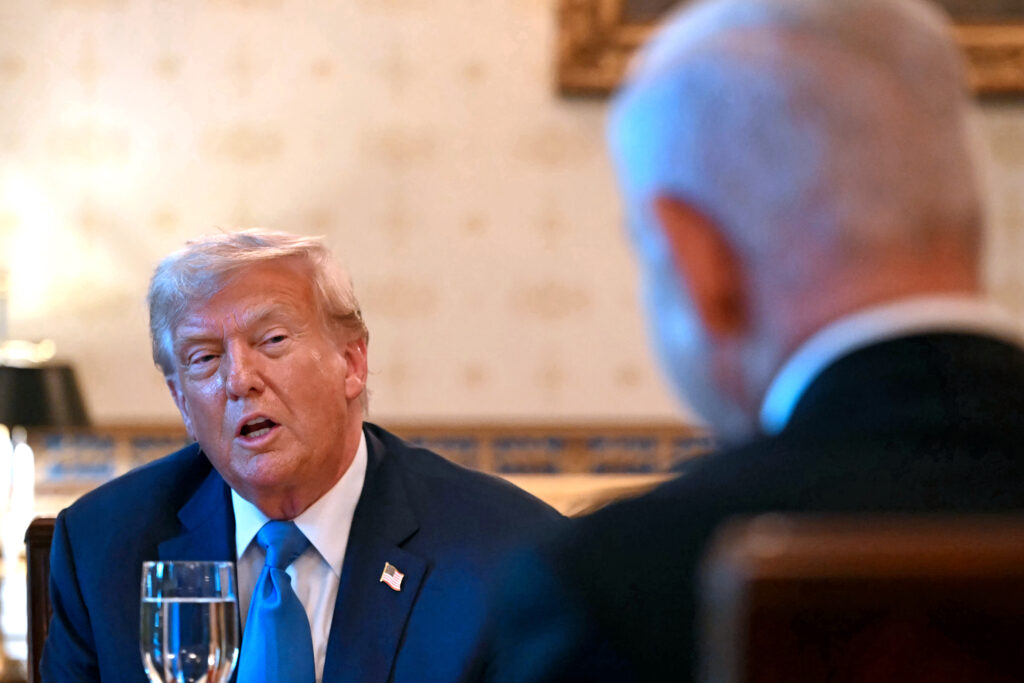
US President Donald Trump said Wednesday he was still deciding whether to join Israel’s strikes on Iran, claiming Tehran now wants talks at the White House but may have waited too long.Trump held his second Situation Room meeting in two days with his national security team as he left the world guessing about his potential order of military action.”I may do it, I may not do it. I mean, nobody knows what I’m going to do,” Trump told reporters at the unveiling of one of two giant new flagpoles at the White House.”I can tell you this, that Iran’s got a lot of trouble, and they want to negotiate.”He added that “the next week is going to be very big” when it comes to determining Iran’s fate.The White House said Trump would be briefed in the Situation Room again on Thursday, a holiday in the United States.Trump’s comments came after the Islamic republic’s supreme leader Ayatollah Ali Khamenei rejected his demands for an unconditional surrender and warned the United States of “irreparable damage” if it intervenes.A day after saying Khamenei was an “easy target”, Trump told AFP in the Oval Office that a change of leadership in Tehran “could happen.”But Republican Trump, who faces opposition from the isolationist wing of his support base to joining any more foreign wars, insisted that he had not yet made up his mind on whether to take US action.”I have ideas as to what to do, but I haven’t made a final (decision),” Trump said. “I like to make the final decision one second before it’s due, because things change. Especially with war.”The Wall Street Journal reported that Trump had told aides on Tuesday he had approved attack plans for Iran but was holding off to see if Iran would give up its nuclear program. “All options are on the table,” a White House official told AFP when asked about the report.Secretary of State Marco Rubio will meet Thursday in Washington with British Foreign Secretary David Lammy, the State Department said, for talks expected to focus on Iran.- ‘Very late’ -Trump appeared to be in no hurry to reach what would be one of the most consequential decisions of his presidency — spending more than an hour dealing with the installation of his new flagpoles. He said Iran was reaching out to try to strike a deal on its nuclear program to end the conflict with US ally Israel.”They want to come to the White House, I may do that,” Trump said. He added however that it was “very late to be talking… There’s a big difference between now and a week ago.”Iran denied it had offered to send officials to Washington.”No Iranian official has ever asked to grovel at the gates of the White House,” Iran’s mission to the United Nations posted on X.Trump had favored a diplomatic route to end Iran’s nuclear program, seeking a deal to replace the agreement he tore up in his first term in 2018.But since Israeli Prime Minister Benjamin Netanyahu launched strikes on Iran six days ago Trump has moved in behind the key US ally and is now weighing whether to use American military power against Tehran too.Trump said Wednesday that Iran was “weeks” away from being able to make a nuclear bomb.He noted that the United States is the only country with “bunker buster” bombs capable of taking out Iran’s Fordow nuclear plant “but that doesn’t mean I’m going to do it.” The US president said he had told Netanyahu to “keep going” with Israel’s offensive against Iran, adding that they were speaking every day.Trump however rebuffed Russian President Vladimir Putin’s offer to mediate in the Israel-Iran conflict, saying Russia should end its own war in Ukraine first.”He actually offered to help mediate, I said ‘do me a favor, mediate your own. Let’s mediate Russia first, okay? You can worry about this later,'” Trump said. 

Justice at stake as generative AI enters the courtroom

Generative artificial intelligence (GenAI) is making its way into courts despite early stumbles, raising questions about how it will influence the legal system and justice itself.Judges use the technology for research, lawyers utilize it for appeals and parties involved in cases have relied on GenAI to help express themselves in court.”It’s probably used more than people expect,” said Daniel Linna, a professor at the Northwestern Pritzker School of Law, about GenAI in the US legal system.”Judges don’t necessarily raise their hand and talk about this to a whole room of judges, but I have people who come to me afterward and say they are experimenting with it.”In one prominent instance, GenAI enabled murder victim Chris Pelkey to address an Arizona courtroom — in the form of a video avatar — at the sentencing of the man convicted of shooting him dead in 2021 during a clash between motorists.”I believe in forgiveness,” said a digital proxy of Pelkey created by his sister, Stacey Wales.The judge voiced appreciation for the avatar, saying it seemed authentic.”I knew it would be powerful,” Wales told AFP, “that that it would humanize Chris in the eyes of the judge.”The AI testimony, a first of its kind, ended the sentencing hearing at which Wales and other members of the slain man’s family spoke about the impact of the loss.Since the hearing, examples of GenAI being used in US legal cases have multiplied.”It is a helpful tool and it is time-saving, as long as the accuracy is confirmed,” said attorney Stephen Schwartz, who practices in the northeastern state of Maine.”Overall, it’s a positive development in jurisprudence.”Schwartz described using ChatGPT as well as GenAI legal assistants, such as LexisNexis Protege and CoCounsel from Thomson Reuters, for researching case law and other tasks.”You can’t completely rely on it,” Schwartz cautioned, recommending that cases proffered by GenAI be read to ensure accuracy.”We are all aware of a horror story where AI comes up with mixed-up case things.”The technology has been the culprit behind false legal citations, far-fetched case precedents, and flat-out fabrications.In early May, a federal judge in Los Angeles imposed $31,100 in fines and damages on two law firms for an error-riddled petition drafted with the help of GenAI, blasting it as a “collective debacle.”The tech is also being relied on by some who skip lawyers and represent themselves in court, often causing legal errors.And as GenAI makes it easier and cheaper to draft legal complaints, courts already overburdened by caseloads could see them climb higher, said Shay Cleary of the National Center for State Courts.”Courts need to be prepared to handle that,” Cleary said.- Transformation -Law professor Linna sees the potential for GenAI to be part of the solution though, giving more people the ability to seek justice in courts made more efficient.”We have a huge number of people who don’t have access to legal services,” Linna said.”These tools can be transformative; of course we need to be thoughtful about how we integrate them.”Federal judges in the US capitol have written decisions noting their use of ChatGPT in laying out their opinions.”Judges need to be technologically up-to-date and trained in AI,” Linna said.GenAI assistants already have the potential to influence the outcome of cases the same way a human law clerk might, reasoned the professor.Facts or case law pointed out by GenAI might sway a judge’s decision, and could be different than what a legal clerk would have come up with.But if GenAI lives up to its potential and excels at finding the best information for judges to consider, that could make for well-grounded rulings less likely to be overturned on appeal, according to Linna.

US approves Gilead’s twice-yearly injection to prevent HIV

The US Food and Drug Administration on Wednesday approved Gilead Sciences’ twice-yearly injection to prevent HIV — a move the company hailed as a major breakthrough in the fight against the sexually transmitted virus.Drugs to prevent HIV transmission, known as pre-exposure prophylaxis or PrEP, have existed for more than a decade. But because they typically require taking a daily pill, they have yet to make a significant dent in global infections.”This is a historic day in the decades-long fight against HIV,” Gilead chairman and chief executive Daniel O’Day said in a statement.Lenacapavir, marketed under the brand name Yeztugo, has been shown to reduce the risk of HIV transmission by more than 99.9 percent in adults and adolescents — making it functionally akin to a powerful vaccine.The company conducted two large clinical trials. The first, involving more than 2,000 women in sub-Saharan Africa, resulted in a 100 percent reduction in infections and demonstrated superiority over the daily oral pill Truvada.In the second trial, involving over 2,000 men and gender-diverse individuals, only two infections were recorded — a 99.9 percent prevention rate, again surpassing Truvada.Reported side effects included injection site reactions, headache, and nausea.Results from both trials were published in The New England Journal of Medicine, and the journal Science named lenacapavir its 2024 “Breakthrough of the Year.”– Price concerns dampen hope –Despite the impressive results, optimism may be tempered by the drug’s cost — a list price of $28,218 per year in the United States, Gilead spokeswoman Blair Baumwell told AFP in an email Wednesday. An earlier long-acting HIV prevention shot — cabotegravir, which is injected every two months and was approved by the FDA in 2021 — costs tens of thousands of dollars per year and has yet to make a major global impact.Lenacapavir’s current list price for its previously approved use as a treatment for HIV is $39,000 annually.Baumwell said the $28,000-plus per year cost for Lenacapavir as a preventive drug is “in line with” those of existing PrEP products and that the company inspects insurers to cover it.”We are working to make Yeztugo accessible for anyone who needs or wants it and expect to see broad insurance coverage,” she said in the email.Activists are urging Gilead to drastically cut the price to help end the HIV pandemic.”Even high-income countries will not be able to afford widescale use of lenacapavir at prices above US $20,000 per year,” said Andrew Hill of Liverpool University, who led a team of chemists and scientists that found it could be mass-produced and sold for as little as $25 per person per year.”I congratulate Gilead and US partners for advancing this important innovation,” added Winnie Byanyima, under-secretary-general of the United Nations. “Lenacapavir could be the tool we need to bring new infections under control — but only if it is priced affordably and made available to everyone who could benefit.”In October, Gilead signed agreements with six pharmaceutical companies to produce and distribute generic versions of the drug, pending regulatory approval, in 120 low- and middle-income countries.Because it will take time for those countries to begin production, the company also announced a separate deal in December with the Global Fund — an international partnership established by the United Nations, alongside the US President’s Emergency Plan for AIDS Relief (PEPFAR) and others — to purchase doses for two million people.However, cuts to the PEPFAR program under President Donald Trump’s administration have cast uncertainty over the future of that agreement.

US to screen social media of foreign students for anti-American content

Foreigners seeking to study in the United States will be required to make public their social media profiles to allow screening for anti-American content under new State Department guidelines released Wednesday.The State Department had temporarily paused issuing visas for foreign students at the end of May while it came up with the new social media guidance and it will now resume taking appointments.”The enhanced social media vetting will ensure we are properly screening every single person attempting to visit our country,” a senior State Department official said.US consular officers will conduct a conduct a “comprehensive and thorough vetting of all student and exchange visitor applicants,” the official said.To facilitate the screening, student visa applicants will be asked to adjust the privacy settings on all their social media profiles to “public,” the official said.In an executive order on his first day as president, Donald Trump called for increased vetting of persons entering the United States to ensure they “do not bear hostile attitudes toward its citizens, culture, government, institutions, or founding principles.”Student visas are one of a series of battles waged over higher education by the Trump administration, which has rescinded thousands of visas and sought to ban Harvard University from accepting international students.Secretary of State Marco Rubio has revoked visas in large part of students who led demonstrations critical of Israel’s offensive in Gaza, as he uses an obscure law that allows the removal of people deemed to go against US foreign policy interests.In April, the Department of Homeland Security said the social media of foreign student applicants would be examined for “antisemitic activity” that could result in visa denial.The US government has been vetting the social media of persons seeking to immigrate to the United States or obtain a green card for more than a decade.

Lakers to be sold in record-breaking $10 billion deal: ESPN

The Los Angeles Lakers are being sold in a record-breaking $10 billion deal that makes the iconic franchise the highest-valued sports team in US history, ESPN reported Wednesday.The report said the Lakers owners, the Buss family, would sell their controlling interest in the team to billionaire Mark Walter, who already owns a minority stake in the franchise.While Jeanie Buss would continue as Lakers governor, the deal ends the Buss family’s 46-year reign over the NBA giants.Walter is the chief executive of holding company TWG Global which has built an impressive portfolio of professional sports teams, including the Los Angeles Dodgers and Los Angeles Sparks. He is also part of the ownership group of English Premier League side Chelsea.TWG also owns the Billie Jean King Cup tennis tournament and the Cadillac Formula One team.While further specifics of the deal were not disclosed, Lakers legend Earvin “Magic” Johnson — a business partner of Walter — was among the first to react to news of the agreement.”Laker fans should be ecstatic,” Johnson wrote on X. “A few things I can tell you about Mark — he is driven by winning, excellence, and doing everything the right way. And he will put in the resources needed to win! I can understand why Jeanie sold the team to Mark Walter because they are just alike.”- ‘The best choice’ -Johnson cited Walter’s ownership of the Dodgers baseball team as a reason for optimism. The Dodgers have won the World Series twice since Walter’s ownership group took over the club, and in recent years have adopted an aggressive recruitment strategy that has seen them sign some of the sport’s best talent, including Japanese superstar Shohei Ohtani on a 10-year, $700 million deal.”Mark is the best choice and will be the best caretaker of the Laker brand,” Johnson wrote. “The proof is in the pudding on what he’s been able to accomplish with the LA Dodgers. Mark has been nothing short of a winner.”The Buss family selling the Lakers marks the end of an era in the NBA, whose modern popularity owes much to the franchise’s 1980s heyday.The Lakers were bought in 1979 by charismatic tycoon Jerry Buss, who quickly helped turn the franchise into a sporting powerhouse as well as a globally recognised brand.The Buss era brought the Lakers 11 NBA championships — more than any other team over the same period — and encompassed golden ages which included the “Showtime” Lakers of Magic Johnson as well as a hat-trick of championships between 2000 and 2002 when the team was spearheaded by Kobe Bryant.More recently the team recruited superstar LeBron James, who led the Lakers to a 17th championship in 2020, and stunned the league earlier this after swooping for Dallas Mavericks star Luka Doncic.Walter has been a minority owner of the Lakers since 2021 when he bought a share in a deal which also gave him first refusal to purchase the club should the Buss family ever decide to sell.The sale of the club smashes the previous highest figure paid for a US sports team, the $6.1 billion paid for the Boston Celtics earlier this year.That Celtics sale eclipsed the $6.05 billion that Josh Harris paid for the Washington Commanders in 2023.