AFP USA

SpaceX to launch private astronauts on first crewed polar orbit

SpaceX is set to launch the first human spaceflight directly over Earth’s polar regions on Monday — a days-long, privately funded orbital mission involving four astronauts.Named “Fram2” after the famed Norwegian ship built in the 19th century for Arctic and Antarctic expeditions, the mission will feature a range of experiments including taking the first X-ray in space and growing mushrooms in microgravity.It’s hoped that the research will support future long-duration space travel to Mars.The crew will launch aboard a SpaceX Crew Dragon capsule on a Falcon 9 rocket in a window that opens at 9:46 pm Monday (0146 GMT Tuesday) from NASA’s Kennedy Space Center in Florida.Three other launch windows are available at 11:20 pm Monday, as well as 12:53 am and 2:26 am Tuesday, SpaceX said, adding that other windows could be opened if needed. “With the same pioneering spirit as early polar explorers, we aim to bring back new data and knowledge to advance the long-term goals of space exploration,” said mission commander Chun Wang. Wang, a Chinese-born Maltese adventurer and co-founder of crypto companies f2pool and skatefish, selected the rest of the crew: vehicle commander Jannicke Mikkelsen, a Norwegian film director; mission pilot Rabea Rogge, a robotics researcher from Germany; and mission specialist and medical officer Eric Philips, an Australian polar explorer. The team trained for eight months in preparation for the approximately four-day trip, including a wilderness expedition in Alaska to simulate living in close quarters under harsh conditions.Upon returning to Earth, the crew will attempt to exit the spacecraft without additional medical support — part of a study to help researchers understand how well astronauts can perform basic tasks after spaceflight.Except for the Apollo lunar missions, Earth’s polar regions have remained out of view for astronauts, including those aboard the International Space Station (ISS). Even on Apollo, they did not fly directly over the Earth’s poles.SpaceX has carried out five private astronaut missions to date — three in collaboration with Axiom Space to the ISS, and two free-flying in Earth orbit.The first of these was Inspiration4 in 2021, followed by Polaris Dawn, which featured the first spacewalk conducted by private astronauts.Both free-flying missions were chartered by e-payments billionaire Jared Isaacman, who has also been nominated by President Donald Trump to serve as the next NASA administrator.Isaacman is also a close associate of SpaceX CEO Elon Musk.
World economies brace for Trump tariffs ahead of deadline

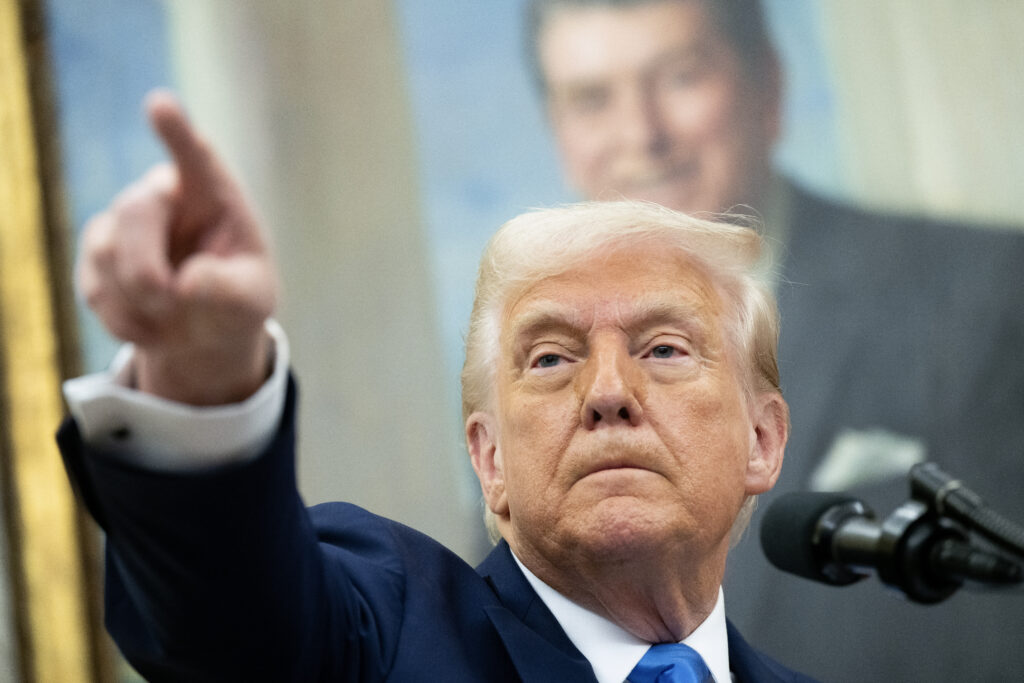
World economies shuddered on Monday ahead of US President Donald Trump’s “Liberation Day,” when he is set to unleash tariffs against multiple countries, risking global turmoil to address what he says are unfair trade imbalances.Trump — who has been making unprecedented use of presidential powers since taking office in January — is set to announce Wednesday exactly what tariffs will be imposed and whether they might also target entire sectors.The Republican billionaire insists that reciprocal tariffs are needed because the world’s biggest economy has been “ripped off by every country in the world.”Critics, however, warn that the strategy risks a global trade war, provoking a chain reaction of retaliation by major trading partners including China, Canada and the European Union.White House Press Secretary Karoline Leavitt told reporters that the goal on Wednesday would be to announce “country-based tariffs,” but that Trump remains committed to imposing separate sector-specific charges in the future.”Any country that has treated the American people unfairly should expect to receive a tariff in return on Wednesday,” Leavitt said.The uncertainty was roiling markets, with the tech-focused Nasdaq Composite Index down around 0.7 percent in New York on Monday afternoon while key European and Asian indexes closed lower.Market nervousness had intensified after Trump over the weekend said his tariffs would include “all countries.”Leavitt said the president sees the stock market as a “snapshot of a moment in time.””He’s doing what’s best for Main Street and Wall Street will work out just fine,” she added.The Wall Street Journal reported Sunday that advisers have considered imposing global tariffs of up to 20 percent, to hit almost all US trading partners. Trump remained vague, saying his tariffs would be “far more generous” than ones already levied against US products.- ‘Economic pain’ -Trump’s fixation on tariffs is fanning US recession fears. Goldman Sachs analysts raised their 12-month recession probability from 20 percent to 35 percent.This reflects a “lower growth forecast, falling confidence, and statements from White House officials indicating willingness to tolerate economic pain.” Goldman Sachs also lifted its forecast for underlying inflation at end-2025.Already, China and Canada have imposed counter-tariffs on US goods, while the EU unveiled its own measures due to start in mid-April. More countermeasures could come after Wednesday.Ryan Sweet of Oxford Economics said to “expect the unexpected,” anticipating that Trump would “take aim at some of the largest offenders.”What matters is how broad-based Trump’s tariffs are and whether the tool is merely a negotiating tactic or part of a more major shift, he said.Besides reciprocal country tariffs, Trump could unveil additional sector-specific levies on the likes of pharmaceuticals and semiconductors. He earlier announced auto tariffs to take effect Thursday.Economists have expected the upcoming salvo could target the 15 percent of partners that have persistent trade imbalances with the United States, a group that US Treasury Secretary Scott Bessent called a “Dirty 15.”The United States has some of its biggest goods deficits with China, the EU, Mexico, Vietnam, Taiwan, Japan, South Korea, Canada and India.- ‘Existential moment’ -US trade partners are rushing to minimize their exposure, with reports suggesting India might lower some duties.European Central Bank President Christine Lagarde said Monday that Europe should move towards economic independence, telling France Inter radio that Europe faces an “existential moment.”Separately, British Prime Minister Keir Starmer spoke with Trump on “productive negotiations” towards a UK-US trade deal, his Downing Street office said Sunday.German Chancellor Olaf Scholz said the EU would respond firmly to Trump’s tariffs, although he stressed that the bloc was open to compromise.It is “entirely possible” for fresh tariffs to be swiftly reduced or put on hold, said Greta Peisch, partner at law firm Wiley Rein.In February, Washington paused steep levies on Mexican and Canadian imports for a month as the North American neighbors pursued negotiations.”There are many different scenarios: delays while talks continue, potential reductions or tariffs being put in place immediately,” added Peisch, a former official at the US Trade Representative’s office.

Trump White House mulls deciding who sits in press room

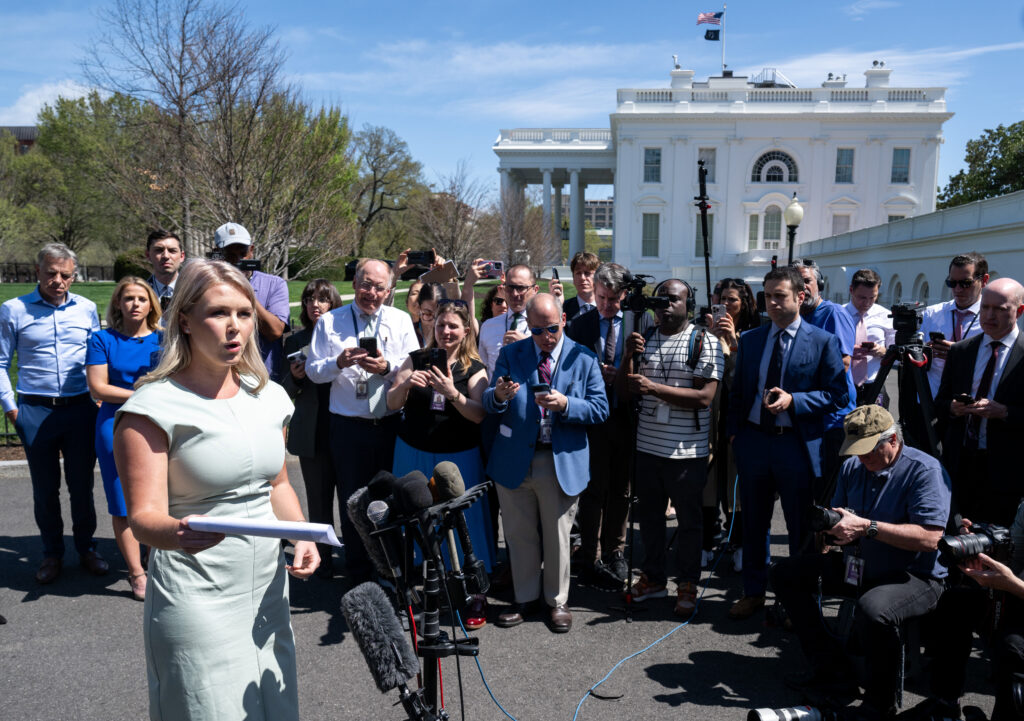
The White House said Monday it is “seriously considering” taking control of deciding which journalists get seats in the famed briefing room, in the latest bid by President Donald Trump’s administration to to exert power over the media.The 49 spots in the press room, where spokespeople, officials and occasionally the president take the podium, have long been allocated by the non-partisan group of independent journalists, the White House Correspondents Association (WHCA).White House Press Secretary Karoline Leavitt accused the WHCA of trying to maintain a “monetized monopoly over the briefing room.” “As for switching up seating in the briefing room, it’s something we are seriously considering,” she told Fox News.”The briefing room is part of the People’s House, it belongs to the American people. It does not belong to elitist journalists here in Washington DC.”News outlet Axios reported earlier that the White House wanted to take control of the seating chart to give more prime front-of-room spots to new media, and move some legacy outlets further back.The WHCA, of which AFP is a member, opposed the “wrong-headed” move.”The reason the White House wants control of the briefing room is the same reason they took control of the pool: to exert pressure on journalists over coverage they disagree with,” WHCA President Eugene Daniels said in a statement.The WHCA and the White House both said they had tried to broker a meeting on the issue.It is the latest effort by the White House to shape who covers Trump after taking control from the WHCA in February of the “pool” that covers the president in the Oval Office and when he travels on Air Force One.The White House has added access to the pool for new and in several cases openly pro-Trump media, while reducing access to mainstream organizations.It also continues to bar the Associated Press news agency from almost all presidential events as it refuses to refer to the Gulf of Mexico as the “Gulf of America,” the name newly decreed by Trump.

Pentagon chief orders gender-neutral fitness standards for combat troops

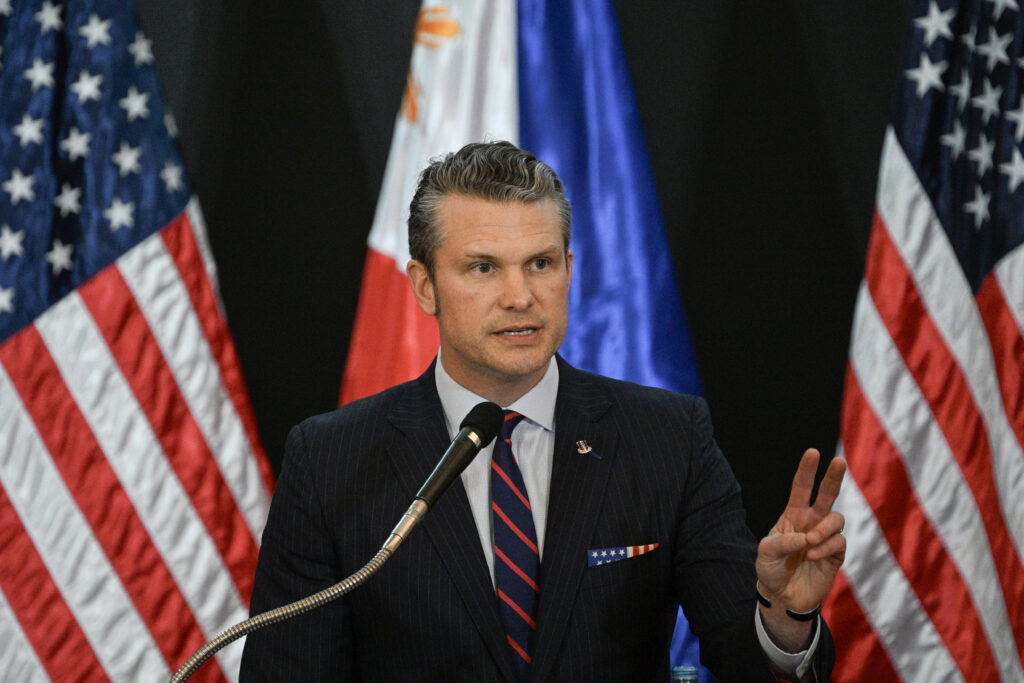
US Defense Secretary Pete Hegseth, who has previously expressed opposition to women serving in combat, has ordered the military to develop gender-neutral physical fitness standards for frontline troops, a memo released Monday said.”I am directing the Secretaries of the Military Departments to develop comprehensive plans to distinguish combat arms occupations from non-combat arms occupations,” Hegseth wrote in the memo, which is dated March 30.”All entry-level and sustained physical fitness requirements within combat arms positions must be sex-neutral, based solely on the operational demands of the occupation and the readiness needed to confront any adversary,” according to the memo, which also specifies that no current standards will be lowered.Making changes to physical fitness standards could potentially curb the recruitment of new military personnel as well as the retention of those already in the armed forces.But having gender-neutral requirements for combat troops — who face physically demanding tasks in the field, such as marching long distances and carrying heavy weapons and packs that are the same regardless of gender — would ensure they all meet the same minimum standards.On an episode of the “Shawn Ryan Show” podcast aired before his nomination to be defense secretary, Hegseth said he was opposed to women serving in combat roles, though not their presence in the armed forces as a whole.But he sought to move away from those remarks in his Senate confirmation hearing earlier this year, telling lawmakers that “women will have access to ground combat roles… given the standards remain high.”Hegseth is a frequent critic of so-called “woke” policies — by companies, at universities, and in the military — that attempt to increase opportunities for ethnic and sexual minorities, and has launched a campaign against such policies as Pentagon chief.

Trump confident in finding TikTok buyer before deadline

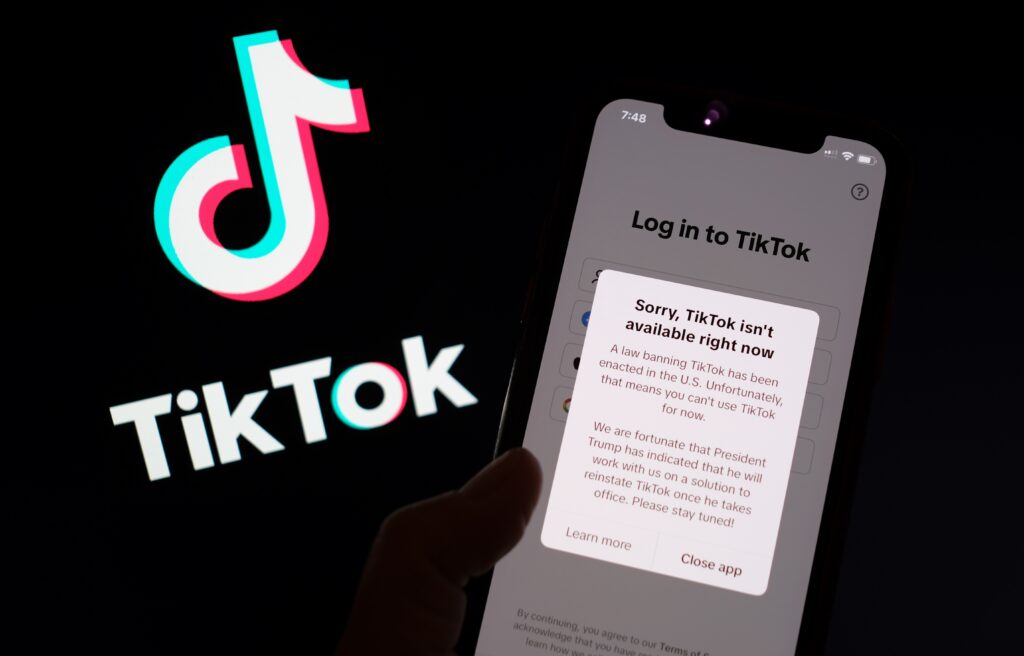
President Donald Trump again downplayed risks that TikTok is in danger of being banned in the United States, saying he remains confident of finding a buyer for the app’s US business by a Friday deadline.The hugely popular video-sharing app, which has over 170 million American users, is under threat from a law that passed overwhelmingly last year and orders TikTok to split from its Chinese owner ByteDance or face a ban in the United States.Motivated by widespread belief in Washington that TikTok is ultimately controlled by the Chinese government, the law took effect on January 19, one day before Trump’s inauguration.But the Republican president quickly announced a delay that has allowed it to continue to operate; that delay is set to expire on April 5.”We have a lot of potential buyers. There’s tremendous interest in TikTok,” Trump told reporters onboard Air Force One late Sunday.”We have a lot of people that want to buy TikTok. We’re dealing with China also on it, because they may have something to do with it,” he said, adding “I’d like to see TikTok remain alive.”Any deal to divest TikTok from ByteDance will require the approval of Beijing, and Trump has said he may offer to reduce tariffs on China as a way to get Beijing’s approval for the sale.Trump, though he supported a ban in his first term, has lately become the app’s greatest defender, seeing it as a reason more young voters supported him in November’s election.One of his major political donors, billionaire Jeff Yass, is also a major stakeholder in parent company ByteDance.- ByteDance on board? -Several proposals for TikTok’s US business have emerged since the law began to make its way through Congress last year.But according to The New York Times, citing people involved in coming up with a solution, the most likely fix would see existing US investors in ByteDance roll over their stakes into a new independent global TikTok company.Additional US investors would be brought on to reduce the proportion of Chinese investors. Trump at one point said the US government could also take a stake through a newly announced national sovereign fund.Dan Ives of Wedbush Securities told AFP that he believed cloud company Oracle would “play a major role” in such a deal and that “ByteDance will still control and own the algorithm” and have board seats.Much of TikTok’s US activity is already housed on Oracle servers, and the company’s executive chairman, Larry Ellison, is a longtime Trump ally who was also floated as a buyer of TikTok’s US activity in Trump’s first term.The arrangement would go against the spirit of the law, which is in part based on the premise that TikTok’s algorithm can be weaponized by the Chinese against US interests.But University of Richmond School of Law professor Carl Tobias said he did not expect opposition in the Republican-led Congress, or if Trump ordered another extension to the sale deadline.”Lawmakers have expressed little opposition to Trump’s actions (including ones) which federal judges have ruled violate the Constitution or congressionally-passed statutes,” he said.Other proposals include an initiative called “The People’s Bid for TikTok,” launched by real estate and sports tycoon Frank McCourt’s Project Liberty initiative.Artificial intelligence startup Perplexity recently expressed interest in buying TikTok as did a joint venture involving YouTube mega-celebrity MrBeast.When the last deadline passed, in January, TikTok temporarily shut down in the United States, to the dismay of millions of users.

Court grants bail to man accused of damaging Trump’s Scottish golf resort

A court granted bail on Monday to a man accused of damaging Donald Trump’s Turnberry golf resort in Scotland, after protesters targeted the US president’s luxury sporting retreat earlier this month.Kieran Robson, 33, was charged with maliciously damaging property and made no plea during the brief hearing at Ayr Sheriff Court in southwest Scotland.Robson, who was arrested on March 12, was released on bail pending a further court date.Police were called to the South Ayrshire resort overnight on March 8. Greens had been damaged, the resort’s clubhouse was sprayed with red paint and “GAZA IS NOT 4 SALE” was painted in white letters on the lawn.Following a call with UK Prime Minister Keir Starmer on Sunday, Trump took to his Truth Social network to condemn the damage to his resort and praise UK law enforcement.Last week, a 66-year-old woman and a 75-year-old man arrested during the investigation were released pending further enquiries, according to Scottish police.The Turnberry property in southwest Scotland is one of two resorts Trump owns in the country, his mother’s ancestral home.Another Trump golf course in Ireland was targeted in March, when activists planted Palestinian flags on the greens.

Clock ticks on Trump’s reciprocal tariffs as countries seek reprieve

The clock is ticking down to Donald Trump’s “Liberation Day” when the US president has threatened to unleash a wide range of tariffs against countries running persistent trade imbalances with the United States.The move — which comes as Trump has been making unprecedented use of presidential powers — is driven by his insistence that the world’s biggest economy has been “ripped off by every country in the world” and his conviction that reciprocal tariffs are needed to restore parity.But critics warn that the strategy risks a global trade war, provoking further retaliation by major trading partners like China, Canada and the European Union.The size of the levies to be announced on Wednesday will vary from country to country and the precise plans remain murky.”Expect the unexpected,” said Ryan Sweet, chief US economist at Oxford Economics.He expects the Trump administration to “take aim at some of the largest offenders.”But what matters ultimately is how broad-based the tariffs are and whether the tool is merely a negotiating tactic or part of a regime shift, he said.Trump on Sunday dashed hopes he might scale back, saying his tariffs would include “all countries.””You’d start with all countries, so let’s see what happens,” the president told reporters onboard Air Force One.”We’ve been talking about all countries, not a cutoff,” he said, insisting however that his tariffs would be “far more generous” than those levied against the United States.US trade partners have been rushing to minimize their exposure ahead of Trump’s deadline, with reports suggesting India might lower some duties.Besides the reciprocal country tariffs, Trump could also unveil additional sector-specific levies on the likes of pharmaceuticals and semiconductors.These would come on top of new auto levies due to take effect Thursday.Already, China and Canada have imposed counter-tariffs on US goods in response to Trump’s earlier actions, while the EU unveiled its own measures due to start in mid-April.European Central Bank President Christine Lagarde said Monday that Europe was facing an “existential moment.””He calls it ‘Liberation Day’ in the United States. I see it as a moment when we must collectively decide to take greater control of our destiny and I think it is a step towards independence,” she told France Inter radio.Canadian Prime Minister Mark Carney told Trump his government would impose retaliatory tariffs after Washington’s action Wednesday.- ‘Dirty 15’ -Before Trump’s comments on Sunday, the upcoming salvo had been expected to target the 15 percent of partners that have persistent trade imbalances with the United States, a group that US Treasury Secretary Scott Bessent called a “Dirty 15.”The United States has its biggest goods deficits with parties including China, the EU, Mexico, Vietnam, Taiwan, Japan, South Korea, Canada and India.With countries seeking compromise, it is “entirely possible” for fresh tariffs to be swiftly reduced or put on hold, said Greta Peisch, partner at law firm Wiley Rein.In February, she noted, steep levies on Mexican and Canadian imports were paused for a month as the North American neighbors furthered negotiations.”There are many different scenarios: delays while talks continue, potential reductions or tariffs being put in place immediately,” said Peisch, a former official at the US Trade Representative’s office.- ‘Dark cloud’ -Sweet of Oxford Economics warned that a “dark cloud of uncertainty” hangs over the economy.Some domestic steel manufacturers and union leaders have welcomed Trump’s recent tariff hikes on metals and autos.But while his proposals are meant to revitalize US industry, they have alarmed many other industries.The American Automotive Policy Council, which represents carmakers Ford, General Motors and Stellantis, cited a report Friday by economist Arthur Laffer, which noted that 25-percent auto tariffs stand to raise US vehicle costs and disrupt supply chains.While stressing its commitment to Trump’s economic vision, the council urged for “a fair and predictable trade environment.”In a letter Thursday, the International Fresh Produce Association cautioned that proposed US tariffs and other countries’ retaliation threaten the stability of farmers and businesses.And the National Retail Federation warned in February that reciprocal tariffs could prove “extremely disruptive,” warning of higher costs to households and an erosion of their spending power.More broadly, companies tend to hold off on investments when rules are unclear and this could weigh on hiring, Sweet said.Economists also warn that sweeping tariffs could cause a spike in inflation if companies fail to absorb additional costs, passing them on to consumers.

Trump says confident of TikTok deal before deadline

President Donald Trump said Sunday he was confident of reaching a deal on TikTok ahead of the April 5 deadline for its Chinese owner ByteDance to sell the popular short video app or see it banned in the United States.”We have a lot of potential buyers. There’s tremendous interest in TikTok,” Trump told reporters onboard Air Force One.”We have a lot of people that want to buy TikTok. We’re dealing with China also on it, because they may have something to do with it,” he said, adding “I’d like to see TikTok remain alive.”China on Thursday had rebuffed a suggestion from Trump that he might offer to reduce tariffs to get Beijing’s approval for the sale of TikTok to a non-Chinese firm.Trump said this month the United States was in talks with four groups interested in acquiring the platform, which has 170 million American users.A US law has ordered TikTok to divest from ByteDance or be banned in the United States, enacted over concerns that Beijing could exploit the app to spy on Americans or covertly influence US public opinion.The law took effect on January 19, a day before Trump’s inauguration, but he quickly announced a delay that has allowed it to continue to operate.That delay is set to expire on April 5.”There’ll be a deal with TikTok, I’m pretty certain,” Trump said when asked if he would extend the deadline if there was no deal.Trump attempted to ban TikTok in the United States because of national security concerns during his first stint in the White House but has warmed up to it.”Selfishly speaking, I won the young vote by 36 points. Republicans generally don’t do very well with the young crowd, and I think a lot of it could have been TikTok,” he said.

Trump says US tariffs to hit ‘all countries’

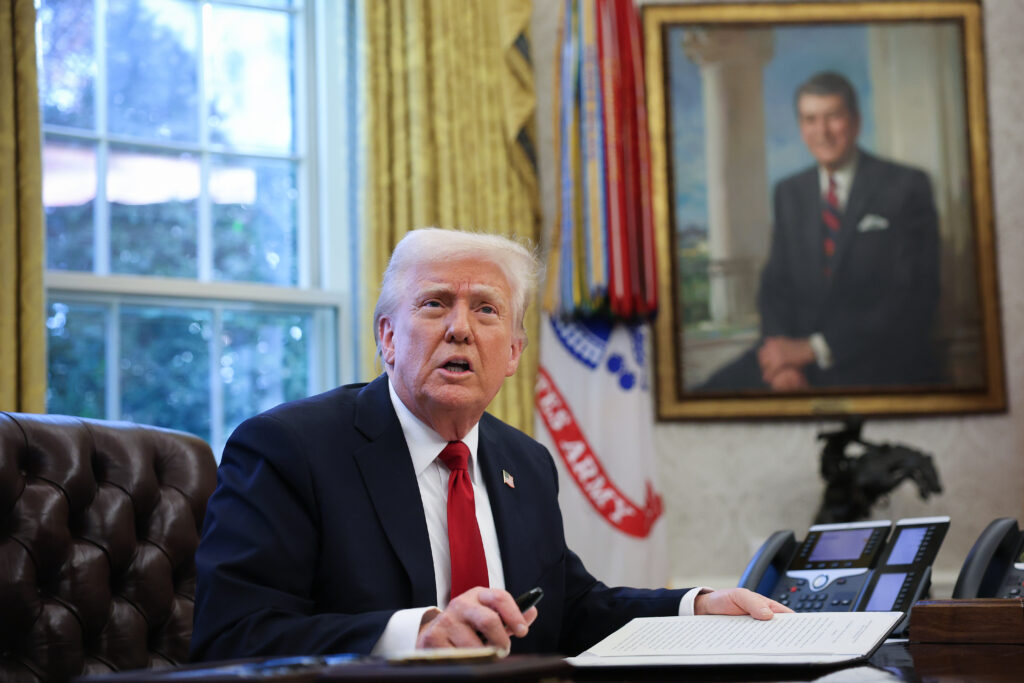
President Donald Trump said Sunday the tariffs he plans to impose in the coming days would include “all countries”, not just those with the largest trade imbalances with the United States.Trump has promised a “Liberation Day” on April 2, when he is set to unveil reciprocal levies to address trade practices that his government deems unfair.”You’d start with all countries, so let’s see what happens,” Trump told reporters onboard Air Force One, dashing hopes he might scale back some of the threatened levies or that they would target a select group with persistent trade imbalances.”I haven’t heard a rumor about 15 countries, 10 or 15,” he said when asked which nations would be affected.”Essentially all of the countries that we’re talking about. We’ve been talking about all countries, not a cutoff,” he said, without giving details.Trump’s upcoming tariff salvo had been expected to target the 15 percent of partners that have persistent trade imbalances with the United States, a group Treasury Secretary Scott Bessent called a “Dirty 15.”But despite widening the target, the president insisted his tariffs would be more “generous” than those levied against the United States.”The tariffs will be far more generous than those countries were to us, meaning they will be kinder than those countries were to the United States of America over the decades,” he said.”They ripped us off like no country has ever been ripped off in history and we’re going to be much nicer than they were to us. But it’s substantial money for the country nevertheless,” he said.Trump has already slapped tariffs on steel and aluminum imports and additional levies on imports from China.Tariffs on imported autos are also due to take effect on April 3.Trump’s top trade aide Peter Navarro said the tax on auto imports could raise $100 billion a year.”And in addition, the other tariffs are going to raise about $600 billion a year, about $6 trillion over a 10-year period,” Navarro told Fox New Sunday.Trump’s plans to unleash a wide range of reciprocal tariffs risk a global trade war, with other countries already vowing to retaliate and economists warning the sweeping moves risk stoking inflation and triggering a downturn.Trump has defended the levies as a way to raise government revenue and revitalize US industry.

Computer pioneer Microsoft turns 50 in the age of AI

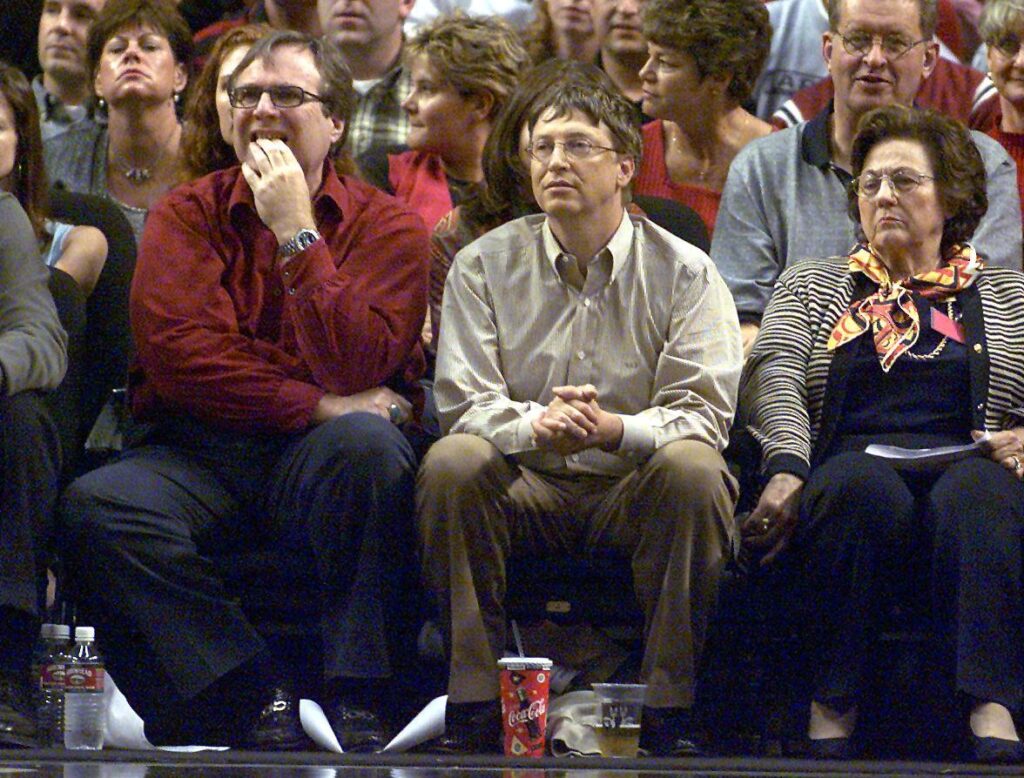
Microsoft has been at the heart of computing for half a century, becoming a tech stalwart almost taken for granted as lifestyles embraced the internet.As the company, founded with a vision of putting computers in every home and office, celebrates its 50th anniversary on Friday, it is looking to boost its fortunes by being a leader in the fast-developing field of artificial intelligence (AI).”From a storytelling standpoint, they’ve been a boring company and a boring stock,” eMarketer analyst Jeremy Goldman said of the Richmond, Washington-based behemoth.”It’s funny because they have a $2.9 trillion market cap, and that is huge,” he continued, referring to Microsoft’s value based on its share price.The only company with a higher market cap is iPhone maker Apple.Cloud computing is fueling Microsoft’s revenue with the help of its ubiquitous Office software, now hosted online and no longer released in boxes of floppy disks or CDs.”It’s not a very sexy infrastructure, but it’s a very valuable one,” Goldman said of Microsoft’s data centers and software at the foundation of its cloud-computing platform.Amazon Web Services (AWS) and Google are Microsoft’s cloud-computing rivals.- ‘Micro-Soft’ -Clouds were the stuff of weather forecasts rather than computing when Bill Gates and childhood friend Paul Allen founded what was first called “Micro-Soft” in 1975.They launched the MS-DOS operating system that became known as “Windows” and went on to run most of the world’s computers.Microsoft Office programs including Word, Excel and PowerPoint became standard business tools, even fending off free Google Docs software.”Microsoft had a lot of businesses that were weaker and challenged — the perfect example is Office,” Goldman said.”That Office is still such a meaningful business for them says something about the way they were able to innovate.”Current chief executive Satya Nadella championed a Microsoft shift to making its software available on just about any device as subscription services hosted in the cloud.The move likely saved Microsoft from seeing free services like Google Docs reduce their market share to zero, the analyst said.- ‘Achilles heel’ -Microsoft remains in the shadow of other US tech giants when it comes to offerings such as social networks, smartphones and the AI-infused digital assistants that have become woven into people’s lives, but it is not for lack of effort.Microsoft introduced Xbox video game consoles in 2001, steadily building up its stable of studios, making the blockbuster buy of Activision Blizzard two years ago and adding an online subscription service for players.And despite its launch of the Bing search engine in 2009, Google still dominates that market.Microsoft in 2016 bought career-focused social network LinkedIn, which has seen steady growth. But it still lacks the reach of Meta’s Facebook or Instagram, or the influence of Elon Musk’s X (formerly Twitter).Microsoft is among those in the running to buy TikTok, which faces a ban in the United States if not sold by China-based ByteDance.While Apple and Google have excelled at making it easy or even fun for users to engage with products, that has been an “Achilles heel” for Microsoft, according to Goldman.”It’s never been a strong suit of theirs,” the analyst said.- Mobile miss -Known for a focus on sales rather than innovation, Steve Ballmer, who followed Gates as chief of Microsoft from 2000 to 2013, has been faulted for missing the shift to smartphones and other mobile computing devices.His successor, Nadella, took over with a vow to make Microsoft a “mobile-first, cloud-first” company and Microsoft has since invested heavily in AI, taking a stake in ChatGPT-maker OpenAI and building the technology into offerings including Bing, though to little avail.- Behind in AI? -Independent analyst Jack Gold believes that despite those investments and efforts, Microsoft lags in AI because it lacks its own chips or foundation model.”They are not as advanced in that as AWS and Google, so they’re still playing a little bit of catchup in that space,” Gold said of Microsoft.Google Cloud’s revenue growth is on pace to overtake Microsoft’s Azure for second place in the market in two years, the analyst said.