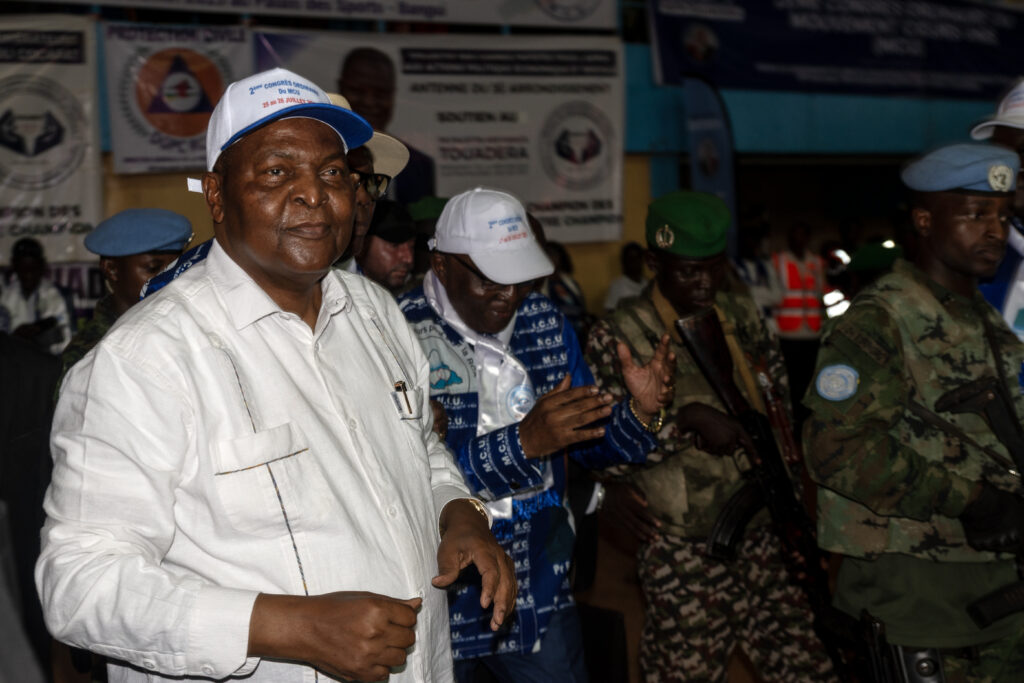
Faustin-Archange Touadera’s re-election as president of the Central African Republic was not in doubt for most observers, but what challenges loom largest and how he will meet them remains less certain.After a bloody civil war that dragged on from 2013 to 2018, some stability has returned to the country of around 5.5 million people which lies in the middle of a region beset by conflict and instability.Touadera — who was allowed to run again after a constitutional change passed by a 2023 referendum — now begins a new term leading one of the world’s poorest countries, much reliant on international aid despite natural resources such as uranium, lithium, diamonds, gold and lumber.- Security issues -“One of the major challenges of this third term will be his ability to maintain stable internal security forces,” Mathilde Tarif, researcher at Belgium’s Ghent University, said.Touadera told reporters on Tuesday he would offer myriad armed groups the chance of dialogue.”In some areas, the government has trained and armed militias that have switched sides and are attacking the state,” said Fulbert Ngodji, an analyst at the International Crisis Group, citing recent clashes between the AAKG militia and the army in the country’s southeast.Those concerns come at a time when funding for international aid is evaporating.- Wagner group -The former French colony remains the last bastion of Russia’s paramilitary group Wagner, now a key government security partner paid in lucrative gold and diamond contracts.Deployed since 2018 at Touadera’s request to underpin an army lacking funding and organisation, Wagner fighters have played a key role in securing a degree of stability.The government now controls nearly 90 percent of the country, compared with 80 percent in the hands of armed groups in 2021, analysts say.Since Wagner founder Yevgeny Prigozhin died in a plane crash in 2023 after a short-lived mutiny against Moscow, the Russian defence ministry has sought to replace Wagner with the Africa Corps umbrella group to coordinate its security operations on the continent.Sergei Eledinov, a retired Russian military officer and expert on African security, said he did not believe that Moscow would rush to dismantle a structure that has proved “successful”.”I think that in the near future, they are unlikely to break it up.”- Partnerships -Touadera will depend heavily on the success of partnerships he has established with Rwanda, the United Arab Emirates and Russia on which “he relies to continue stabilising his regime”, Tarif, of Ghent University, said.With the reduction in international aid, “it will become increasingly difficult to replenish the coffers with traditional partners such as UN agencies and the European Union,” she added.The UAE has already financed a new airport in the capital Bangui and the Sakai 2 solar power plant. France holds a permit to operate a uranium mine and Wagner has its gold and logging concessions obtained since its deployment.- Development pains -“Touadera has succeeded, at least in the capital, in attracting new investments; there’s a political and economic class that is reinvesting,” Tarif said.But “the hinterland remains in a catastrophic state, whether in terms of infrastructure, access to water or sanitation,” she said.More than 70 percent of people in the Central African Republic live below the poverty line and education access is limited.”People are suffering in the provinces,” Marguerite Yache-Ngolo, 64, a resident of Bangui, told AFP on Tuesday.”You only have to go 200 kilometres (125 miles) from Bangui to see the reality: no good schools, no drinking water, no possibility of eating at least twice a day, not even access to healthcare,” complained 29-year-old student Elodie.”Touadera’s opponents have highlighted that Central Africans must benefit more from the natural resources,” Ngodji said, adding he believed nothing was done during Touadera’s first two terms to combat endemic corruption.But he said that local elections held at the same time as the presidential vote and for the first time in nearly 40 years could pave the way for decentralisation and more development opportunities for marginalised areas.